Stock Analysis · Superior Plus Corp (SPRPY)
Overview
Superior Plus Corp is a North American energy distribution company best known for delivering propane and related services to residential, commercial, industrial, agricultural, and wholesale customers. The business is relatively easy to understand: it buys fuel, distributes it through local delivery networks, and earns money from both the fuel itself and the service of getting it to customers reliably. The company has historically expanded through acquisitions, especially in propane distribution, while also operating a smaller compressed natural gas activity.
Its revenue base is concentrated in propane distribution. Based on recent company reporting, the business can be understood through the following main sources:
- U.S. propane distribution: approximately 55% to 65% of revenue. This includes fuel sales and services to households, businesses, farms, industrial customers, and wholesale accounts across multiple states.
- Canadian propane distribution: approximately 30% to 40% of revenue. This covers a similar customer mix in Canada, including heating, industrial use, and agricultural demand.
- Compressed natural gas and other energy-related activities: generally less than 10% of revenue. This piece is much smaller and is tied to lower-carbon fuel applications and related services.
One important feature of the model is that reported revenue can move up or down with fuel prices even when customer activity is stable. For this reason, margins, cash generation, customer retention, and volume trends often matter more than revenue alone when judging the underlying business.
The business flow over the last several years shows a company with fairly stable revenue around the mid-$2 billion range, but with meaningful swings in profitability. Gross profit improved from 2022 through 2025, operating income recovered strongly, and net income moved from a loss in 2022 to a profit in 2025. That improvement suggests pricing discipline, operating efficiencies, and post-acquisition integration have been more important than headline sales growth.
Key Figures
| Metric | Value | Sector ⓘ |
|---|---|---|
| Date | Oct 17, 2026 | |
| Context | ||
| Sector | Utilities | |
| Industry | Utilities - Regulated Gas | |
| Market Cap ⓘ | $1.21B | |
| Beta ⓘ | 0.28 | |
Value (Cheapness) | ||
| P/E Ratio ⓘ | N/A | 17.28 |
| P/B Ratio ⓘ | 4.05 | 1.51 |
| FCF Yield ⓘ | 16.83% | 0.65% |
| Dividend Yield ⓘ | 1.72% | 3.77% |
| EBIT / EV ⓘ | 5.34% | 5.01% |
| PEG ⓘ | N/A | |
Growth (Business expansion) | ||
| Revenue Growth ⓘ | 2.90% | 6.10% |
| RPS Growth (5Y CAGR) ⓘ | -3.22% | 3.87% |
| EPS Growth (5Y CAGR) ⓘ | N/A | -11.30% |
| BVPS Growth (5Y CAGR) ⓘ | -3.47% | 4.23% |
| Margin Growth (5Y Trend) ⓘ | 9.91% | 3.57% |
| FCF Growth (5Y CAGR) ⓘ | 30.34% | -8.84% |
| DPS Growth (5Y CAGR) ⓘ | -28.33% | 4.84% |
Quality (Business durability) | ||
| ROIC (Latest) ⓘ | 4.60% | 6.53% |
| ROA (Latest) ⓘ | -0.11% | 3.20% |
| ROIC (5Y Median) ⓘ | N/A | 5.95% |
| ROA (5Y Median) ⓘ | 1.07% | 2.75% |
| Net Debt / EBIT (Latest) ⓘ | 10.18 | 7.13 |
| Net Debt / EBIT (5Y Median) ⓘ | 9.53 | 7.23 |
| Net Debt / EBITDA (Latest) ⓘ | 3.70 | 4.31 |
| Net Debt / Assets ⓘ | 44.19% | 38.42% |
| EBITDA / Interest ⓘ | 4.71 | 4.58 |
| Operating Margin (Latest) ⓘ | 6.20% | 20.83% |
| Operating Margin (5Y Median) ⓘ | 6.13% | 20.08% |
| Debt to Equity (Latest) ⓘ | N/A | 137.69% |
| Profit Margin (Latest) ⓘ | -0.16% | 11.37% |
| Free Cash Flow (Latest) ⓘ | $203.10M | |
Momentum (Price trend) | ||
| 3Y Return ⓘ | N/A | +52.37% |
| 12M Return (excl. last month) ⓘ | N/A | +8.84% |
| 6M Return ⓘ | +2.52% | -3.95% |
| Price vs. 200-Day MA ⓘ | N/A | -0.79% |
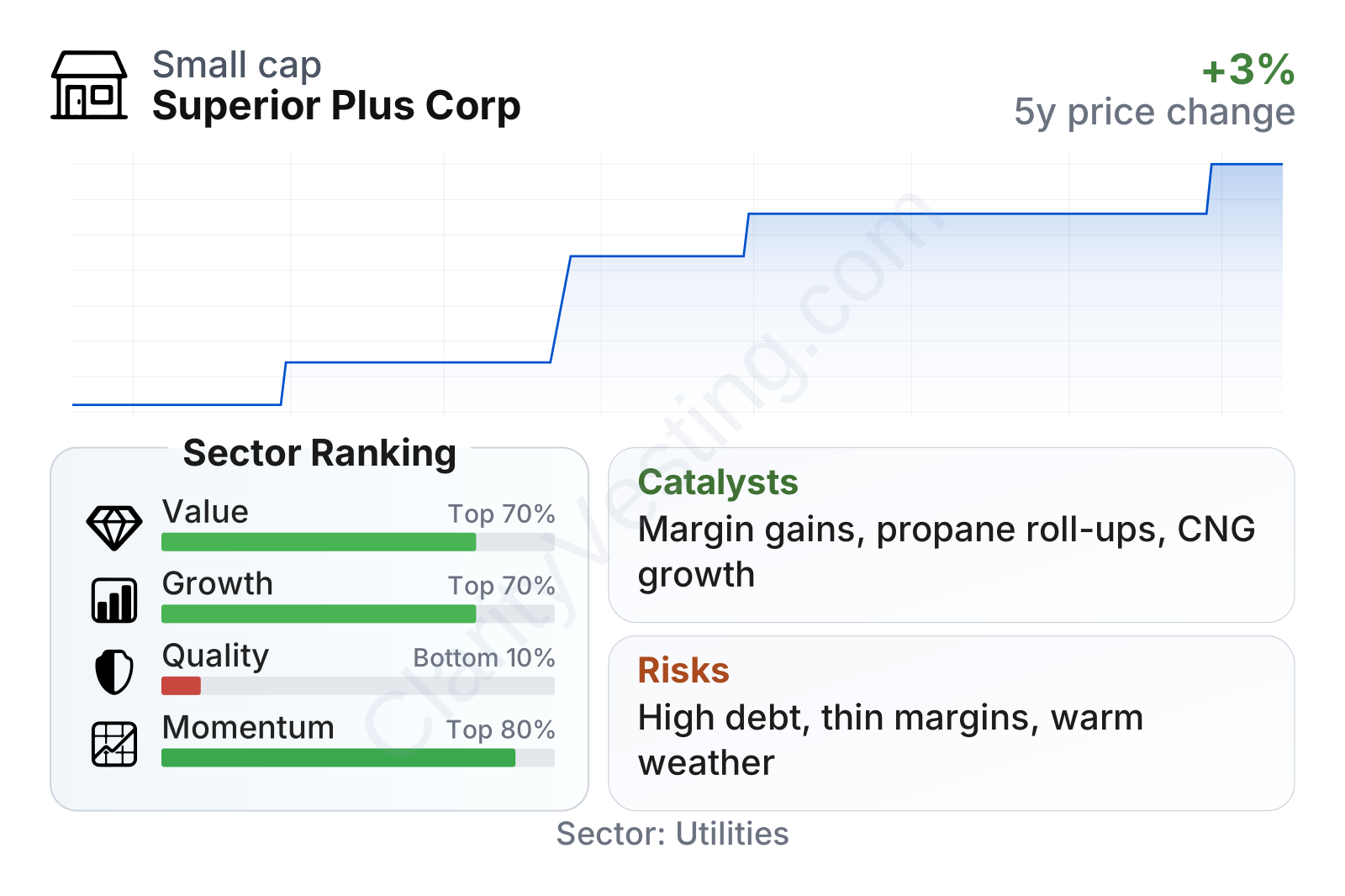
Recent market behavior has been fairly calm, which fits a defensive utility-like fuel distributor. The stock has moved only modestly in 2026 so far, and its beta of 0.3 points to lower share-price volatility than the broader market. In the factor breakdown, value and growth both rank in the upper portion of the sector, while quality ranks near the bottom. That mixed picture is important: Superior Plus looks stronger on cash generation than on profitability or balance-sheet efficiency.
Free cash flow stands out. The company’s free cash flow yield is far above the sector median, and five-year free cash flow growth has been strong. At the same time, profitability remains thin: operating margin is well below the sector median, return on assets is slightly negative on a trailing basis, and leverage remains elevated on an EBIT basis. The dividend yield is also below the sector median, reflecting that the current case depends more on operational execution and cash conversion than on income appeal alone.
Growth
Superior Plus operates in a mature but resilient segment. Propane is not a high-growth fuel market in the same way as software, semiconductors, or some renewable technologies, but it remains essential in many rural and off-grid locations where electrification is slower, infrastructure is limited, or customers need portable fuel. That gives the company exposure to steady end markets rather than rapid structural expansion.
The strategy for future growth is based less on breakthrough innovation and more on consolidation, route density, operating efficiency, and disciplined pricing. In propane distribution, scale matters because fixed costs can be spread across more customers and delivery routes. A larger footprint can improve purchasing, logistics, and overhead absorption. That makes bolt-on acquisitions and integration execution central to the long-term outlook.
Another potential support is the smaller compressed natural gas platform. It is not large enough to redefine the company today, but it gives Superior Plus some exposure to lower-emission fuel applications. If management expands this segment profitably, it could modestly improve the growth profile and diversify the business beyond traditional propane.
Revenue per share has been uneven over the last several years, declining sharply in 2023, flattening in 2024, and then recovering in 2025. That pattern reinforces the idea that this is not a smooth compounding growth business. Even so, the latest recovery is meaningful because it came alongside better operating income and positive net income. Recent company updates have also emphasized operational initiatives, balance sheet discipline, and portfolio optimization, all of which matter more than raw top-line expansion in this kind of business.
A practical catalyst for the next phase is margin improvement rather than dramatic sales acceleration. If Superior Plus continues to improve route efficiency, customer mix, procurement, and integration of acquired operations, earnings can rise even in a low-growth demand environment. Weather can also create short-term upside in colder periods, although that is not a dependable long-term engine by itself.
Risks
This article is for informational purposes only and does not constitute financial advice. Some content is AI-generated. See Disclaimer


