Stock Analysis · Siriuspoint Ltd (SPNT)
Overview
SiriusPoint Ltd is a global specialty insurer and reinsurer. In simple terms, it helps other insurance companies and large commercial clients absorb risks that are too large, too complex, or too volatile to keep on one balance sheet. Its business mixes reinsurance, where it insures insurers, and insurance, where it underwrites selected specialty policies directly or through managing general agents and program partners.
The company operates across property, accident and health, casualty, specialty, and other lines where pricing discipline and risk selection matter more than scale alone. That is important for understanding SiriusPoint: it is not trying to be the biggest player in reinsurance. It is trying to be a more selective underwriter with a cleaner portfolio and better profitability than it had a few years ago.
Based on recent annual reporting, SiriusPoint’s revenue mix is primarily driven by underwriting activity, with investment income acting as a secondary contributor. At a high level, the main economic sources are:
- Net premiums earned and other underwriting-related income: approximately 80% to 90% of total revenue. This includes premiums from reinsurance contracts and specialty insurance policies written directly or through distribution partners.
- Net investment income: approximately 10% to 20% of total revenue. Like most insurers, SiriusPoint invests its float, mainly in fixed-income securities and other investments, and earns income on that asset base.
- Other items: a small and more variable portion linked to realized and unrealized investment effects, fee-related income, or portfolio changes, depending on the period.
Over the last several years, the business has become noticeably more profitable after a difficult 2022. Revenue has not moved in a straight line, but the bigger change has been in underwriting quality: losses and expenses became better controlled, allowing earnings to recover sharply.
The financial flow over time shows a clear turnaround rather than smooth growth. After a weak 2022, operating profit and net income recovered strongly in 2023 and remained positive afterward, with a further step-up in 2025. That pattern suggests the key driver has been improved execution and portfolio quality more than simple top-line expansion.
Key Figures
| Metric | Value | Sector ⓘ |
|---|---|---|
| Date | Oct 03, 2026 | |
| Context | ||
| Sector | Financial Services | |
| Industry | Insurance - Reinsurance | |
| Market Cap ⓘ | $2.82B | |
| Beta ⓘ | 0.61 | |
Value (Cheapness) | ||
| P/E Ratio ⓘ | 6.12 | 12.60 |
| P/B Ratio ⓘ | 1.28 | 1.23 |
| FCF Yield ⓘ | 8.63% | 10.16% |
| Dividend Yield ⓘ | N/A | 2.96% |
| EBIT / EV ⓘ | 22.33% | 7.77% |
| PEG ⓘ | N/A | |
Growth (Business expansion) | ||
| Revenue Growth ⓘ | -0.50% | 9.50% |
| RPS Growth (5Y CAGR) ⓘ | 15.48% | 12.10% |
| EPS Growth (5Y CAGR) ⓘ | N/A | -9.45% |
| BVPS Growth (5Y CAGR) ⓘ | 5.03% | 5.01% |
| Margin Growth (5Y Trend) ⓘ | 15.82% | -4.07% |
| FCF Growth (5Y CAGR) ⓘ | 182.84% | 4.96% |
| DPS Growth (5Y CAGR) ⓘ | 12.80% | 8.79% |
Quality (Business durability) | ||
| ROIC (Latest) ⓘ | 19.65% | 9.60% |
| ROE (Latest) ⓘ | 22.55% | 13.84% |
| ROA (Latest) ⓘ | 4.03% | 1.53% |
| ROIC (5Y Median) ⓘ | 9.60% | 7.86% |
| ROE (5Y Median) ⓘ | 9.02% | 12.20% |
| ROA (5Y Median) ⓘ | 1.57% | 1.29% |
| Net Debt / EBIT (Latest) ⓘ | -0.07 | 0.91 |
| Net Debt / EBIT (5Y Median) ⓘ | -0.31 | 0.74 |
| Net Debt / EBITDA (Latest) ⓘ | -0.07 | 0.97 |
| Operating Margin (Latest) ⓘ | 20.73% | 22.12% |
| Operating Margin (5Y Median) ⓘ | 11.58% | 24.39% |
| Debt to Equity (Latest) ⓘ | 30.80% | 60.37% |
| Profit Margin (Latest) ⓘ | 16.85% | 26.62% |
| Free Cash Flow (Latest) ⓘ | $243.20M | |
Momentum (Price trend) | ||
| 3Y Return ⓘ | +137.22% | +89.23% |
| 12M Return (excl. last month) ⓘ | +30.40% | +17.35% |
| 6M Return ⓘ | +12.90% | +10.00% |
| Price vs. 200-Day MA ⓘ | +7.87% | +3.73% |
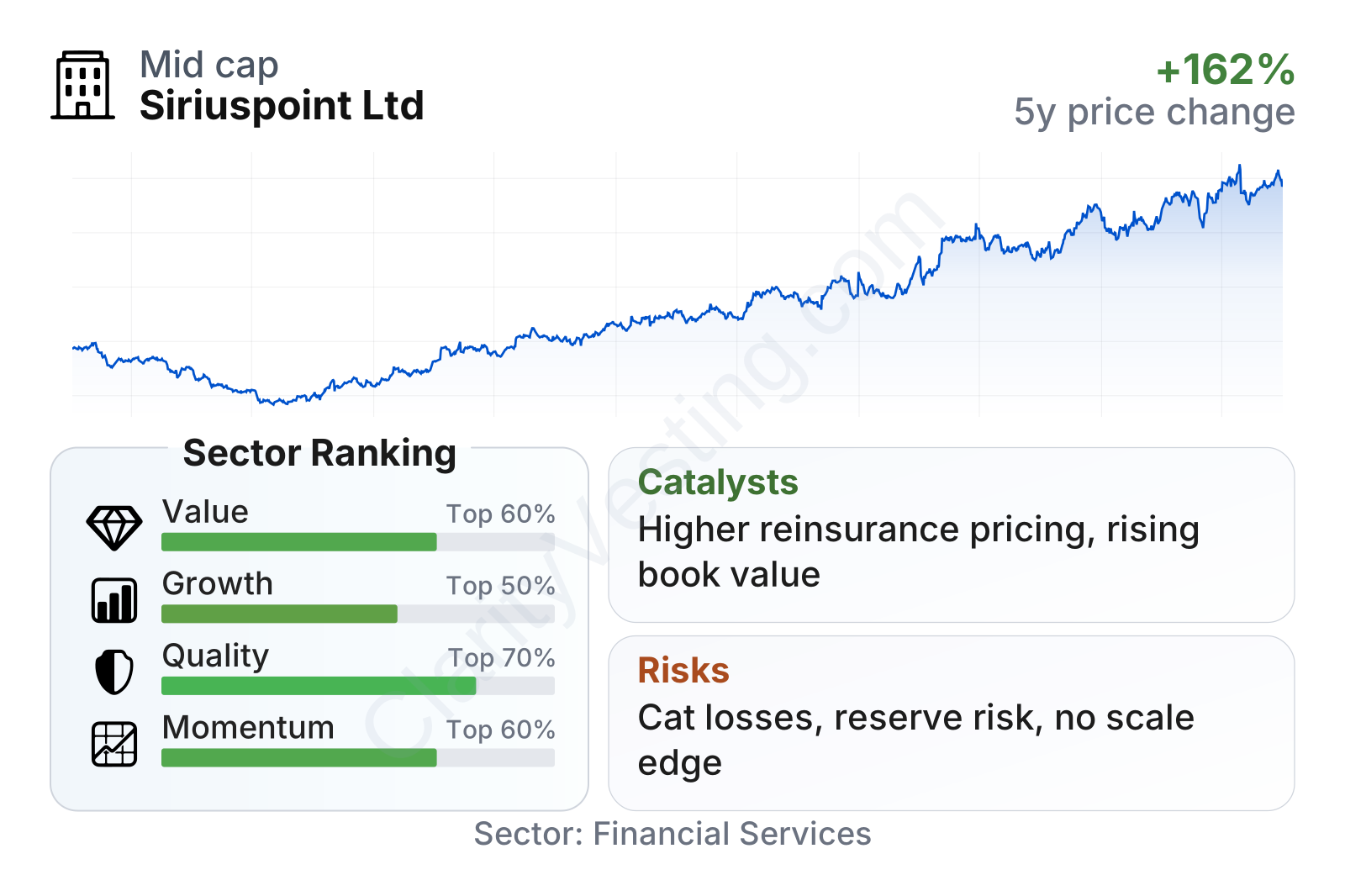
SiriusPoint stands out more for profitability and balance-sheet strength than for near-term growth. Valuation metrics look mixed but generally not stretched: earnings-based multiples are below sector norms, while price-to-book is close to the industry range. Quality indicators are stronger, with returns on equity and assets above median levels and leverage lower than many peers. Growth metrics are less impressive in the most recent year because revenue was roughly flat to slightly down, even though longer-term per-share figures improved.
The market has also recognized part of that improvement. The share price has risen substantially from 2022 lows and has outperformed the sector over multi-year and recent periods. Even after that rise, the company remains in the small-cap range within financial services, which means operating progress can still move sentiment materially.
Growth
SiriusPoint operates in a sector that should remain relevant for the long term. Reinsurance and specialty insurance benefit from structural demand drivers such as rising insured values, climate-related catastrophe exposure, cyber risk, medical cost inflation, and the increasing complexity of global commercial risks. Even when the economy slows, insurers and large businesses still need risk transfer. That gives the industry a durable role, although results can be volatile from year to year.
For SiriusPoint specifically, the growth case is less about aggressive expansion and more about disciplined compounding. Management has spent recent years reshaping the portfolio, reducing underperforming exposure, improving underwriting standards, and emphasizing areas where pricing is more attractive. In insurance and reinsurance, that can create value even if premium volume does not surge, because better pricing and lower losses often matter more than writing more business.
Earnings per share underline that point. Results were deeply disrupted in 2022, then recovered strongly in 2023 and improved again in 2025. This is not a straight-line earnings profile, but the direction since the restructuring period has been favorable. For a reinsurer, that kind of rebound is meaningful because it shows that underwriting discipline and reserve management have improved enough to offset the sector’s natural volatility.
Book value per share, a key measure for insurers, has also been uneven but ended much stronger after the recent recovery. The sharp rise into 2025 suggests that retained earnings and capital rebuilding materially strengthened shareholder equity on a per-share basis. In this industry, sustainable growth in book value is often one of the clearest signs that a turnaround is becoming more durable.
A practical catalyst is the broader pricing environment in reinsurance and specialty lines. After several years of loss inflation and catastrophe pressure, many contracts have been repriced at better terms across the industry. If SiriusPoint keeps allocating capital carefully, it can benefit from these firmer market conditions without needing to dominate market share.
Another favorable element is investment income. Higher interest rates have improved yields on insurer investment portfolios across the sector. For a company like SiriusPoint, that can support earnings even in periods when underwriting conditions are mixed, provided credit quality and duration risk stay under control.
Risks
This article is for informational purposes only and does not constitute financial advice. Some content is AI-generated. See Disclaimer