Stock Analysis · Suburban Propane Partners LP (SPH)
Overview
Suburban Propane Partners LP is a fuel distribution and energy services company focused mainly on propane. It supplies residential households, commercial customers, industrial users, agricultural clients, and public-sector accounts across the United States. In practical terms, the business delivers propane for home heating, cooking, water heating, backup power, and business operations, while also selling related equipment and service plans.
The company’s revenue is still heavily tied to traditional propane distribution. Based on recent annual filings, the business mix is centered on fuel sales, with a smaller contribution from services and equipment.
- Propane sales and distribution: approximately 90% to 95% of total revenue. This includes bulk propane delivered to residential, commercial, industrial, and agricultural customers.
- Fuel oil and refined fuels: approximately 3% to 7% of revenue, depending on the year and commodity pricing. This activity includes heating oil and certain other refined fuel products sold in some local markets.
- Appliance, parts, installation, maintenance, and other service revenue: approximately 2% to 5% of revenue. This covers tank installations, repairs, equipment leasing, and related customer services.
That mix matters because it makes Suburban Propane less like a fast-growing utility platform and more like a mature, cash-generating distribution business whose results depend on weather, fuel demand, commodity costs, and customer retention.
The recent income flow also shows a business with meaningful gross profit generation but uneven conversion into bottom-line earnings because of operating costs and interest expense. Revenue has moved around with energy prices, while profits have been more volatile than sales.
One notable pattern is that annual revenue has fluctuated around the same general range over the last several years, but net income has been less stable. That points to a company where margins and financing costs matter at least as much as simple sales growth.
Key Figures
| Metric | Value | Sector ⓘ |
|---|---|---|
| Date | Oct 17, 2026 | |
| Context | ||
| Sector | Utilities | |
| Industry | Utilities - Regulated Gas | |
| Market Cap ⓘ | $1.15B | |
| Beta ⓘ | 0.39 | |
Value (Cheapness) | ||
| P/E Ratio ⓘ | 8.95 | 17.28 |
| P/B Ratio ⓘ | 1.59 | 1.51 |
| FCF Yield ⓘ | 10.88% | 0.65% |
| Dividend Yield ⓘ | 7.58% | 3.77% |
| EBIT / EV ⓘ | 8.48% | 5.01% |
| PEG ⓘ | 1.21 | |
Growth (Business expansion) | ||
| Revenue Growth ⓘ | 0.50% | 6.10% |
| RPS Growth (5Y CAGR) ⓘ | 1.78% | 3.87% |
| EPS Growth (5Y CAGR) ⓘ | 3.69% | -11.30% |
| BVPS Growth (5Y CAGR) ⓘ | 7.95% | 4.23% |
| Margin Growth (5Y Trend) ⓘ | -2.04% | 3.57% |
| FCF Growth (5Y CAGR) ⓘ | -12.69% | -8.84% |
| DPS Growth (5Y CAGR) ⓘ | 1.52% | 4.84% |
Quality (Business durability) | ||
| ROIC (Latest) ⓘ | 10.92% | 6.53% |
| ROA (Latest) ⓘ | 5.62% | 3.20% |
| ROIC (5Y Median) ⓘ | 11.89% | 5.95% |
| ROA (5Y Median) ⓘ | 5.66% | 2.75% |
| Net Debt / EBIT (Latest) ⓘ | 6.38 | 7.13 |
| Net Debt / EBIT (5Y Median) ⓘ | 6.71 | 7.23 |
| Net Debt / EBITDA (Latest) ⓘ | 4.80 | 4.31 |
| Net Debt / Assets ⓘ | 56.14% | 38.42% |
| EBITDA / Interest ⓘ | 3.65 | 4.58 |
| Operating Margin (Latest) ⓘ | 14.86% | 20.83% |
| Operating Margin (5Y Median) ⓘ | 13.37% | 20.08% |
| Debt to Equity (Latest) ⓘ | 186.21% | 137.69% |
| Profit Margin (Latest) ⓘ | 9.37% | 11.37% |
| Free Cash Flow (Latest) ⓘ | $125.36M | |
Momentum (Price trend) | ||
| 3Y Return ⓘ | +27.98% | +52.37% |
| 12M Return (excl. last month) ⓘ | -1.89% | +8.84% |
| 6M Return ⓘ | -10.31% | -3.95% |
| Price vs. 200-Day MA ⓘ | -7.33% | -0.79% |
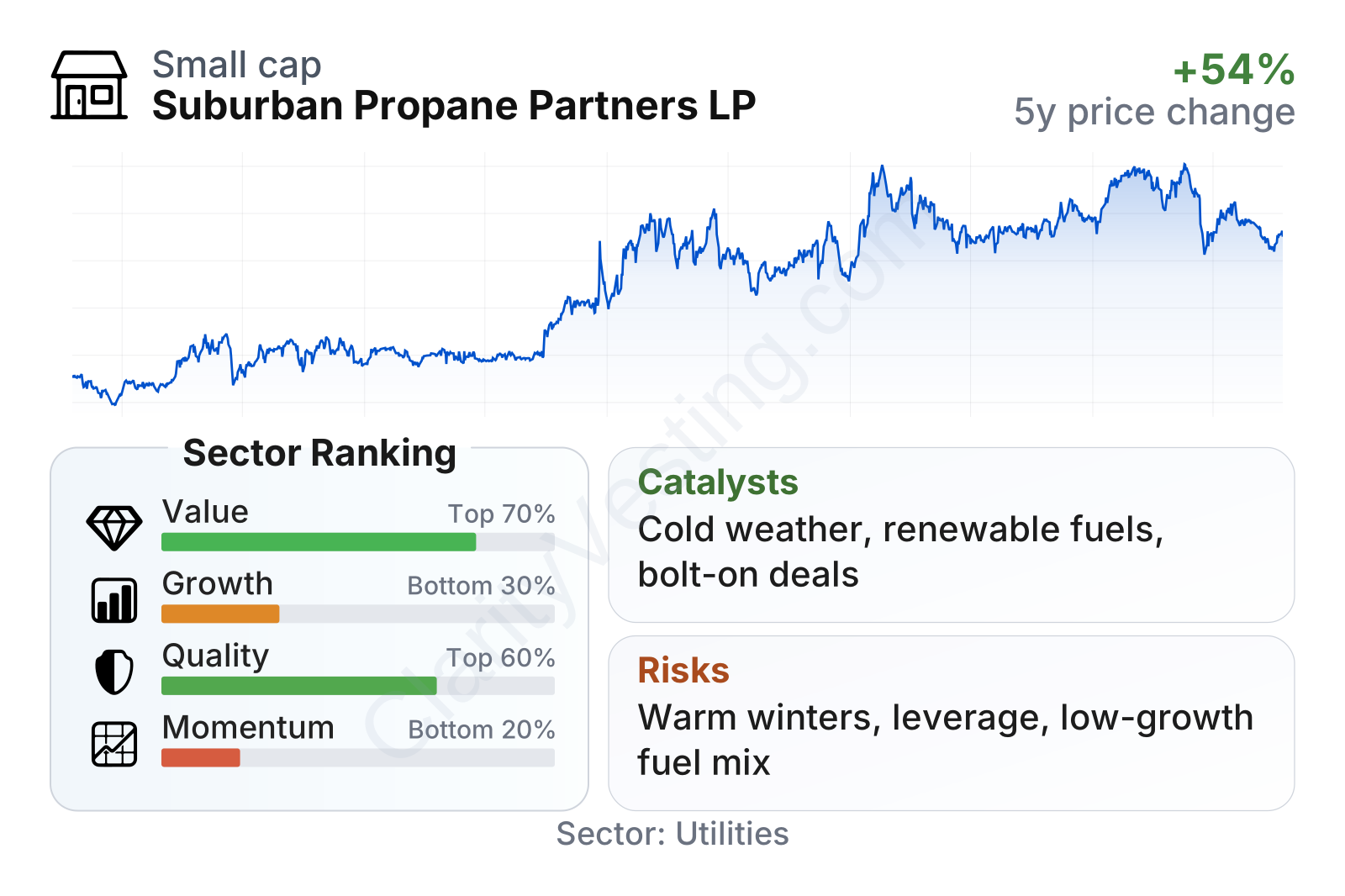
Suburban Propane is a relatively small public company within the utilities universe, and its share price behavior has been fairly calm, with a beta well below 1. On valuation and cash-generation measures, it screens better than many sector peers: earnings multiple, free cash flow yield, and dividend yield all stand out favorably. The weaker areas are growth and recent stock momentum, which reflects a business that produces cash but has not delivered strong expansion.
Growth
Suburban Propane operates in a sector that is stable rather than rapidly expanding. Propane remains important in rural and off-grid areas, especially where natural gas pipelines are unavailable, so the core market has durable demand. At the same time, it is not a structurally high-growth category. Long-term expansion is therefore more likely to come from operational improvements, acquisitions, customer retention, and adjacent energy offerings than from a broad surge in propane consumption.
The company’s strategy has generally followed that logic. Management has continued to emphasize disciplined operations, local market density, and cash flow, while also exploring newer energy themes such as renewable propane, renewable natural gas, and hydrogen-related initiatives through partnership investments and pilot projects. Those efforts are strategically sensible because they could help keep the company relevant in a cleaner-energy environment, but they are still small relative to the core propane business.
Revenue per share has been fairly flat over the last few years, with some decline followed by a partial recovery. That reinforces the idea that this is not currently an expansion-driven business. The more encouraging point is that the company has shown an ability to protect its economics over time even without strong top-line growth.
Free cash flow has also been uneven, falling sharply before recovering. Even so, the latest trailing level remains meaningful for a company of this size, and that cash generation is central to the equity case. It supports distributions, debt service, and selective investment without requiring fast revenue growth.
A relevant catalyst is the continued focus on renewable fuels and lower-carbon gas alternatives. Another is any period of colder weather, which can lift volumes in the residential heating business. In addition, the company has periodically used acquisitions to strengthen local market positions, and that remains one of the clearer ways to add scale in a mature industry.
Recent company communications have continued to highlight operational discipline, customer service, and work in renewable energy platforms rather than a major change in business model. That suggests the main opportunity is gradual evolution, not a near-term transformation.
Risks
This article is for informational purposes only and does not constitute financial advice. Some content is AI-generated. See Disclaimer


