Stock Analysis · Spectrum Brands Holdings Inc (SPB)
Overview
Spectrum Brands Holdings is a consumer products company that sells everyday household items through retailers, e-commerce channels, and distributors. Its brands are mostly positioned in practical, repeat-purchase categories rather than luxury or highly specialized products. The company has become more focused in recent years after portfolio changes and asset sales, and today it is centered on products used in home care, pet care, and personal grooming.
Based on the company’s recent annual reporting structure, revenue mainly comes from the following segments:
- Home & Personal Care: approximately 44% of fiscal 2025 net sales. This includes small kitchen appliances, garment care products, and personal care items sold under brands such as Black+Decker, Russell Hobbs, George Foreman, and Remington.
- Global Pet Care: approximately 31% of fiscal 2025 net sales. This business includes aquatics, companion animal supplies, pet habitat products, and related consumables under brands such as Tetra, FURminator, DreamBone, and SmartBones.
- Home & Garden: approximately 25% of fiscal 2025 net sales. This segment includes household pest control and lawn-and-garden control products, mainly under Spectracide, Hot Shot, Cutter, and Repel.
The business mix matters because these categories behave differently. Pet care tends to be more recurring, home and personal care depends more on consumer discretionary spending and retail promotions, while home and garden is more seasonal and can be affected by weather patterns.
The profit flow over the last few years shows a company that has improved its cost base and reduced interest expense after a period of weaker operating performance. Revenue has drifted lower from 2022 levels, but gross profit and operating profitability recovered meaningfully in 2024 before moderating again, which suggests a business still in the middle of an efficiency and portfolio reset rather than one with perfectly steady earnings.
Key Figures
| Metric | Value | Sector ⓘ |
|---|---|---|
| Date | Oct 04, 2026 | |
| Context | ||
| Sector | Consumer Defensive | |
| Industry | Household & Personal Products | |
| Market Cap ⓘ | $1.80B | |
| Beta ⓘ | 0.64 | |
Value (Cheapness) | ||
| P/E Ratio ⓘ | 24.32 | 18.17 |
| P/B Ratio ⓘ | 1.01 | 1.27 |
| FCF Yield ⓘ | 16.19% | 12.39% |
| Dividend Yield ⓘ | 2.37% | 2.83% |
| EBIT / EV ⓘ | 8.74% | 6.38% |
| PEG ⓘ | 1.36 | |
Growth (Business expansion) | ||
| Revenue Growth ⓘ | 7.70% | 3.80% |
| RPS Growth (5Y CAGR) ⓘ | 11.81% | 6.20% |
| EPS Growth (5Y CAGR) ⓘ | 41.16% | -14.56% |
| BVPS Growth (5Y CAGR) ⓘ | 21.43% | 3.26% |
| Margin Growth (5Y Trend) ⓘ | -0.38% | -0.25% |
| FCF Growth (5Y CAGR) ⓘ | -9.28% | 4.65% |
| DPS Growth (5Y CAGR) ⓘ | 2.97% | 6.86% |
Quality (Business durability) | ||
| ROIC (Latest) ⓘ | -5.77% | 12.58% |
| ROA (Latest) ⓘ | 2.29% | 6.32% |
| ROIC (5Y Median) ⓘ | 2.71% | 10.36% |
| ROA (5Y Median) ⓘ | 2.77% | 5.44% |
| Net Debt / EBIT (Latest) ⓘ | 2.26 | 1.91 |
| Net Debt / EBIT (5Y Median) ⓘ | 10.95 | 2.32 |
| Net Debt / EBITDA (Latest) ⓘ | 1.55 | 1.36 |
| Net Debt / Assets ⓘ | 13.68% | 21.25% |
| EBITDA / Interest ⓘ | 10.44 | 9.61 |
| Operating Margin (Latest) ⓘ | 7.54% | 8.91% |
| Operating Margin (5Y Median) ⓘ | 4.17% | 9.53% |
| Debt to Equity (Latest) ⓘ | 40.47% | 71.66% |
| Profit Margin (Latest) ⓘ | 2.76% | 5.39% |
| Free Cash Flow (Latest) ⓘ | $291.60M | |
Momentum (Price trend) | ||
| 3Y Return ⓘ | +10.26% | +15.25% |
| 12M Return (excl. last month) ⓘ | +66.97% | +2.49% |
| 6M Return ⓘ | +7.45% | +2.26% |
| Price vs. 200-Day MA ⓘ | +0.31% | +0.43% |
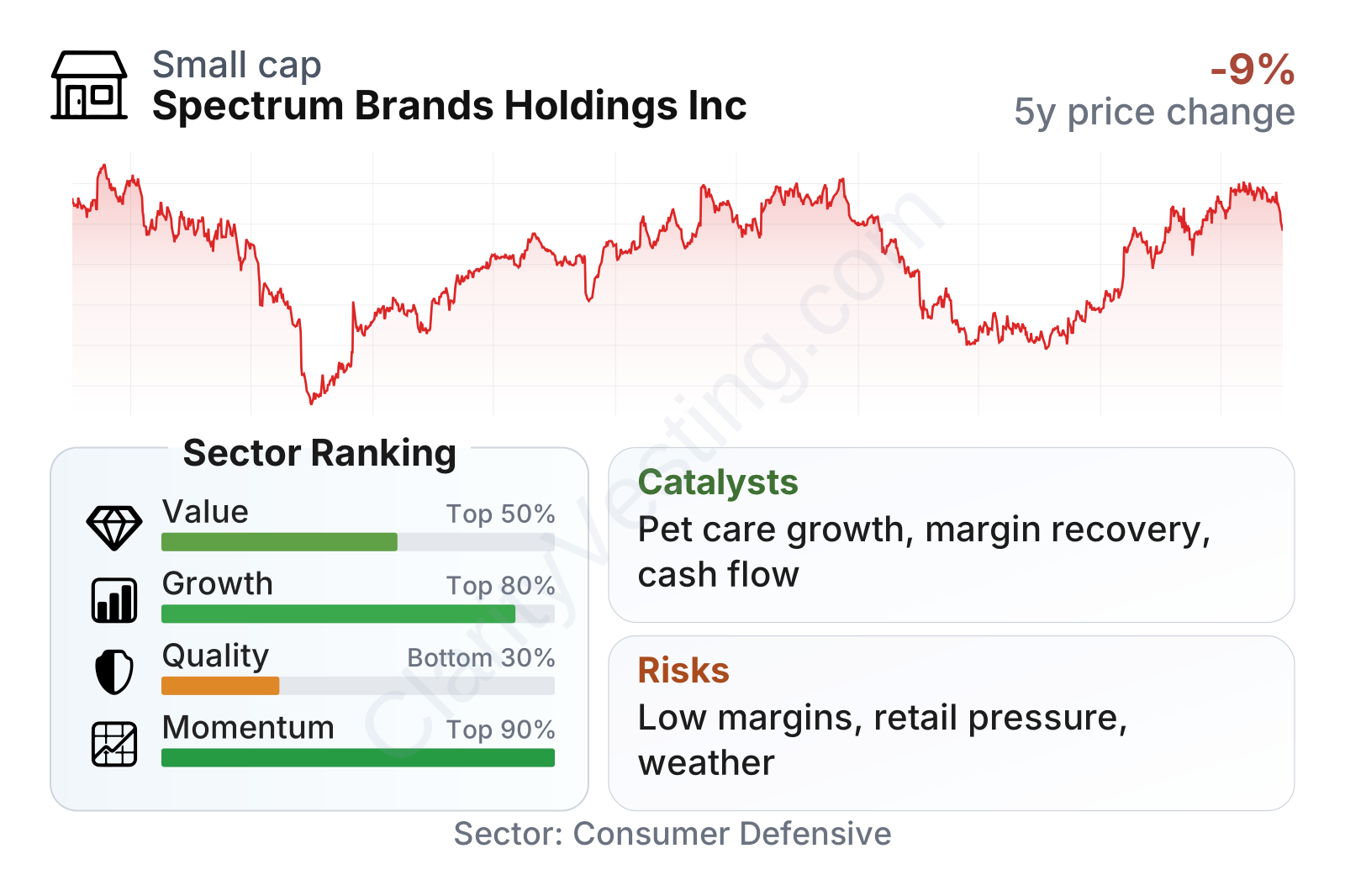
Spectrum Brands is a mid-sized company with a relatively low share-price volatility profile, as reflected by a beta below 1. In the factor breakdown, value and momentum look comparatively strong versus much of the sector, while quality ranks weakly. That combination usually points to a company where the market is recognizing recent improvement, but where profitability and return metrics still lag stronger consumer product peers. Free cash flow generation is currently solid, leverage is manageable, and revenue growth is running ahead of the sector median, but the business is not yet converting that into above-average profit quality.
Growth
Spectrum Brands operates in categories that are mature overall, but still capable of selective expansion. Pet care remains the clearest structural growth area because spending on companion animals has held up well over time and premiumization continues in several subcategories. Home and personal care is a steadier but less exciting area, where product refreshes, shelf-space wins, and international execution matter more than broad industry expansion. Home and garden can grow in favorable seasons, though it is naturally less predictable.
The recent growth pattern has been uneven. Revenue contracted through much of 2023 and parts of 2025, then turned positive again in 2026, with the latest year-over-year growth running in the high-single-digit range and ahead of the sector median. That rebound is encouraging because it suggests the company is no longer only relying on cost actions to support results.
Another useful sign is cash generation. Free cash flow has been volatile over the past few years, including a deep dip in 2024, but the trailing figure has recovered to roughly $290 million. For a company of this size, that is meaningful. It provides room for debt service, dividends, share repurchases when used, and brand support. Still, the longer-term free-cash-flow trend remains weaker than ideal, so the recent recovery needs to prove durable.
The company’s strategy appears sensible in a simple way: focus on categories where branded consumer products still matter, streamline operations, and use a cleaner balance sheet to stabilize earnings. A major catalyst in recent years has been the simplification of the business following divestitures, which has made Spectrum easier to analyze and less burdened by the heavy leverage it once carried. If management can turn that simpler structure into steadier margins and more consistent cash conversion, growth can look better than the underlying sector growth rate.
Recent company communications have also highlighted efforts around innovation, new product launches, retailer execution, and operational productivity. None of these alone transforms the company, but together they can matter in a consumer products business where small margin gains and better inventory discipline can significantly affect earnings.
Risks
This article is for informational purposes only and does not constitute financial advice. Some content is AI-generated. See Disclaimer