Stock Analysis · South32 (SOUHY)
Overview
South32 is a diversified mining and metals company created from the demerger of BHP’s non-core assets in 2015. It produces raw materials used in construction, steelmaking, packaging, transportation, and the energy transition. Its portfolio spans bauxite, alumina, aluminum, manganese, silver, lead, zinc, nickel, copper, and metallurgical coal, with operating assets in Australia, Southern Africa, and South America, plus development exposure in North America.
That diversification matters because South32 is not dependent on a single mine or a single metal. At the same time, it is still very exposed to commodity cycles, so results can move sharply when prices for aluminum, coal, manganese, or base metals rise or fall.
Based on South32’s latest annual reporting, revenue is mainly generated from the following segments, listed from largest to smallest:
- Aluminum: approximately 24% of group revenue. This comes from the company’s share of the Hillside and Mozal aluminum smelters.
- Worsley Alumina: approximately 21%. Alumina is the refined material used to make aluminum.
- Australia Manganese: approximately 14%. This business produces manganese ore used mainly in steelmaking.
- Illawarra Metallurgical Coal: approximately 12%. Metallurgical coal is used to make steel, not electricity.
- Cannington: approximately 12%. This mine produces silver, lead, and zinc.
- South Africa Manganese: approximately 8%. This includes manganese ore and alloys.
- Cerro Matoso: approximately 5%. A ferronickel operation in Colombia.
- Sierra Gorda: approximately 4%. South32 owns a stake in this Chilean copper mine.
In simple terms, South32 is a mid-to-large global miner with a mix of mature cash-generating assets and a few future-facing metals exposures, especially copper and aluminum-related materials.
The overall earnings profile has been volatile over the last several years. Revenue and operating profit fell sharply after the 2022 commodity peak, but the latest period shows a clear recovery in operating income and net income as costs improved and several assets performed better. That rebound is important, but it also highlights how cyclical the business remains.
Key Figures
| Metric | Value | Sector ⓘ |
|---|---|---|
| Date | Oct 17, 2026 | |
| Context | ||
| Sector | Basic Materials | |
| Industry | Other Industrial Metals & Mining | |
| Market Cap ⓘ | $14.74B | |
| Beta ⓘ | 0.75 | |
Value (Cheapness) | ||
| P/E Ratio ⓘ | 13.95 | 16.90 |
| P/B Ratio ⓘ | 1.51 | 1.65 |
| FCF Yield ⓘ | 13.15% | 5.76% |
| Dividend Yield ⓘ | 2.76% | 2.13% |
| EBIT / EV ⓘ | 8.21% | 6.30% |
| PEG ⓘ | 7.32 | |
Growth (Business expansion) | ||
| Revenue Growth ⓘ | 1.10% | 11.10% |
| RPS Growth (5Y CAGR) ⓘ | -10.14% | 4.49% |
| EPS Growth (5Y CAGR) ⓘ | N/A | -13.47% |
| BVPS Growth (5Y CAGR) ⓘ | -1.70% | 5.51% |
| Margin Growth (5Y Trend) ⓘ | -14.35% | -1.54% |
| FCF Growth (5Y CAGR) ⓘ | -33.20% | 0.37% |
| DPS Growth (5Y CAGR) ⓘ | -17.66% | 6.08% |
Quality (Business durability) | ||
| ROIC (Latest) ⓘ | 8.95% | 9.26% |
| ROA (Latest) ⓘ | 9.08% | 4.91% |
| ROIC (5Y Median) ⓘ | 4.28% | 7.70% |
| ROA (5Y Median) ⓘ | 1.52% | 3.86% |
| Net Debt / EBIT (Latest) ⓘ | -0.22 | 1.40 |
| Net Debt / EBIT (5Y Median) ⓘ | -0.14 | 1.70 |
| Net Debt / EBITDA (Latest) ⓘ | -0.13 | 0.95 |
| Net Debt / Assets ⓘ | -1.95% | 13.69% |
| EBITDA / Interest ⓘ | 12.67 | 12.34 |
| Operating Margin (Latest) ⓘ | 10.88% | 13.20% |
| Operating Margin (5Y Median) ⓘ | 14.29% | 11.80% |
| Debt to Equity (Latest) ⓘ | 19.08% | 40.56% |
| Profit Margin (Latest) ⓘ | 18.30% | 6.43% |
| Free Cash Flow (Latest) ⓘ | $1.94B | |
Momentum (Price trend) | ||
| 3Y Return ⓘ | +58.95% | +68.89% |
| 12M Return (excl. last month) ⓘ | +109.63% | +30.21% |
| 6M Return ⓘ | -0.89% | -4.16% |
| Price vs. 200-Day MA ⓘ | +4.88% | -1.27% |
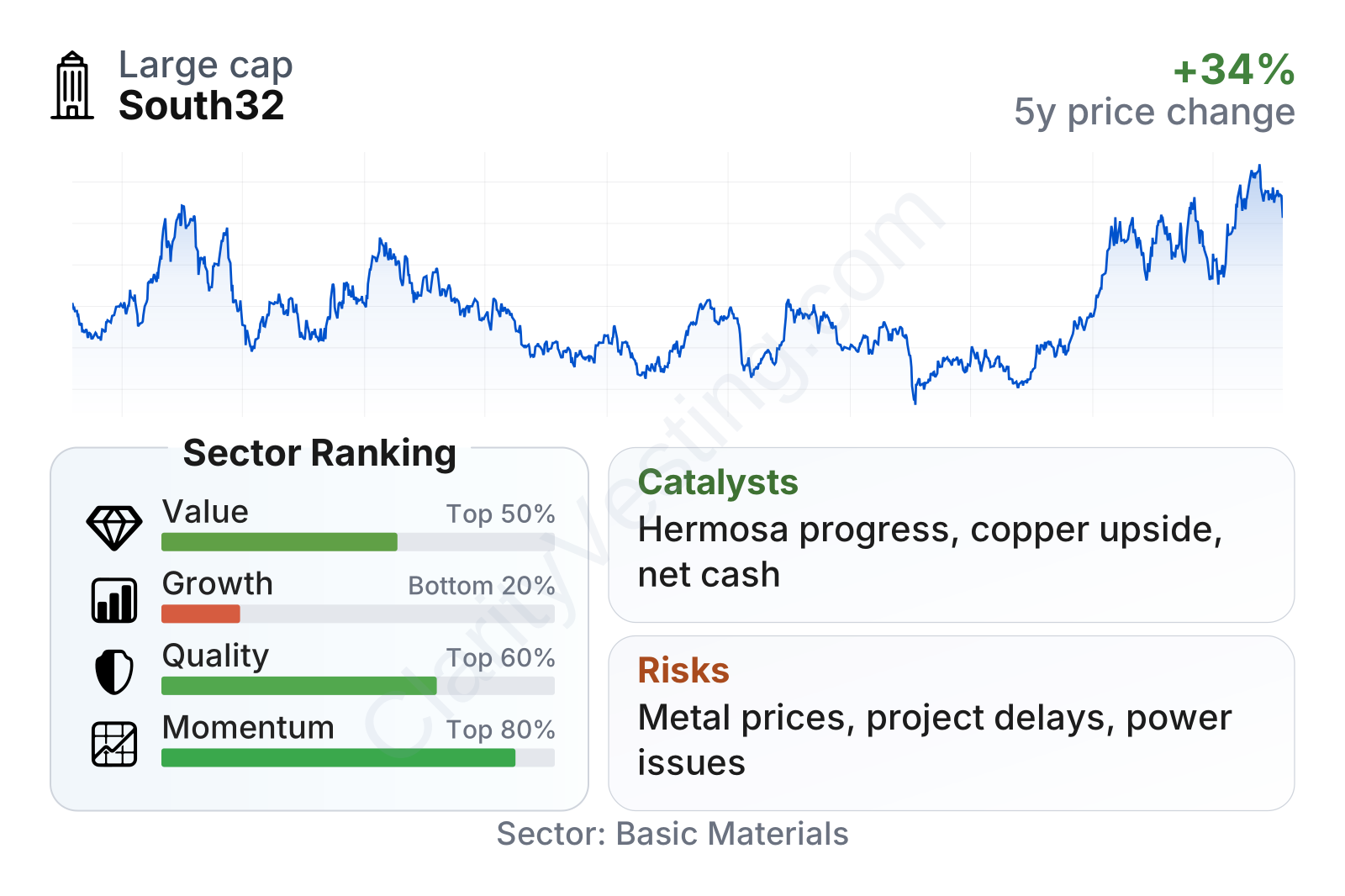
South32 sits in the large-cap range for the materials sector and shows relatively low share-price volatility for a mining company, with a beta below 1. On valuation metrics, it screens somewhat cheaper than the sector median on earnings and book value, while its free cash flow yield and EBIT-to-enterprise-value ratio look stronger than many peers. The weaker area is growth, where the company ranks near the bottom of the sector because the last five years include a meaningful earnings and cash flow downturn after the commodity boom. Quality is more balanced: profitability is solid, and the balance sheet is notably conservative.
Growth
South32 operates in a sector with mixed long-term demand drivers. Some of its products, such as metallurgical coal and manganese, are linked to traditional steelmaking and tend to follow industrial production and construction activity. Others, such as copper, nickel, alumina, and aluminum, are tied more directly to electrification, grid investment, transport lightweighting, and renewable infrastructure. That gives the company exposure to both mature and growing end markets.
The main strategic question is whether South32 can gradually tilt its portfolio toward metals with better long-term demand and lower structural pressure. Management has been moving in that direction through its stake in Sierra Gorda copper mine and through development of the Hermosa project in the United States, which is centered on zinc, lead, silver, and battery-grade manganese potential. Hermosa is one of the more important future catalysts because it could give South32 a larger presence in minerals with strategic relevance to domestic U.S. supply chains.
Recent top-line performance shows how uneven mining growth can be. Revenue contracted sharply in the downcycle, then returned to modest growth. That pattern suggests South32 is still recovering rather than delivering consistently strong expansion. For long-term analysis, this matters because value creation will likely depend more on project quality, capital discipline, and commodity mix than on steady year-over-year sales growth.
Cash generation remains one of the more encouraging parts of the picture. Even though free cash flow has come down from earlier highs, the business still produces meaningful cash relative to its current size. That supports dividends, project funding, and resilience during weaker parts of the cycle. If commodity conditions remain supportive and newer projects advance on schedule, South32 has room to improve cash generation without relying heavily on debt.
A notable recent development is the company’s continued progress at Hermosa, including work tied to permitting, development planning, and its positioning within U.S. critical minerals policy. In addition, stronger copper exposure through Sierra Gorda can become more valuable if supply remains tight and electrification-related demand continues to build over time.
Risks
This article is for informational purposes only and does not constitute financial advice. Some content is AI-generated. See Disclaimer


