Stock Analysis · Sunny Optical Technology Company Limited (SOTGY)
Overview
Sunny Optical Technology Company Limited is a Chinese manufacturer of optical and imaging components used in smartphones, vehicles, consumer electronics, and industrial applications. In simple terms, the company makes camera modules, lenses, and optical systems that help devices “see.” Its products sit inside phone cameras, advanced driver-assistance systems, vehicle cabins, security equipment, and other connected devices.
The business is generally organized around three main product groups, with mobile and automotive optics forming the core of revenue. Based on the company’s recent annual disclosures, the mix is approximately as follows:
- Optical components: about 40% to 45% — mainly handset lens sets, vehicle lens sets, and other optical parts used in mobile devices, cars, and specialized equipment.
- Optoelectronic products: about 35% to 40% — mainly camera modules for smartphones and vehicles, including products that combine sensors, lenses, and packaging.
- Optical instruments: about 15% to 20% — microscopes, analytical instruments, and other precision optical products for industrial, scientific, and educational use.
That mix matters because it shows a business in transition. Smartphones remain important, but automotive optics has become a major strategic pillar. Over the last several years, the company has continued to invest heavily in research and development while recovering from the margin pressure that hit consumer electronics demand earlier in the cycle. Revenue has rebounded meaningfully from the 2023 low, and profitability has improved from that trough, although the business still operates in a highly competitive hardware market.
The multi-year income flow shows a sharp profitability drop in 2022 and 2023, followed by a notable recovery in 2024 and 2025. It also highlights that research and development remains substantial, which is important in a component industry where product cycles are fast and technical capability can decide customer wins.
Key Figures
| Metric | Value | Sector ⓘ |
|---|---|---|
| Date | Oct 03, 2026 | |
| Context | ||
| Sector | Technology | |
| Industry | Electronic Components | |
| Market Cap ⓘ | $9.32B | |
| Beta ⓘ | 1.15 | |
Value (Cheapness) | ||
| P/E Ratio ⓘ | 13.19 | 29.95 |
| FCF Yield ⓘ | 55.62% | 4.22% |
| Dividend Yield ⓘ | 1.84% | 1.30% |
| EBIT / EV ⓘ | N/A | 2.83% |
| PEG ⓘ | 1.43 | |
Growth (Business expansion) | ||
| Revenue Growth ⓘ | 11.50% | 15.80% |
| RPS Growth (5Y CAGR) ⓘ | 2.95% | 8.55% |
| EPS Growth (5Y CAGR) ⓘ | -20.82% | -11.72% |
| Margin Growth (5Y Trend) ⓘ | -5.42% | 0.39% |
| FCF Growth (5Y CAGR) ⓘ | -9.43% | 9.72% |
| DPS Growth (5Y CAGR) ⓘ | -14.24% | 7.73% |
Quality (Business durability) | ||
| ROIC (Latest) ⓘ | 17.50% | 9.36% |
| ROIC (5Y Median) ⓘ | 9.14% | 8.32% |
| Net Debt / EBIT (Latest) ⓘ | 1.21 | 0.50 |
| Net Debt / EBIT (5Y Median) ⓘ | 0.12 | 0.46 |
| Net Debt / EBITDA (Latest) ⓘ | 0.70 | 0.28 |
| Net Debt / Assets ⓘ | 14.80% | 3.44% |
| EBITDA / Interest ⓘ | N/A | 12.67 |
| Operating Margin (Latest) ⓘ | 7.82% | 9.81% |
| Operating Margin (5Y Median) ⓘ | 8.07% | 8.50% |
| Debt to Equity (Latest) ⓘ | 39.68% | 33.33% |
| Profit Margin (Latest) ⓘ | 10.56% | 7.15% |
| Free Cash Flow (Latest) ⓘ | $5.18B | |
Momentum (Price trend) | ||
| 3Y Return ⓘ | +21.20% | +49.46% |
| 12M Return (excl. last month) ⓘ | -19.50% | +16.51% |
| 6M Return ⓘ | +22.21% | +24.29% |
| Price vs. 200-Day MA ⓘ | +1.43% | +4.74% |
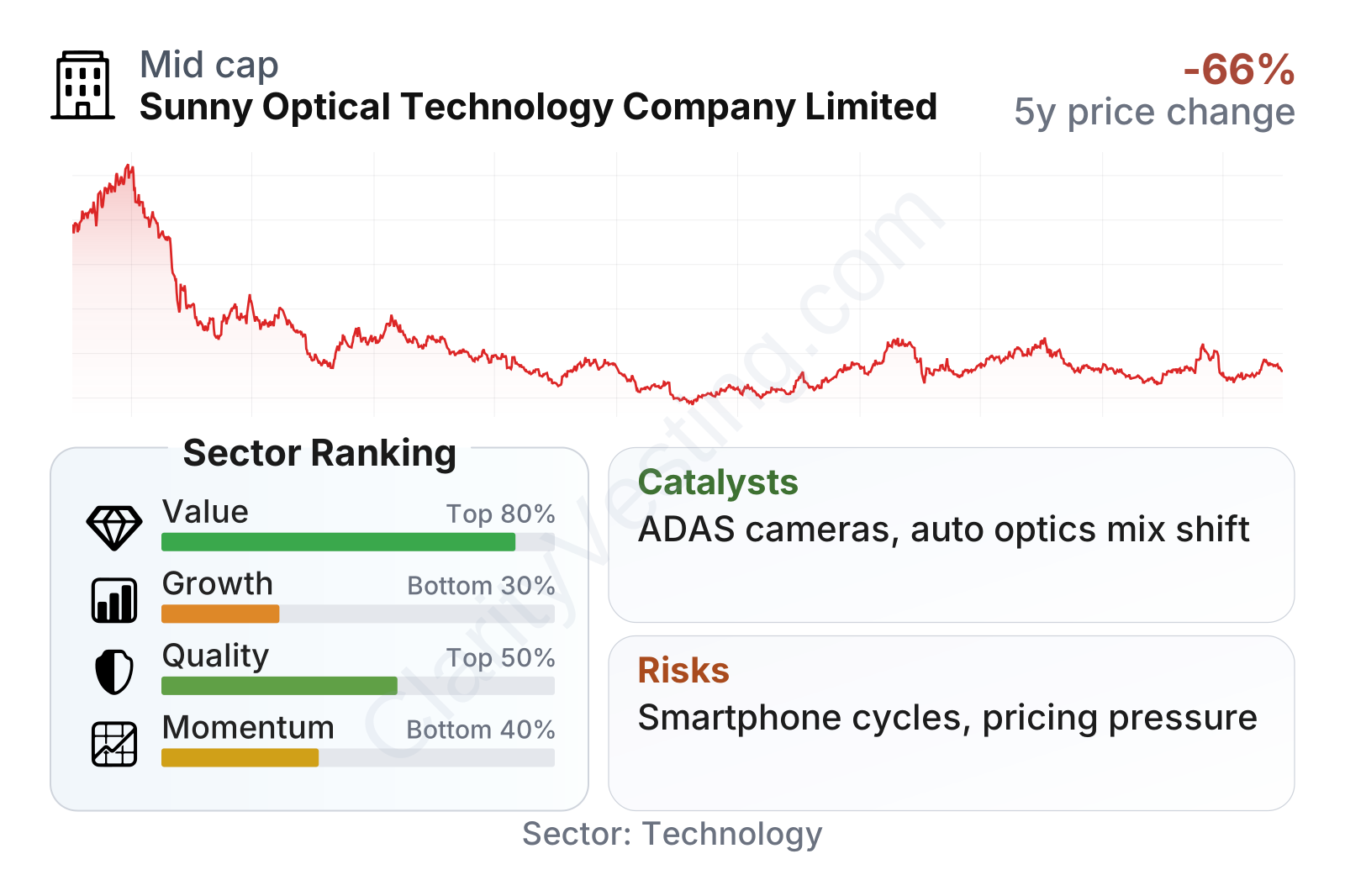
Sunny Optical is a large technology components company with share-price volatility that has been significant over the past few years. The metrics point to a business that currently looks inexpensive relative to much of the sector, with a price-to-earnings ratio well below the sector median and a dividend yield slightly above the median. Quality is more mixed: returns on invested capital are solid, profit margin is above the sector median, but operating margin remains somewhat below typical sector levels and leverage is modestly higher than average. Growth is the weakest area in the factor view, reflecting a difficult five-year period shaped by the smartphone downturn and margin compression rather than a straight-line expansion.
Growth
Sunny Optical operates in markets that still have long-term expansion drivers, especially automotive imaging and higher-end optics. The smartphone market is more mature, but the number of cameras and optical complexity per device has increased over time. In vehicles, the growth case is easier to understand: modern cars use more cameras for parking, safety functions, driver assistance, and interior monitoring. As more vehicles add these systems, demand can rise not only from unit growth but also from more optical content per car.
The company’s strategy is coherent with that trend. It has built capabilities across lenses, camera modules, and precision optical manufacturing, which gives it a wider role in the imaging supply chain than a single-product supplier. This is particularly relevant in automotive applications, where reliability standards are higher and long customer qualification cycles can create more durable business once programs are won.
Recent growth has improved compared with the earlier downturn, with year-over-year revenue expansion back in positive territory. Even so, the longer five-year picture remains less impressive than the broader technology sector, which suggests the current rebound still needs to prove that it can translate into sustained earnings compounding rather than only cyclical recovery.
A meaningful catalyst is the continued shift toward intelligent vehicles. More advanced driver-assistance features, surround-view systems, and in-cabin sensing all require additional imaging hardware. Sunny Optical has also remained active in higher-value optical specifications, where performance demands are rising. Another favorable element is the recovery in earnings after the 2023 low, which indicates that operating conditions have normalized to some degree. If that recovery broadens beyond smartphones and into a larger automotive contribution, the company’s growth profile could look structurally stronger than it did during the last few years.
Risks
This article is for informational purposes only and does not constitute financial advice. Some content is AI-generated. See Disclaimer