Stock Analysis · Sonova Holding AG (SONVF)
Overview
Sonova Holding AG is a Swiss medical-device company focused on hearing care. Its products and services are built around helping people hear better through hearing aids, cochlear implant systems, wireless communication accessories, fitting software, and hearing care services delivered through clinics and retail networks. The group operates globally and sells through both professional channels, such as audiologists and hearing care providers, and its own consumer-facing network.
The business is mainly organized around two large activities: hearing instruments and hearing care services, and cochlear implants. In practice, the hearing instrument side is the economic engine of the company, while cochlear implants add a smaller but strategically important growth platform.
Based on Sonova’s recent annual reporting, the main revenue sources can be summarized as follows:
- Hearing Instruments segment: about 91% to 93% of sales. This includes hearing aids sold under brands such as Phonak, Unitron, and Sennheiser-branded hearing products, plus related accessories, software, and a large network of hearing care clinics.
- Cochlear Implants segment: about 7% to 9% of sales. This includes implant systems, external audio processors, upgrades, and related support for people with severe to profound hearing loss.
- By geography, EMEA and the Americas are the largest regions, with Asia-Pacific smaller but still meaningful. The exact mix moves year to year, but the company is broadly diversified across developed hearing-care markets.
That revenue mix matters because it gives Sonova a combination of recurring demand drivers: new hearing aid fittings, replacement cycles, clinic traffic, accessories, and upgrades of installed devices. The income flow over the last several years also shows a business with consistently high gross margins, although net profit has recently been under pressure from higher operating costs and weaker top-line momentum.
Revenue climbed from roughly $3.4 billion in fiscal 2022 to around $3.9 billion in fiscal 2025 before easing back to about $3.6 billion in fiscal 2026. Gross profit stayed strong through that period, but selling and administrative costs rose noticeably, which helps explain why operating income remained relatively stable while net income fell more sharply in the latest year.
Key Figures
| Metric | Value | Sector ⓘ |
|---|---|---|
| Date | Oct 23, 2026 | |
| Context | ||
| Sector | Healthcare | |
| Industry | Medical Devices | |
| Market Cap ⓘ | $20.03B | |
| Beta ⓘ | 1.08 | |
Value (Cheapness) | ||
| P/E Ratio ⓘ | 30.03 | 25.42 |
| P/B Ratio ⓘ | 7.86 | 3.08 |
| FCF Yield ⓘ | 6.53% | 3.12% |
| Dividend Yield ⓘ | 1.72% | 1.85% |
| EBIT / EV ⓘ | N/A | 0.56% |
| PEG ⓘ | 1.29 | |
Growth (Business expansion) | ||
| Revenue Growth ⓘ | -1.00% | 7.50% |
| RPS Growth (5Y CAGR) ⓘ | 2.72% | 8.60% |
| EPS Growth (5Y CAGR) ⓘ | -10.51% | -17.73% |
| BVPS Growth (5Y CAGR) ⓘ | 2.73% | 3.72% |
| Margin Growth (5Y Trend) ⓘ | -3.74% | -0.57% |
| FCF Growth (5Y CAGR) ⓘ | -7.76% | 0.96% |
| DPS Growth (5Y CAGR) ⓘ | 7.75% | 6.69% |
Quality (Business durability) | ||
| ROIC (Latest) ⓘ | 38.04% | 3.17% |
| ROA (Latest) ⓘ | 19.46% | 2.98% |
| ROIC (5Y Median) ⓘ | 16.49% | 4.56% |
| ROA (5Y Median) ⓘ | 10.60% | 1.87% |
| Net Debt / EBIT (Latest) ⓘ | 0.68 | 1.34 |
| Net Debt / EBIT (5Y Median) ⓘ | 1.58 | 1.86 |
| Net Debt / EBITDA (Latest) ⓘ | 0.50 | 1.00 |
| Net Debt / Assets ⓘ | 17.58% | 5.06% |
| EBITDA / Interest ⓘ | 14.23 | 9.55 |
| Operating Margin (Latest) ⓘ | 19.60% | 9.25% |
| Operating Margin (5Y Median) ⓘ | 18.62% | 7.33% |
| Debt to Equity (Latest) ⓘ | 65.48% | 26.68% |
| Profit Margin (Latest) ⓘ | 11.94% | 3.34% |
| Free Cash Flow (Latest) ⓘ | $1.31B | |
Momentum (Price trend) | ||
| 3Y Return ⓘ | +45.68% | +51.61% |
| 12M Return (excl. last month) ⓘ | -5.12% | +19.90% |
| 6M Return ⓘ | +47.41% | +10.10% |
| Price vs. 200-Day MA ⓘ | +26.35% | +6.44% |
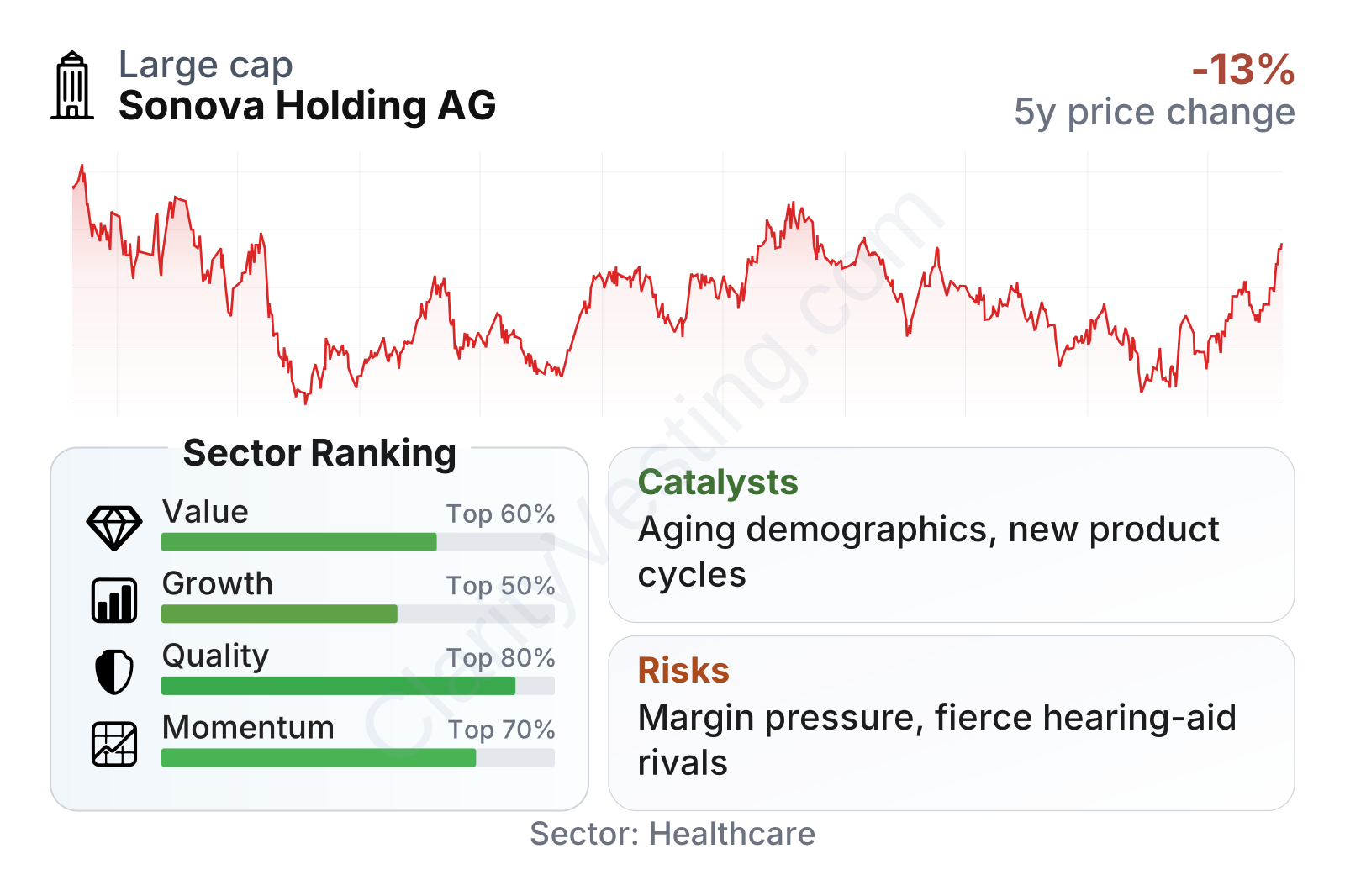
Sonova is a large healthcare equipment company with moderate stock volatility and a quality profile that stands out in its sector. Profitability is well above typical medical-device peers, with operating margin near 20%, profit margin around 12%, and returns on capital and assets far ahead of sector medians. Balance-sheet leverage is not unusually aggressive for the business, and interest coverage remains solid, although debt relative to equity is higher than the sector median.
The weaker area is growth. Recent revenue was slightly down year over year, five-year revenue-per-share growth has been modest, and free cash flow and earnings trends over five years have been uneven. At the same time, the market has recently rewarded the shares: the six-month price rebound has been strong, and the stock is trading clearly above its 200-day average. In other words, the business currently looks stronger on quality and market confidence than on recent growth speed.
Growth
Sonova operates in a sector with long-term structural support. Hearing loss rises with age, and aging populations in Europe, North America, Japan, and many other countries create a steady underlying need for hearing solutions. Penetration rates are still below the size of the medical need, which leaves room for market expansion over time. This is one of the reasons hearing care is often viewed as a resilient healthcare niche rather than a purely cyclical market.
The company’s strategy also fits that backdrop. Sonova combines premium devices, software, connectivity features, and a direct hearing care network. That model can support growth in several ways: it improves control over the patient relationship, helps product launches reach end users more efficiently, and creates recurring revenue from follow-up care, accessories, and replacement purchases. Its cochlear implant business adds another avenue for expansion, especially as upgrade cycles and candidacy awareness improve.
A major catalyst is product innovation. Sonova has been investing for years in speech understanding, connectivity, rechargeable formats, fitting software, and AI-supported features designed to improve hearing in noisy environments. In hearing care, small improvements in user experience matter because they can influence adoption, upgrade rates, and professional recommendations. The Sennheiser consumer hearing brand also gives Sonova a way to address people earlier in the hearing-loss journey, potentially connecting consumer electronics with medical hearing care over time.
Another important tailwind is market normalization after periods of disruption in retail traffic and supply chains. If clinic activity, replacement demand, and new product adoption continue to recover, Sonova has room to improve growth without needing an entirely new business model. Recent company communications in 2026 have also highlighted ongoing portfolio development and regional execution priorities, which suggest management remains focused on rebuilding momentum rather than defending a shrinking base.
Risks
This article is for informational purposes only and does not constitute financial advice. Some content is AI-generated. See Disclaimer


