Stock Analysis · Solventum Corp (SOLV)
Overview
Solventum is a healthcare company focused on products and software used in hospitals, clinics, dental offices, and medical coding and reimbursement workflows. It was separated from 3M in 2024 and now operates as a standalone business. Its portfolio spans medical consumables, oral care products, health information software, and filtration systems used in biopharma and medical environments.
The business is organized into four main segments. Based on the company’s recent annual disclosures, revenue is spread across these activities in roughly the following order:
- Medical Surgical: about 31% of revenue. This includes wound care, vascular access, sterile processing, infection prevention, and other hospital consumables used in everyday clinical care.
- Dental Solutions: about 27% of revenue. This segment sells restoratives, orthodontic products, digital workflows, and other supplies for dental professionals.
- Health Information Systems: about 22% of revenue. This area includes software and services for clinical documentation, revenue cycle, coding, and data-driven workflow tools.
- Purification & Filtration: about 20% of revenue. This segment serves biopharma, medical technologies, and related industrial healthcare applications with filtration and separation products.
That mix matters because Solventum is not a single-product company. It combines recurring demand from everyday healthcare supplies with a software component and a filtration business tied to life sciences production. The result is a relatively diversified healthcare platform, although recent performance shows that diversification has not fully shielded it from operating pressure.
Over the last few years, revenue stayed close to the low-$8 billion range, which points to a business with scale but limited organic expansion. Profitability, however, became much more volatile after the separation from 3M, as interest expense rose and operating costs moved higher. More recently, earnings rebounded sharply, showing that the business still has meaningful underlying earning power if execution improves.
The long-term picture shows a company with fairly steady sales, strong gross profit generation, and a large spending base in selling, administration, and research. The biggest shift came after the spin-off, when interest costs appeared and net income became more uneven. That makes Solventum easier to understand as a mature healthcare platform going through a balance-sheet and efficiency reset rather than a fast-growth business.
Key Figures
| Metric | Value | Sector ⓘ |
|---|---|---|
| Date | Nov 14, 2026 | |
| Context | ||
| Sector | Healthcare | |
| Industry | Medical Instruments & Supplies | |
| Market Cap ⓘ | $15.06B | |
| Beta ⓘ | 0.75 | |
Value (Cheapness) | ||
| P/E Ratio ⓘ | 100.70 | 25.84 |
| P/B Ratio ⓘ | 3.16 | 4.34 |
| FCF Yield ⓘ | 0.01% | 2.57% |
| Dividend Yield ⓘ | N/A | 1.62% |
| EBIT / EV ⓘ | 2.09% | 2.92% |
| PEG ⓘ | 1.22 | |
Growth (Business expansion) | ||
| Revenue Growth ⓘ | -7.00% | 7.15% |
| RPS Growth (5Y CAGR) ⓘ | 0.06% | 8.64% |
| EPS Growth (5Y CAGR) ⓘ | 36.93% | -9.67% |
| BVPS Growth (5Y CAGR) ⓘ | -19.89% | 3.71% |
| Margin Growth (5Y Trend) ⓘ | 1.71% | -0.63% |
| FCF Growth (5Y CAGR) ⓘ | N/A | 1.59% |
| DPS Growth (5Y CAGR) ⓘ | N/A | 6.69% |
Quality (Business durability) | ||
| ROIC (Latest) ⓘ | 3.75% | 5.79% |
| ROA (Latest) ⓘ | 1.10% | 2.88% |
| ROIC (5Y Median) ⓘ | 11.48% | 4.60% |
| ROA (5Y Median) ⓘ | 9.74% | 1.82% |
| Net Debt / EBIT (Latest) ⓘ | 11.59 | 1.33 |
| Net Debt / EBIT (5Y Median) ⓘ | 2.02 | 1.92 |
| Net Debt / EBITDA (Latest) ⓘ | 6.02 | 0.91 |
| Net Debt / Assets ⓘ | 34.05% | 5.89% |
| EBITDA / Interest ⓘ | 3.27 | 9.68 |
| Operating Margin (Latest) ⓘ | 5.10% | 9.24% |
| Operating Margin (5Y Median) ⓘ | 20.81% | 7.30% |
| Debt to Equity (Latest) ⓘ | 109.76% | 28.47% |
| Profit Margin (Latest) ⓘ | 1.91% | 3.33% |
| Free Cash Flow (Latest) ⓘ | $2.00M | |
Momentum (Price trend) | ||
| 3Y Return ⓘ | +11.35% | +48.98% |
| 12M Return (excl. last month) ⓘ | +22.06% | +13.65% |
| 6M Return ⓘ | +19.70% | +14.05% |
| Price vs. 200-Day MA ⓘ | +12.98% | +8.64% |
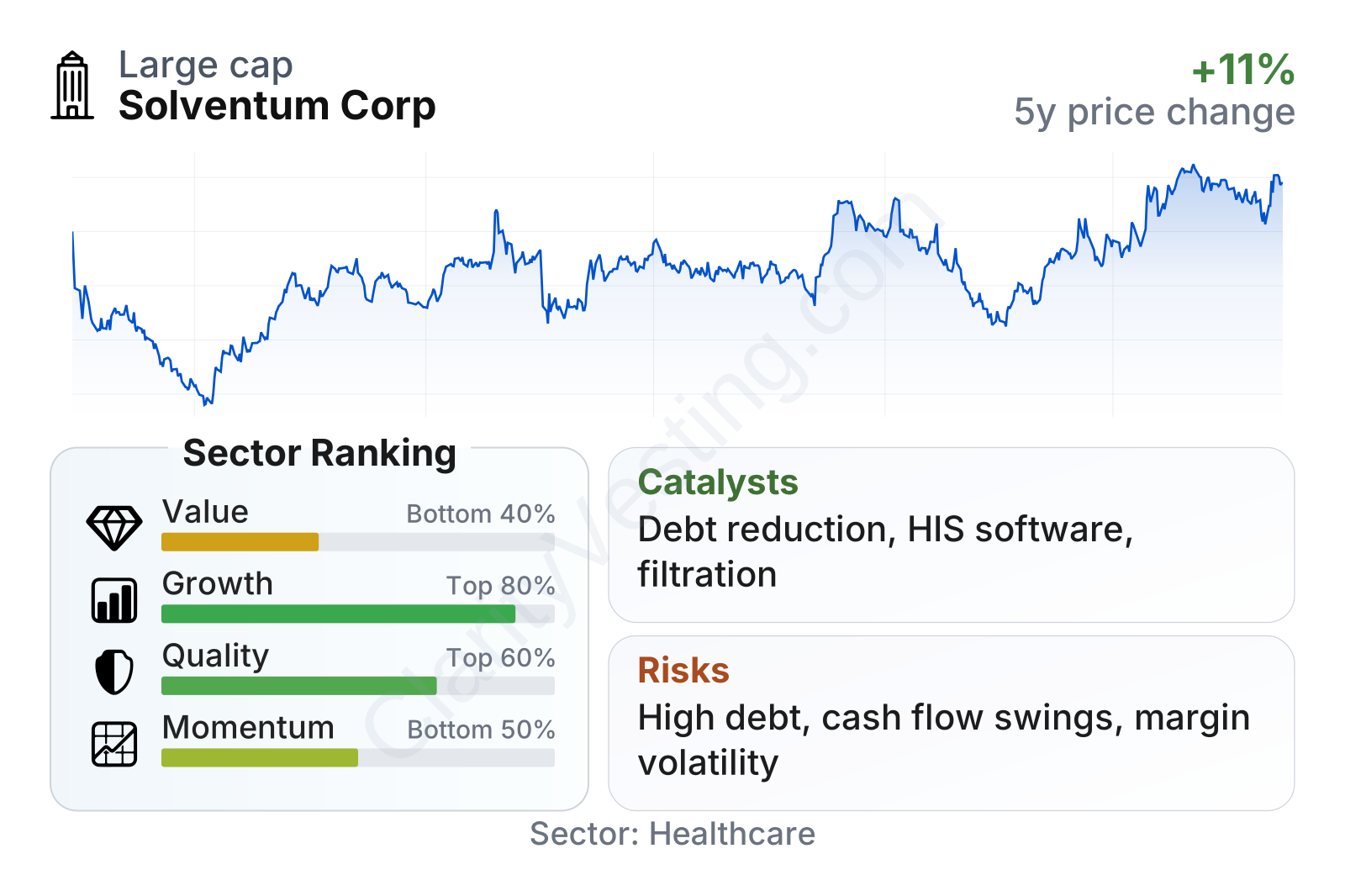
Solventum is a mid-to-large healthcare company with a stock that has been volatile since becoming independent. After a sharp drop in 2024, the share price recovered strongly through parts of 2025 and 2026. The stock’s beta remains below 1, which suggests lower sensitivity to broad market swings than many equities, but the company-specific moves have still been meaningful.
The metrics table paints a mixed picture. Profitability at the operating level remains stronger than much of the sector, and return on invested capital is notably above the median. At the same time, recent revenue growth is weaker than most healthcare peers, leverage is elevated, and the current earnings multiple is unusually high because net income has become less stable. In other words, the company still shows signs of quality in its core operations, but the bottom line and balance sheet make the headline valuation harder to read.
Growth
Solventum operates in areas of healthcare that generally benefit from durable long-term demand. Hospitals continue to need wound care, sterilization, and procedural supplies. Dental markets tend to grow over time with aging populations and demand for restorative and orthodontic care. Health information systems can benefit from the push to automate coding, documentation, and reimbursement. Purification and filtration also have structural support from biopharma manufacturing and quality-control requirements.
That said, the company’s recent sales trend has been uneven rather than clearly accelerating.
Recent quarters moved between modest growth and decline, with the latest year-over-year reading notably below the sector median. That suggests Solventum is still in a transition phase where portfolio quality and end-market resilience are being offset by execution challenges, portfolio pruning, or softer demand in certain areas.
Its strategy for future growth is still coherent. As a standalone company, Solventum can focus capital and management attention on healthcare rather than being one division inside a broader industrial group. Management has emphasized operational improvement, portfolio focus, and debt reduction. In practical terms, the growth case relies less on a dramatic new product cycle and more on making the existing portfolio work better through pricing, productivity, innovation in clinical workflows, and sharper commercial execution.
A meaningful catalyst is the company’s exposure to software-enabled healthcare administration. Hospitals and payers remain under pressure to reduce errors, improve reimbursement capture, and automate documentation. If Solventum strengthens this segment, it could support better mix and margins because software and analytics can carry more attractive economics than physical supplies alone.
Another catalyst is filtration and biopharma exposure. Demand in these categories can benefit from long product qualification cycles and regulated environments, which often create sticky customer relationships once a solution is embedded in a process.
Cash generation is an area to watch closely.
Free cash flow has swung from strongly positive to negative over a relatively short period. For a long-term business case, restoring consistently positive cash conversion is important because it would support debt reduction, internal investment, and more confidence in the post-spin operating model. If cash flow normalizes, the market may view the company’s earnings recovery as more durable.
Recent corporate updates have largely centered on integration, cost actions, and balance-sheet discipline rather than a single transformational event. That does not create the excitement of a breakthrough launch, but it can still matter if the company shows it can convert stable healthcare demand into cleaner and more predictable financial results.
Risks
This article is for informational purposes only and does not constitute financial advice. Some content is AI-generated. See Disclaimer