Stock Analysis · Stolt-Nielsen Limited (SOIEF)
Overview
Stolt-Nielsen Limited is a specialized logistics company focused on transporting and storing bulk liquid products. Its core business is moving chemicals, edible oils, acids, and other liquid cargoes through a network that combines ocean shipping, tank storage terminals, and tank containers. The company also has a smaller aquaculture operation through its land-based seafood activities. This makes Stolt-Nielsen different from a standard shipping company: it is exposed not only to freight rates, but also to storage, handling, and logistics services that are tied to industrial supply chains.
The largest business is Stolt Tankers, which operates parcel tankers designed to carry multiple liquid products on the same voyage. The next largest activities are Stolthaven Terminals, which stores bulk liquids at terminal locations near major ports, and Stolt Tank Containers, which provides door-to-door logistics using tank containers. A smaller but still meaningful segment is Stolt Sea Farm. Based on the latest annual reporting mix, revenue is approximately distributed as follows:
- Stolt Tankers: about 52% of revenue. This includes ocean transportation of chemicals, edible oils, acids, and other bulk liquids.
- Stolt Tank Containers: about 26% of revenue. This covers transport, leasing, and logistics management for liquid cargo moved in tank containers.
- Stolthaven Terminals: about 17% of revenue. This includes storage, handling, and related terminal services for bulk liquids and gases.
- Stolt Sea Farm: about 5% of revenue. This business produces and sells high-value turbot and sole from aquaculture operations.
This structure matters because it gives the company more than one earnings engine. Tanker markets can be cyclical, but terminals and tank containers can add steadier activity tied to recurring customer relationships and infrastructure usage.
Over the last several years, the business has expanded revenue while improving profitability much faster than sales. The broad pattern is that operating income and net income rose materially from 2021 through 2024, then remained at a high level even as revenue growth became less smooth. That suggests better pricing, improved fleet and network utilization, and stronger operating discipline rather than simple expansion in volume alone.
Key Figures
| Metric | Value | Sector ⓘ |
|---|---|---|
| Date | Oct 17, 2026 | |
| Context | ||
| Sector | Industrials | |
| Industry | Marine Shipping | |
| Market Cap ⓘ | $2.46B | |
| Beta ⓘ | -0.57 | |
Value (Cheapness) | ||
| P/E Ratio ⓘ | 8.10 | 22.10 |
| P/B Ratio ⓘ | 0.75 | 1.97 |
| FCF Yield ⓘ | 12.61% | 6.38% |
| Dividend Yield ⓘ | 5.41% | 1.94% |
| EBIT / EV ⓘ | 7.39% | 4.79% |
| PEG ⓘ | -1.74 | |
Growth (Business expansion) | ||
| Revenue Growth ⓘ | 10.90% | 9.30% |
| RPS Growth (5Y CAGR) ⓘ | 7.17% | 7.81% |
| EPS Growth (5Y CAGR) ⓘ | -9.86% | -13.06% |
| BVPS Growth (5Y CAGR) ⓘ | 13.21% | 6.14% |
| Margin Growth (5Y Trend) ⓘ | 8.05% | 0.88% |
| FCF Growth (5Y CAGR) ⓘ | 23.35% | 11.01% |
| DPS Growth (5Y CAGR) ⓘ | 50.94% | 9.48% |
Quality (Business durability) | ||
| ROIC (Latest) ⓘ | 7.26% | 10.84% |
| ROA (Latest) ⓘ | 4.50% | 5.41% |
| ROIC (5Y Median) ⓘ | 9.38% | 9.38% |
| ROA (5Y Median) ⓘ | 6.11% | 4.95% |
| Net Debt / EBIT (Latest) ⓘ | 5.89 | 2.08 |
| Net Debt / EBIT (5Y Median) ⓘ | 5.51 | 2.27 |
| Net Debt / EBITDA (Latest) ⓘ | 2.91 | 1.39 |
| Net Debt / Assets ⓘ | 37.38% | 19.28% |
| EBITDA / Interest ⓘ | 5.27 | 9.58 |
| Operating Margin (Latest) ⓘ | 12.23% | 10.50% |
| Operating Margin (5Y Median) ⓘ | 13.22% | 10.29% |
| Debt to Equity (Latest) ⓘ | 89.00% | 65.48% |
| Profit Margin (Latest) ⓘ | 8.31% | 6.67% |
| Free Cash Flow (Latest) ⓘ | $309.70M | |
Momentum (Price trend) | ||
| 3Y Return ⓘ | +57.54% | +61.68% |
| 12M Return (excl. last month) ⓘ | +2.21% | +12.58% |
| 6M Return ⓘ | +17.32% | 0.00% |
| Price vs. 200-Day MA ⓘ | +29.88% | +0.02% |
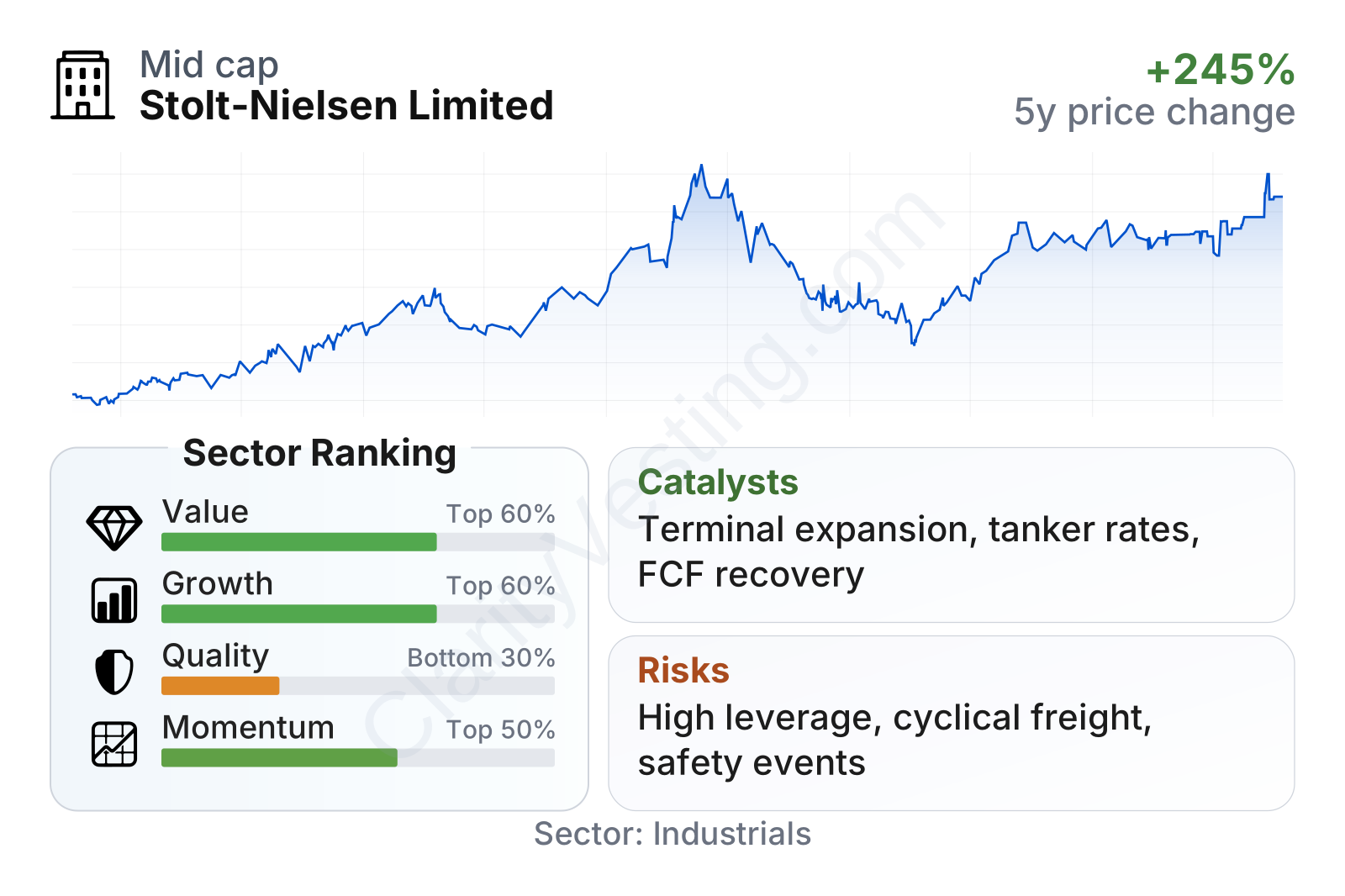
Stolt-Nielsen currently looks inexpensive relative to much of the industrial sector on traditional measures such as earnings and book value, while also showing a solid free cash flow yield and above-median dividend yield. Growth indicators are mixed but generally respectable: recent revenue growth is modestly ahead of the sector median, book value has compounded well, and free cash flow growth over five years has been strong. The weaker area is balance-sheet quality, where leverage remains elevated compared with peers, even though margins and long-term operating performance are stronger than the industry median.
The share price history also shows a company with meaningful cyclicality. The stock appreciated strongly from 2021 into 2024, experienced a notable pullback in 2025, and then recovered materially in 2026. That kind of path is common for shipping-related businesses and shows why long-term assessment matters more here than short-term price swings.
Growth
Stolt-Nielsen operates in a niche of global trade that has long-term relevance. Chemical shipping, liquid storage infrastructure, and specialized tank containers are linked to industrial production, consumer staples, food ingredients, energy transition materials, and global supply chains. These are not high-hype markets, but they are essential ones. Demand growth is usually steadier than in dry bulk shipping, and barriers to entry are higher because customers need safety, compliance, specialized assets, and proven handling capabilities.
The company’s strategy makes sense for future growth because it is built around connected assets rather than a single line of business. A customer may use marine transport, terminal storage, and inland tank-container logistics within the same supply chain. That can deepen customer relationships and support pricing. It also means Stolt-Nielsen benefits when trade flows become more complex, because complexity favors operators with existing infrastructure, safety records, and global coordination.
Revenue growth has not been linear. After a period of very strong expansion in 2021 and 2022, growth cooled and turned negative during parts of 2023 and 2025 before returning to positive territory in 2026. That pattern fits a cyclical transport business rather than a structural decline. What stands out more positively is that the company has remained profitable through those fluctuations and has preserved operating strength better than many transportation businesses do when growth slows.
Cash generation has also been uneven but meaningful. Free cash flow reached a very strong level in 2024, dropped sharply in 2025, and then recovered in 2026. For a capital-intensive company, this is important: strong cash flow supports fleet renewal, terminal investment, debt reduction, and dividends. The company’s long-term free cash flow trend remains favorable even though year-to-year results can swing with working capital, freight conditions, and capital spending.
Several business-specific catalysts could support future performance. Stolt Tankers benefits from a specialized parcel tanker fleet in a market where replacing capacity is expensive and slow. Stolthaven Terminals can expand through additional storage capacity and higher throughput at strategic port locations. Tank containers are supported by intermodal trade and by customer preference for flexible, traceable liquid logistics. In addition, stricter safety and environmental standards can favor established operators over smaller competitors that struggle to finance compliance.
Recent company disclosures have also pointed to continued investment in fleet efficiency, terminal capacity, and logistics capability rather than purely chasing volume. That is a constructive signal for long-term growth because returns in this industry often depend more on disciplined asset allocation and network quality than on aggressive expansion alone.
Risks
This article is for informational purposes only and does not constitute financial advice. Some content is AI-generated. See Disclaimer


