Stock Analysis · Smith & Nephew plc (SNNUF)
Overview
Smith & Nephew is a global medical technology company focused on restoring mobility, repairing damaged tissue, and helping chronic wounds heal. Its products are used mainly in hospitals, surgery centers, and wound care settings. The business is centered on orthopedic reconstruction, sports medicine, ENT procedures, and advanced wound management. In simple terms, the company sells implants, surgical tools, and wound care products that are used when patients need a joint replaced, a ligament repaired, or a difficult wound treated.
The company’s revenue is mainly split across three operating franchises, with orthopedics still the largest contributor. Based on recent annual reporting, the mix is approximately:
- Orthopedics: about 40% to 45% of revenue. This includes knee implants, hip implants, trauma products, robotics-assisted surgery platforms, and other reconstruction products.
- Sports Medicine & ENT: about 30% to 35% of revenue. This includes arthroscopy tools, soft tissue repair systems, shoulder and knee repair products, and ENT procedure devices.
- Advanced Wound Management: about 20% to 25% of revenue. This includes advanced dressings, negative pressure wound therapy, bioactives, and products used to treat chronic or surgical wounds.
Geographically, the company is broad-based, with the United States as its largest market, followed by other developed markets and selected emerging countries. That matters because procedure volumes, hospital budgets, and foreign exchange can all influence results. Over the last several years, the business mix has also shifted toward faster-growing sports medicine, ENT, and higher-value wound care categories, while the company has worked to improve profitability in its larger orthopedic franchise.
The multi-year financial flow shows a useful pattern: revenue has moved steadily upward since 2023, gross profit has also improved, and operating income recovered sharply by 2025. The biggest positive change is that operating profit expanded faster than sales, suggesting the company has been getting more efficient rather than relying only on volume growth.
Key Figures
| Metric | Value | Sector ⓘ |
|---|---|---|
| Date | Oct 03, 2026 | |
| Context | ||
| Sector | Healthcare | |
| Industry | Medical Devices | |
| Market Cap ⓘ | $13.18B | |
| Beta ⓘ | 0.68 | |
Value (Cheapness) | ||
| P/E Ratio ⓘ | 21.28 | 24.06 |
| P/B Ratio ⓘ | 2.29 | 3.08 |
| FCF Yield ⓘ | 12.51% | 3.07% |
| Dividend Yield ⓘ | 2.89% | 2.05% |
| EBIT / EV ⓘ | 12.57% | 0.63% |
| PEG ⓘ | 1.05 | |
Growth (Business expansion) | ||
| Revenue Growth ⓘ | 4.60% | 7.50% |
| RPS Growth (5Y CAGR) ⓘ | 5.01% | 8.70% |
| EPS Growth (5Y CAGR) ⓘ | -3.09% | -18.20% |
| BVPS Growth (5Y CAGR) ⓘ | -1.09% | 3.95% |
| Margin Growth (5Y Trend) ⓘ | 4.79% | -0.58% |
| FCF Growth (5Y CAGR) ⓘ | 16.74% | 0.88% |
| DPS Growth (5Y CAGR) ⓘ | 0.77% | 6.80% |
Quality (Business durability) | ||
| ROIC (Latest) ⓘ | N/A | 3.29% |
| ROA (Latest) ⓘ | 10.58% | 3.02% |
| ROIC (5Y Median) ⓘ | 6.61% | 4.75% |
| ROA (5Y Median) ⓘ | 4.05% | 1.93% |
| Net Debt / EBIT (Latest) ⓘ | 1.65 | 1.33 |
| Net Debt / EBIT (5Y Median) ⓘ | 4.06 | 1.83 |
| Net Debt / EBITDA (Latest) ⓘ | 0.99 | 0.99 |
| Net Debt / Assets ⓘ | 27.52% | 5.33% |
| EBITDA / Interest ⓘ | 9.28 | 9.63 |
| Operating Margin (Latest) ⓘ | 14.84% | 9.25% |
| Operating Margin (5Y Median) ⓘ | 11.46% | 7.80% |
| Debt to Equity (Latest) ⓘ | 73.07% | 28.99% |
| Profit Margin (Latest) ⓘ | 10.08% | 3.60% |
| Free Cash Flow (Latest) ⓘ | $1.65B | |
Momentum (Price trend) | ||
| 3Y Return ⓘ | +18.22% | +37.48% |
| 12M Return (excl. last month) ⓘ | -9.76% | +20.85% |
| 6M Return ⓘ | -14.39% | +9.73% |
| Price vs. 200-Day MA ⓘ | -10.25% | +4.69% |
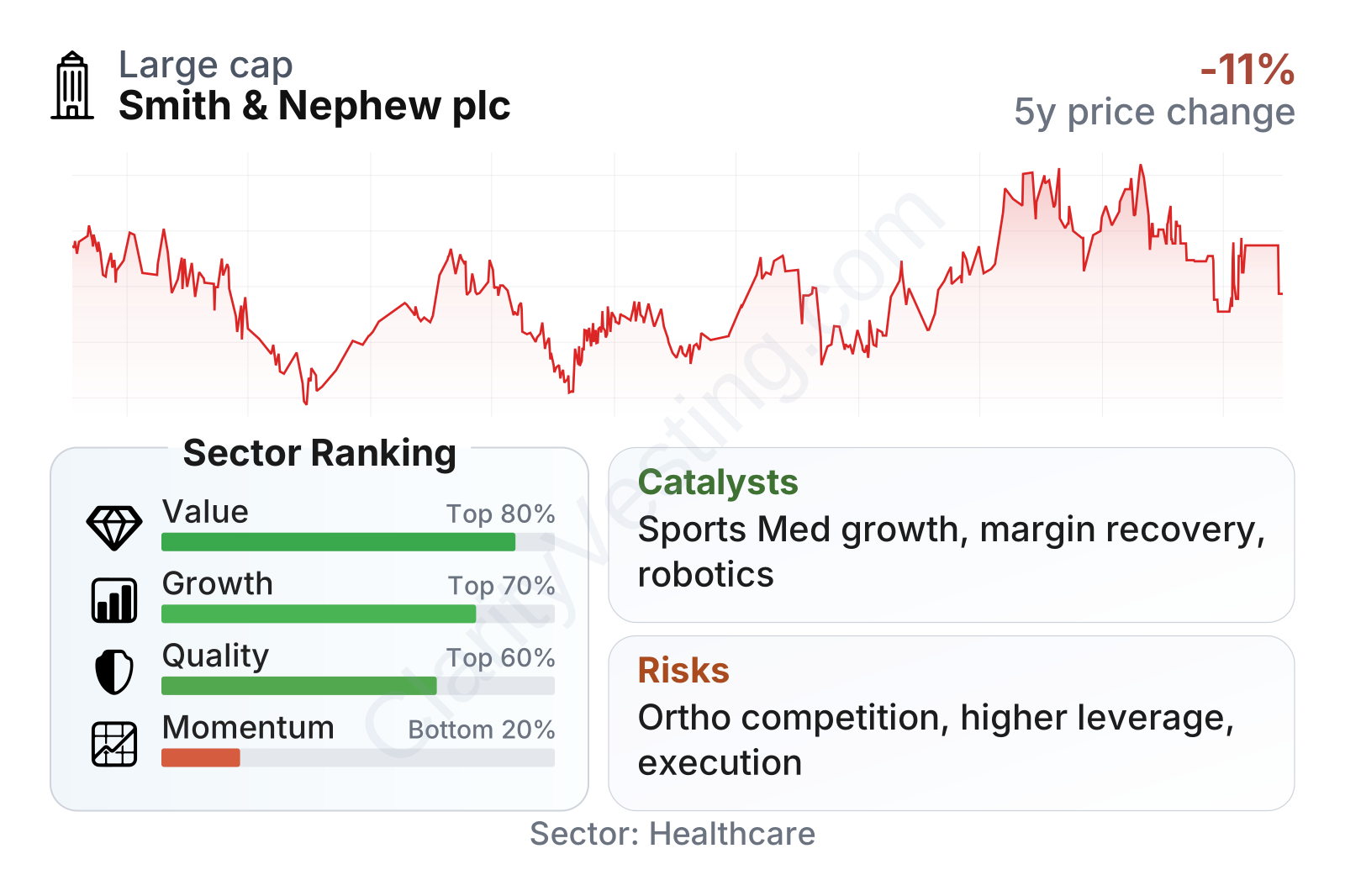
Smith & Nephew sits in the large medical device category, but it is smaller than the biggest diversified industry leaders. The recent picture is mixed in a constructive way. On valuation and cash generation, the company compares favorably with much of the healthcare equipment sector: its earnings multiple is below the sector median, free cash flow yield is much stronger, and the dividend yield is also above the sector median. Quality is respectable as well, with operating margin and profit margin clearly ahead of the typical sector company. Growth is positive, though not exceptional, while recent share-price momentum has been weak relative to peers.
The stock’s path over the last several years also reflects that mixed setup. It has recovered from lower levels seen in 2022, but recent trading has been softer after a stronger run into 2025. That usually points to a market that recognizes improving fundamentals but still wants clearer proof that growth and margin gains can persist.
Growth
Smith & Nephew operates in a sector with solid long-term demand drivers. Aging populations support joint replacement volumes, obesity and sports injuries support repair procedures, and hospitals continue to need products that shorten recovery times and improve operating room efficiency. Wound care also has structural support from diabetes, vascular disease, and the high cost of treating hard-to-heal wounds. These are not short-lived trends, which gives the company exposure to recurring medical need rather than discretionary consumer demand.
The company’s strategy for growth is coherent. It has been emphasizing higher-growth segments such as sports medicine, ENT, and advanced wound care, while also trying to lift returns in orthopedics through product innovation, commercial execution, and better productivity. Robotics is an important piece of that plan in joint reconstruction because hospitals increasingly compare implant systems not just on the implant itself, but on workflow, data, and surgical precision. Smith & Nephew is not the scale leader in robotics, but the category can still help protect pricing and deepen surgeon relationships.
Recent growth metrics point to steady but not explosive expansion. Year-over-year revenue growth has been in the mid-single digits, and the five-year revenue-per-share trend is positive, though below the healthcare sector median. The more encouraging point is that margin trends have improved materially over five years, indicating the business is not just getting larger but also more productive.
Cash generation is one of the strongest parts of the current profile. Free cash flow has compounded at a strong rate over five years and the latest trailing twelve-month figure is sizable for a company of this scale. That gives Smith & Nephew room to support dividends, invest in product development, manage debt, and pursue selective bolt-on acquisitions. In medical devices, strong cash conversion is especially valuable because product cycles, regulatory requirements, and surgeon training all require sustained investment.
A recent opportunity to watch is the company’s continued effort to translate operational improvement into more consistent earnings growth. If procedure recovery remains healthy and newer products gain adoption, especially in sports medicine, robotics-enabled orthopedics, and advanced wound care, the company could continue to close the gap between its moderate sales growth and stronger cash generation.
Risks
This article is for informational purposes only and does not constitute financial advice. Some content is AI-generated. See Disclaimer


