Stock Analysis · Smith & Nephew SNATS Inc (SNN)
Overview
Smith & Nephew is a global medical device company focused on products used by surgeons, sports medicine specialists, and wound care professionals. Its business is built around helping repair or replace damaged joints, treating soft tissue injuries, and supporting the healing of complex wounds. The company sells into hospitals, ambulatory surgery centers, and other clinical settings across the United States, Europe, and emerging markets.
The company’s revenue is mainly spread across three operating franchises.
- Orthopedics: about 41% of revenue. This includes knee and hip implants, trauma products used to treat fractures, and other reconstruction technologies.
- Sports Medicine & ENT: about 31% of revenue. This covers arthroscopic repair tools, biologics, shoulder and knee repair products, and ear, nose, and throat devices.
- Advanced Wound Management: about 28% of revenue. This includes negative pressure wound therapy, dressings, and products used for chronic, surgical, and hard-to-heal wounds.
This mix matters because it gives Smith & Nephew exposure to both procedure-driven categories such as joint replacement and recurring-use categories such as wound care. Over the last several years, sales have moved higher overall, while profitability has improved from the weaker levels seen in 2022 and 2023. The broad business model also reduces dependence on any single product line, although orthopedics remains the largest contributor.
The long-term pattern shows revenue rising from a little above $5.2 billion to more than $6.1 billion over the period shown, while net income recovered meaningfully after a soft patch. Gross profit has also increased, suggesting that scale and pricing have partly offset cost pressure, even though financing costs remain noticeable.
Key Figures
| Metric | Value | Sector ⓘ |
|---|---|---|
| Date | Oct 17, 2026 | |
| Context | ||
| Sector | Healthcare | |
| Industry | Medical Devices | |
| Market Cap ⓘ | $11.67B | |
| Beta ⓘ | 0.67 | |
Value (Cheapness) | ||
| P/E Ratio ⓘ | 18.97 | 24.79 |
| P/B Ratio ⓘ | 2.42 | 3.08 |
| FCF Yield ⓘ | 14.16% | 3.15% |
| Dividend Yield ⓘ | 2.85% | 1.94% |
| EBIT / EV ⓘ | 12.93% | 0.57% |
| PEG ⓘ | 1.05 | |
Growth (Business expansion) | ||
| Revenue Growth ⓘ | 4.60% | 7.45% |
| RPS Growth (5Y CAGR) ⓘ | 4.43% | 8.61% |
| EPS Growth (5Y CAGR) ⓘ | N/A | -17.81% |
| BVPS Growth (5Y CAGR) ⓘ | -1.14% | 3.72% |
| Margin Growth (5Y Trend) ⓘ | 0.57% | -0.62% |
| FCF Growth (5Y CAGR) ⓘ | 16.10% | 1.04% |
| DPS Growth (5Y CAGR) ⓘ | 0.21% | 6.77% |
Quality (Business durability) | ||
| ROIC (Latest) ⓘ | N/A | 3.24% |
| ROA (Latest) ⓘ | 10.54% | 3.01% |
| ROIC (5Y Median) ⓘ | 8.38% | 4.60% |
| ROA (5Y Median) ⓘ | 4.05% | 1.89% |
| Net Debt / EBIT (Latest) ⓘ | 1.61 | 1.34 |
| Net Debt / EBIT (5Y Median) ⓘ | 3.16 | 1.84 |
| Net Debt / EBITDA (Latest) ⓘ | 0.97 | 1.00 |
| Net Debt / Assets ⓘ | 27.52% | 5.45% |
| EBITDA / Interest ⓘ | 10.34 | 9.64 |
| Operating Margin (Latest) ⓘ | 15.38% | 9.27% |
| Operating Margin (5Y Median) ⓘ | 13.66% | 7.38% |
| Debt to Equity (Latest) ⓘ | 73.07% | 28.58% |
| Profit Margin (Latest) ⓘ | 10.08% | 3.59% |
| Free Cash Flow (Latest) ⓘ | $1.65B | |
Momentum (Price trend) | ||
| 3Y Return ⓘ | +35.73% | +42.80% |
| 12M Return (excl. last month) ⓘ | -23.30% | +18.50% |
| 6M Return ⓘ | -13.98% | +7.57% |
| Price vs. 200-Day MA ⓘ | -5.40% | +5.12% |
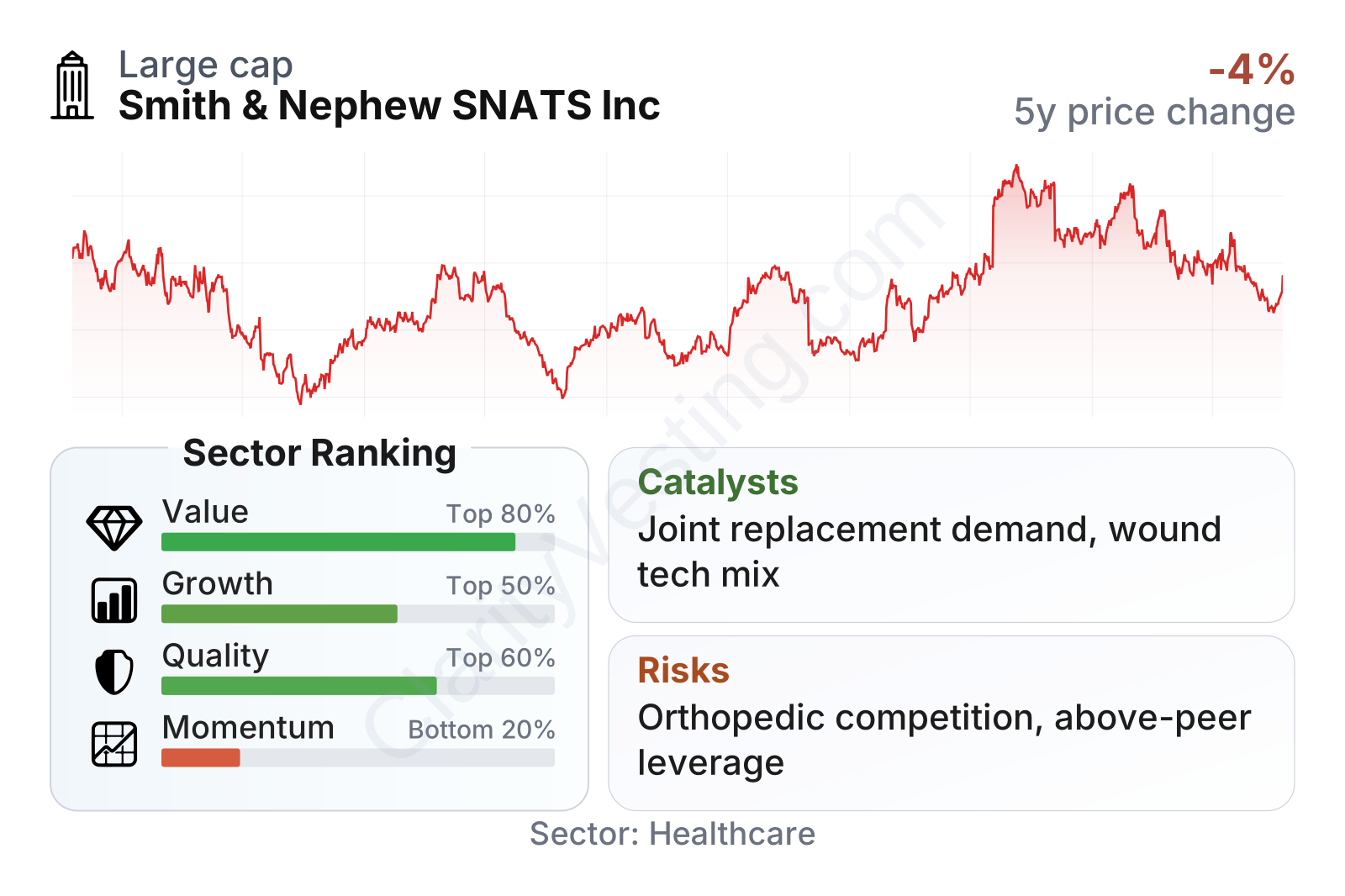
Smith & Nephew stands out more for operating quality and cash generation than for headline growth or recent share-price momentum. Profitability measures are comfortably above many peers, free cash flow generation is strong, and the dividend yield is also above the sector median. At the same time, revenue growth has been positive but not especially fast for healthcare equipment, and recent market performance has lagged much of the sector.
The stock has been volatile over the past several years, with a sharp drop in 2022 followed by a recovery that has not been perfectly steady. That pattern fits a business that is improving operationally, but where the market is still weighing execution, growth pace, and leverage.
Growth
Smith & Nephew operates in a sector with durable long-term demand drivers. Aging populations, rising rates of osteoarthritis, increasing sports injury treatment, and the need for chronic wound care all support continued procedural demand. These are not short-lived trends. Joint reconstruction and advanced wound management in particular are tied to healthcare needs that tend to persist across economic cycles, even if procedure timing can shift.
The company’s strategy also has a logical growth path. Management has been emphasizing better execution in orthopedics, expansion in sports medicine, and continued development of higher-value wound care technologies. The portfolio is aimed at categories where hospitals and surgeons often prefer proven products, clinical familiarity, and reliable service. That does not guarantee fast expansion, but it does create room for steady gains if product launches and commercial execution improve.
Revenue growth has been positive, moving from near-flat levels in 2022 to mid-single-digit and at times higher growth afterward. More recently, the pace has remained constructive rather than explosive, which points to a company progressing in the right direction but still not matching the fastest-growing names in medical devices.
Cash generation has been uneven at points, but the broader picture is encouraging. Free cash flow on a trailing basis is now substantial, and the five-year growth rate in free cash flow is notably strong. For a long-term business, that matters because cash supports debt servicing, product investment, and shareholder distributions without relying too heavily on external financing.
One important catalyst is procedure normalization and mix improvement in orthopedics. Knee and hip replacement demand is supported by demographics, and better manufacturing and commercial execution can lift margins even if revenue growth stays moderate. Another catalyst is the company’s presence in sports medicine and wound care, where newer technologies and less invasive care settings can create incremental growth opportunities. Public company updates in 2026 have continued to highlight operational execution and portfolio development rather than any one dramatic transformation, which suggests the opportunity is more cumulative than binary.
Risks
This article is for informational purposes only and does not constitute financial advice. Some content is AI-generated. See Disclaimer


