Stock Analysis · Senior plc (SNIRF)
Overview
Senior plc is a British industrial group that designs and manufactures engineered components and systems used mainly in aircraft, defense platforms, land vehicles, and industrial applications. For U.S. readers looking at the over-the-counter symbol SNIRF, the company is essentially a specialist supplier rather than a consumer-facing brand. Its products include fluid conveyance systems, structural parts, precision-machined components, and other engineered solutions that are built into larger platforms made by major aerospace and industrial equipment companies.
The business is organized around two main divisions. Aerospace is the larger operation and supplies commercial aerospace, defense aerospace, and space-related programs. Flexonics is the second division and makes engineered products for heavy-duty vehicles, off-highway equipment, power generation, and other industrial markets. This mix gives Senior exposure to long product cycles and recurring aftermarket demand, but also ties results to the health of global aircraft production and industrial spending.
Based on the company’s recent reporting structure, revenue is primarily split as follows:
- Aerospace: about 60% to 65% of group revenue. This includes aerostructures, high-precision components, ducting, thermal management, and fluid systems used on commercial aircraft, military aircraft, and adjacent space applications.
- Flexonics: about 35% to 40% of group revenue. This includes exhaust gas and air management systems, flexible connectors, diesel and gasoline engine components, and industrial sealing or thermal products for trucks, off-highway vehicles, energy, and industrial equipment.
Geographically, Senior operates internationally, with manufacturing and engineering sites across Europe, North America, and Asia. That global footprint matters because its customers are large original equipment manufacturers and tier-one suppliers that need dependable delivery and certification standards in regulated markets such as aerospace and defense.
The broad financial picture over the last several years shows a recovery in sales and operating profit after the pandemic-disrupted period, although margins remain moderate for a specialized industrial supplier. Revenue rose strongly from 2021 through 2024, while operating income improved more steadily than net income, suggesting that financing costs and other non-operating items still weigh on bottom-line results.
The profit flow shows a business that has rebuilt revenue and operating earnings since 2021, but with a large share of sales still absorbed by production costs and overhead. Operating performance has improved, yet interest expense remains meaningful, which helps explain why net profitability has not advanced as smoothly as operating income.
Key Figures
| Metric | Value | Sector ⓘ |
|---|---|---|
| Date | Oct 17, 2026 | |
| Context | ||
| Sector | Industrials | |
| Industry | Aerospace & Defense | |
| Market Cap ⓘ | $1.40B | |
| Beta ⓘ | 1.04 | |
Value (Cheapness) | ||
| P/E Ratio ⓘ | N/A | 22.10 |
| P/B Ratio ⓘ | 4.06 | 1.97 |
| FCF Yield ⓘ | 3.61% | 6.38% |
| Dividend Yield ⓘ | 0.59% | 1.94% |
| EBIT / EV ⓘ | N/A | 4.79% |
| PEG ⓘ | N/A | |
Growth (Business expansion) | ||
| Revenue Growth ⓘ | 5.30% | 9.30% |
| RPS Growth (5Y CAGR) ⓘ | 3.45% | 7.81% |
| EPS Growth (5Y CAGR) ⓘ | -43.05% | -13.06% |
| BVPS Growth (5Y CAGR) ⓘ | -2.22% | 6.14% |
| Margin Growth (5Y Trend) ⓘ | 1.70% | 0.88% |
| FCF Growth (5Y CAGR) ⓘ | 53.73% | 11.01% |
| DPS Growth (5Y CAGR) ⓘ | 72.09% | 9.48% |
Quality (Business durability) | ||
| ROIC (Latest) ⓘ | N/A | 10.84% |
| ROA (Latest) ⓘ | 3.53% | 5.41% |
| ROIC (5Y Median) ⓘ | 6.18% | 9.38% |
| ROA (5Y Median) ⓘ | 2.95% | 4.95% |
| Net Debt / EBIT (Latest) ⓘ | 1.27 | 2.08 |
| Net Debt / EBIT (5Y Median) ⓘ | 4.70 | 2.27 |
| Net Debt / EBITDA (Latest) ⓘ | 0.76 | 1.39 |
| Net Debt / Assets ⓘ | 18.38% | 19.28% |
| EBITDA / Interest ⓘ | 4.66 | 9.58 |
| Operating Margin (Latest) ⓘ | 6.80% | 10.50% |
| Operating Margin (5Y Median) ⓘ | 4.86% | 10.29% |
| Debt to Equity (Latest) ⓘ | 51.63% | 65.48% |
| Profit Margin (Latest) ⓘ | -5.05% | 6.67% |
| Free Cash Flow (Latest) ⓘ | $50.57M | |
Momentum (Price trend) | ||
| 3Y Return ⓘ | +94.73% | +61.68% |
| 12M Return (excl. last month) ⓘ | +40.55% | +12.58% |
| 6M Return ⓘ | -19.05% | 0.00% |
| Price vs. 200-Day MA ⓘ | -6.49% | +0.02% |
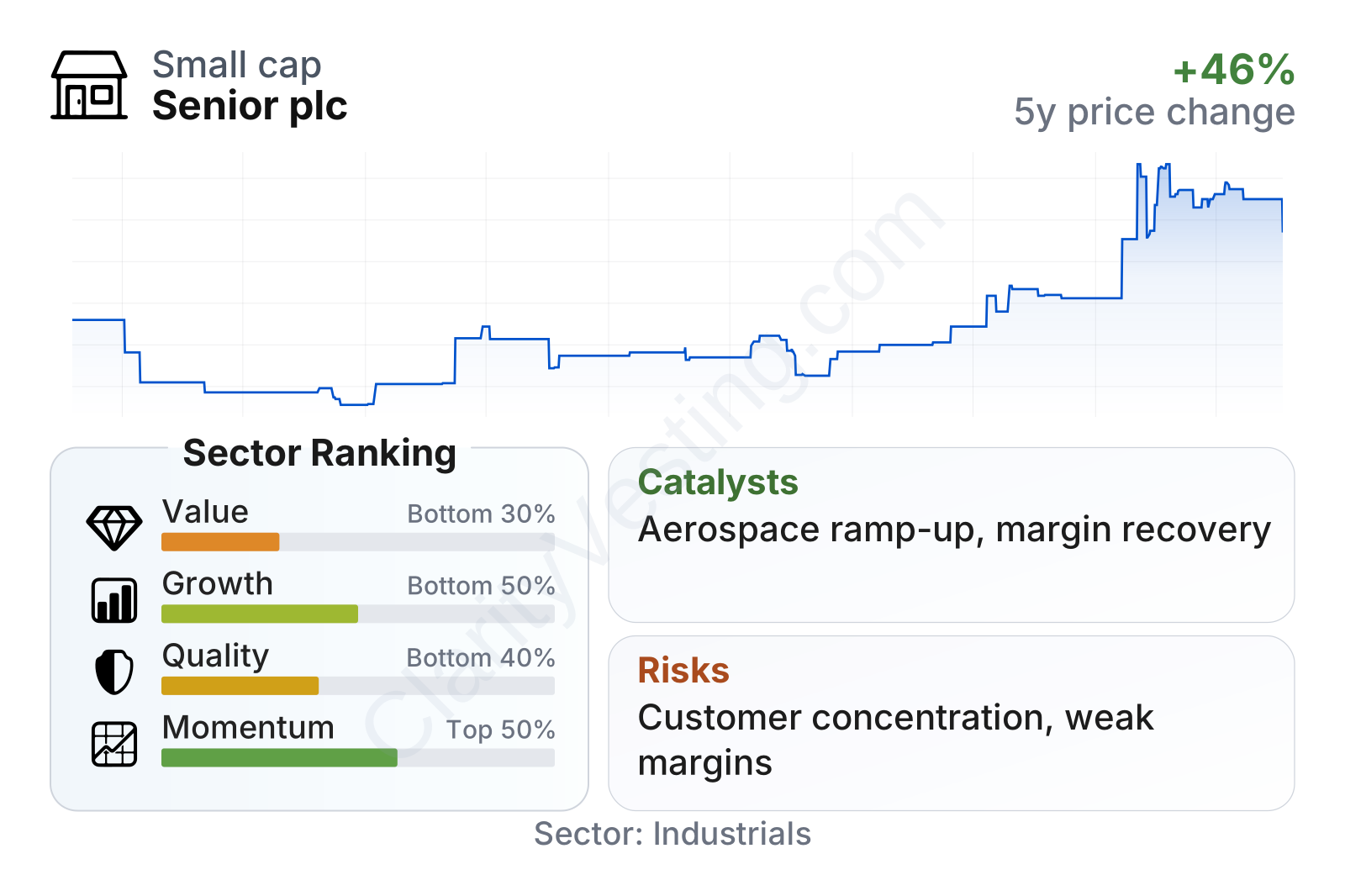
Senior sits in the mid-cap range and shows a mixed profile. Share-price momentum has been stronger than much of the industrial sector over the past year and over three years, reflecting improving sentiment around aerospace recovery. On the other hand, value metrics are less favorable relative to the sector, with a low free-cash-flow yield and a price-to-book ratio above the sector median. Growth is also uneven: recent revenue growth is positive, operating margins have improved over five years, and free cash flow has expanded sharply from a low base, but earnings per share and book value per share have been weaker over the same period. Balance-sheet leverage looks manageable on current EBITDA, though interest coverage is not especially strong for the sector.
Growth
Senior operates in a part of the market with credible long-term demand drivers. Commercial aerospace remains supported by large aircraft backlogs, rising air traffic over time, and the need for airlines to renew fleets. Defense demand has also stayed firm across many Western markets, while space and adjacent high-specification components offer selective growth opportunities. On the industrial side, the outlook is less uniform, but heavy-duty and off-highway demand can still provide useful diversification.
The company’s strategy is broadly logical for this setting. Senior focuses on specialized components rather than trying to build complete platforms. That can be attractive because certified parts, long customer relationships, and engineering know-how tend to create durable program positions. Once a supplier is designed into an aircraft or defense platform, replacement is not simple. This does not remove cyclicality, but it can make revenue streams more resilient over a program life.
A key catalyst is continued normalization in commercial aerospace production. If major aircraft manufacturers keep increasing build rates, suppliers like Senior can benefit from both higher original equipment volumes and stronger aftermarket activity as fleets stay active longer. The Aerospace division is the clearest path to expansion because it serves markets with long backlogs and demanding qualification standards.
Another growth support is operational improvement. The company has lifted operating margin over the last five years, and cash generation has strengthened sharply. That matters because even modest sales growth can create a more noticeable effect on earnings if manufacturing efficiency, pricing discipline, and mix continue to improve.
Recent company updates have also pointed to steady demand in core aerospace programs and a generally constructive order environment. For a business of Senior’s size, incremental wins on major platforms or better-than-expected production schedules can have an outsized impact on sentiment, especially because the market still appears to view the group as a recovery and execution case rather than a fully matured compounder.
Risks
This article is for informational purposes only and does not constitute financial advice. Some content is AI-generated. See Disclaimer


