Stock Analysis · Singapore Telecommunications Limited (SNGNF)
Overview
Singapore Telecommunications Limited, better known as Singtel, is one of the largest telecom groups in Asia. The company provides mobile, broadband, pay-TV, enterprise connectivity, cloud and cybersecurity services, and it also owns major stakes in regional mobile operators. For many readers, the easiest way to think about Singtel is as a telecom utility with an added regional investment portfolio: it earns money from serving customers directly in Singapore and Australia, and it also participates in the growth of mobile and data usage across Asia through associated companies.
Its business mix is broader than that of a traditional domestic phone company. Consumer services include mobile plans, fiber broadband, television, and digital services. Business services cover network solutions, data centers, managed services, cloud, and cybersecurity. A meaningful part of value also comes from Optus in Australia and from equity interests in regional operators such as Bharti Airtel, AIS, and Telkomsel through Singtel’s portfolio structure.
Based on the latest annual disclosures, Singtel’s revenue is mainly generated from the following sources, ordered from largest to smallest at a high level:
- Optus in Australia: approximately 55% to 60% of group operating revenue. This includes mobile services, handset sales, fixed connectivity, enterprise telecom, and digital infrastructure activity in Australia.
- Singtel Singapore: approximately 20% to 25% of group operating revenue. This covers mobile, broadband, TV, and enterprise services in Singapore.
- NCS and enterprise digital services: approximately 10% to 15% of group operating revenue. This area includes IT services, systems integration, applications, cloud, data, and government or corporate digital transformation projects.
- Other smaller activities and intercompany adjustments: the remaining 5% to 10%.
Reported profit is more diversified than revenue because associates contribute a large share of earnings. In other words, the businesses customers see directly are not the whole picture: stakes in major Asian telecom operators can have an outsized effect on bottom-line results and asset value.
The multiyear operating flow shows a company with fairly stable revenue around the low-$11 billion range, while profit has been more volatile because telecom operations, asset recycling, and associate contributions do not move in a straight line every year. That matters for long-term analysis: Singtel is not purely a steady local telecom operator, but a combination of recurring cash generation and periodic value realization from its regional holdings.
Key Figures
| Metric | Value | Sector ⓘ |
|---|---|---|
| Date | Nov 21, 2026 | |
| Context | ||
| Sector | Communication Services | |
| Industry | Telecom Services | |
| Market Cap ⓘ | $53.07B | |
| Beta ⓘ | 0.27 | |
Value (Cheapness) | ||
| P/E Ratio ⓘ | 18.11 | 17.77 |
| FCF Yield ⓘ | 7.72% | 7.57% |
| Dividend Yield ⓘ | 5.92% | 2.85% |
| EBIT / EV ⓘ | 10.23% | 6.92% |
| PEG ⓘ | 5.70 | |
Growth (Business expansion) | ||
| Revenue Growth ⓘ | 6.10% | 6.30% |
| RPS Growth (5Y CAGR) ⓘ | -1.82% | 4.62% |
| EPS Growth (5Y CAGR) ⓘ | -23.85% | -14.44% |
| Margin Growth (5Y Trend) ⓘ | 0.60% | 1.03% |
| FCF Growth (5Y CAGR) ⓘ | -4.65% | 5.91% |
| DPS Growth (5Y CAGR) ⓘ | 27.78% | 5.03% |
Quality (Business durability) | ||
| ROIC (Latest) ⓘ | N/A | 8.39% |
| ROIC (5Y Median) ⓘ | 2.31% | 8.33% |
| Net Debt / EBIT (Latest) ⓘ | 1.08 | 1.88 |
| Net Debt / EBIT (5Y Median) ⓘ | 7.07 | 2.83 |
| Net Debt / EBITDA (Latest) ⓘ | 0.80 | 1.22 |
| Net Debt / Assets ⓘ | 19.25% | 20.70% |
| EBITDA / Interest ⓘ | 12.80 | 8.41 |
| Operating Margin (Latest) ⓘ | 30.45% | 15.44% |
| Operating Margin (5Y Median) ⓘ | 9.92% | 13.32% |
| Debt to Equity (Latest) ⓘ | 48.90% | 60.11% |
| Profit Margin (Latest) ⓘ | 25.58% | 8.06% |
| Free Cash Flow (Latest) ⓘ | $4.10B | |
Momentum (Price trend) | ||
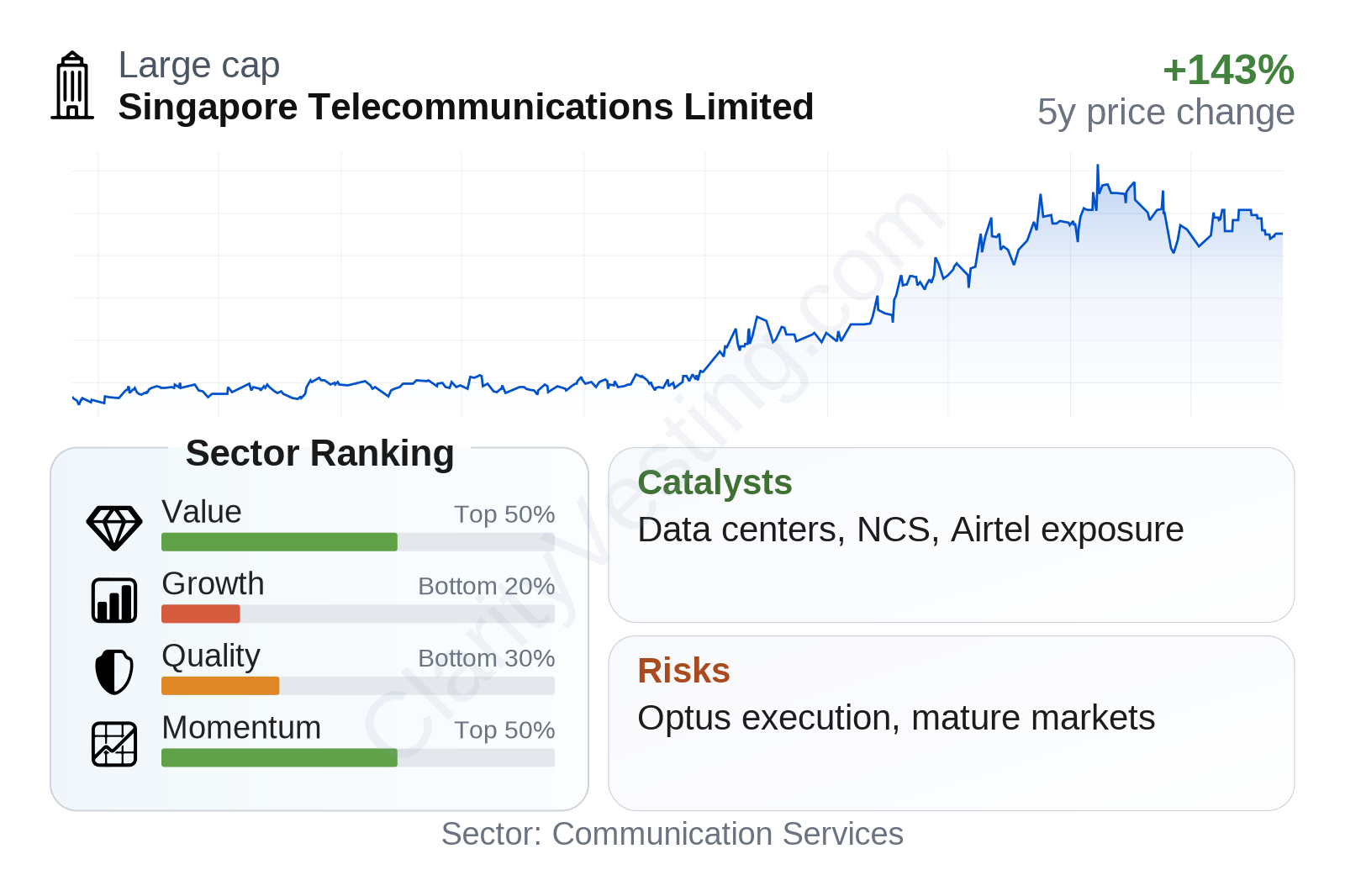
| 3Y Return ⓘ | +123.13% | +35.91% |
| 12M Return (excl. last month) ⓘ | +7.32% | +2.79% |
| 6M Return ⓘ | -7.88% | 0.00% |
| Price vs. 200-Day MA ⓘ | +3.38% | +0.03% |
Singtel looks like a very large telecom group with unusually low share-price volatility, as shown by its beta well below 1. On valuation, it sits close to the sector median on earnings, while free cash flow yield is also around sector norms. Income generation stands out more clearly: the trailing dividend yield is around 6%, well above the sector median.
Profitability and balance-sheet strength are mixed in an interesting way. Current operating and net margins are strong versus the sector, while leverage appears conservative, with debt-to-equity below 20%, net debt to EBITDA far below the industry median, and interest coverage comfortably above peers. That said, quality is not uniformly strong because longer-term returns on invested capital have been modest, suggesting the business has not always converted its large asset base into high returns.
Growth metrics are the weakest part of the profile. Recent year-over-year revenue growth is roughly in line with the sector, but five-year trends in revenue per share, earnings per share, and free cash flow are softer than many peers. By contrast, the stock’s market performance has been strong over three years, even after a pullback over the last six months, which suggests sentiment has improved faster than the underlying long-term growth record.
Growth
Singtel operates in a sector that is mature in its traditional form but still growing in the areas that matter most for the next decade: mobile data usage, enterprise digital infrastructure, cloud connectivity, cybersecurity, AI-related network demand, and data center capacity. Telecom subscriptions alone are not the attraction here. The more relevant question is whether Singtel can use its networks, enterprise relationships, and regional assets to capture a bigger share of digital spending.
Its strategy broadly makes sense for that environment. In Singapore and Australia, telecom networks remain essential infrastructure, and demand for connectivity continues to rise even in mature markets. On top of that base, management has been pushing into higher-value services through enterprise technology, cybersecurity, and digital infrastructure. NCS is particularly important because it gives Singtel exposure to IT services and public-sector transformation work rather than only traditional phone and broadband revenue.
Another growth lever is capital recycling. Singtel has spent the last few years highlighting the value of infrastructure assets such as data centers, submarine cables, and network-related platforms. This can support growth in two ways: first, by freeing up capital from mature assets, and second, by redeploying it into areas with better long-term demand. For a telecom group, that is important because organic growth from subscriptions alone is usually limited.
There is also a regional angle that long-term readers should not ignore. Singtel’s stakes in Asian operators provide indirect exposure to faster-growing mobile and digital economies than Singapore itself. That portfolio can amplify earnings when those associates perform well, and it can create additional optionality if asset values are crystallized over time.
Recent developments also support the idea that the company’s opportunity set is broader than simple domestic telecom. Singtel has continued to emphasize data centers, AI-ready connectivity, and enterprise digital services, while Optus remains a major player in the Australian market. These are not guaranteed growth engines, but they are more credible catalysts than relying only on price increases in mature mobile markets.
Risks
This article is for informational purposes only and does not constitute financial advice. Some content is AI-generated. See Disclaimer