Stock Analysis · Sinofert Holdings Limited (SNFRF)
Overview
Sinofert Holdings Limited is a Chinese agricultural inputs company focused on helping farms improve crop yields. Its business covers the distribution and production of fertilizers, crop nutrition products, agricultural chemicals, and related farming services. In simple terms, it sits in a practical part of the food supply chain: supplying the products that growers need before crops can be harvested.
The company’s revenue mainly comes from selling fertilizer products, with additional contributions from crop protection and agronomy-related activities. Based on the company’s public reporting structure in recent annual materials, the mix is centered on fertilizers and nutrient products, while service income is much smaller. The broad revenue picture is approximately as follows:
- Fertilizer distribution and related agricultural inputs: the dominant source of revenue, likely well above 70%. This includes nitrogen, phosphate, potash, compound fertilizers, and other crop nutrient products sold through Sinofert’s distribution network.
- Production and sale of specialized fertilizer and crop nutrition products: a meaningful but smaller share, likely in the low double digits. This includes blended and value-added fertilizer offerings designed for more tailored crop needs.
- Agrochemicals, agronomic services, and other activities: a smaller portion of revenue. These activities can include crop protection products, farming advisory support, and certain logistics or supporting services.
What makes Sinofert relatively easy to understand is that demand for its products is tied to a basic need: farmers must keep using crop nutrients to maintain yields. The company is not selling discretionary consumer goods; it is tied to food production, planting intensity, and fertilizer application trends in China.
Profit flow has improved over the last several years even though revenue has not grown in a straight line. Revenue moved in a fairly stable range from 2021 through 2025, while gross profit, operating income, and net income generally trended upward, suggesting better product mix, cost control, or improved pricing discipline. That matters because fertilizer distribution is often a scale business with tight margins.
The business appears to have become more efficient. Over the 2021 to 2025 period, revenue stayed around the low-to-mid $20 billion range, but gross profit expanded and net income rose from under $0.9 billion to above $1.2 billion. That points to stronger execution rather than growth driven only by volume.
Key Figures
| Metric | Value | Sector ⓘ |
|---|---|---|
| Date | Oct 17, 2026 | |
| Context | ||
| Sector | Basic Materials | |
| Industry | Agricultural Inputs | |
| Market Cap ⓘ | $1.65B | |
| Beta ⓘ | 0.75 | |
Value (Cheapness) | ||
| P/E Ratio ⓘ | 7.00 | 16.90 |
| P/B Ratio ⓘ | 0.08 | 1.65 |
| FCF Yield ⓘ | 31.93% | 5.76% |
| Dividend Yield ⓘ | 28.51% | 2.13% |
| EBIT / EV ⓘ | N/A | 6.30% |
| PEG ⓘ | N/A | |
Growth (Business expansion) | ||
| Revenue Growth ⓘ | 10.60% | 11.10% |
| RPS Growth (5Y CAGR) ⓘ | 0.02% | 4.49% |
| EPS Growth (5Y CAGR) ⓘ | N/A | -13.47% |
| BVPS Growth (5Y CAGR) ⓘ | 5.90% | 5.51% |
| Margin Growth (5Y Trend) ⓘ | 2.62% | -1.54% |
| FCF Growth (5Y CAGR) ⓘ | 67.69% | 0.37% |
| DPS Growth (5Y CAGR) ⓘ | 28.19% | 6.08% |
Quality (Business durability) | ||
| ROIC (Latest) ⓘ | N/A | 9.26% |
| ROA (Latest) ⓘ | 14.01% | 4.91% |
| ROIC (5Y Median) ⓘ | 8.49% | 7.70% |
| ROA (5Y Median) ⓘ | 5.01% | 3.86% |
| Net Debt / EBIT (Latest) ⓘ | -0.24 | 1.40 |
| Net Debt / EBIT (5Y Median) ⓘ | -1.12 | 1.70 |
| Net Debt / EBITDA (Latest) ⓘ | -0.19 | 0.95 |
| Net Debt / Assets ⓘ | -3.81% | 13.69% |
| EBITDA / Interest ⓘ | N/A | 12.34 |
| Operating Margin (Latest) ⓘ | 7.69% | 13.20% |
| Operating Margin (5Y Median) ⓘ | 4.34% | 11.80% |
| Debt to Equity (Latest) ⓘ | 15.85% | 40.56% |
| Profit Margin (Latest) ⓘ | 5.37% | 6.43% |
| Free Cash Flow (Latest) ⓘ | $527.62M | |
Momentum (Price trend) | ||
| 3Y Return ⓘ | +24.56% | +68.89% |
| 12M Return (excl. last month) ⓘ | -14.34% | +30.21% |
| 6M Return ⓘ | -40.05% | -4.16% |
| Price vs. 200-Day MA ⓘ | -3.93% | -1.27% |
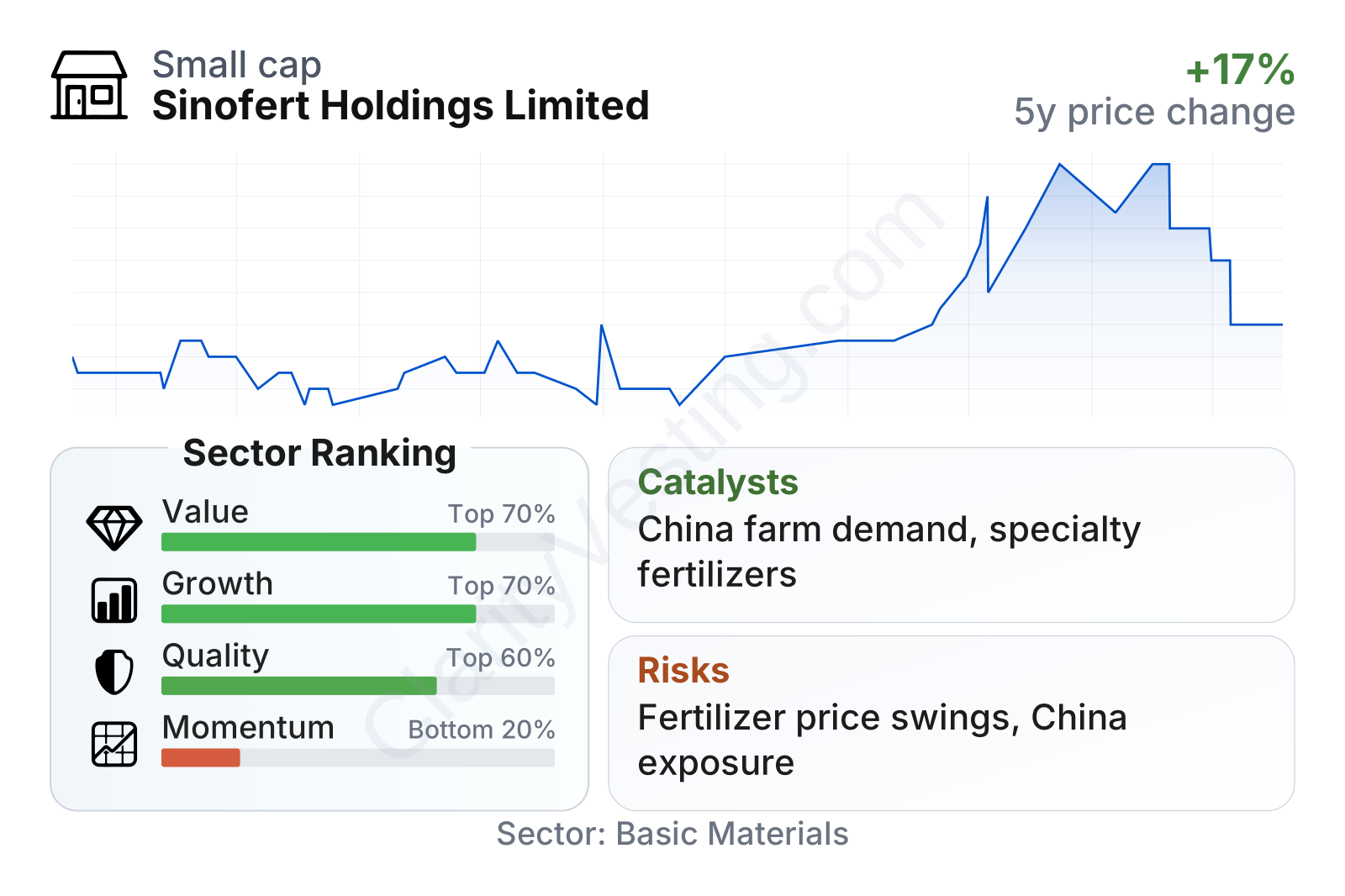
Sinofert is a mid-sized company by market value, and its recent metrics paint a mixed but interesting picture. On valuation, the shares screen as inexpensive relative to many peers: the P/E ratio is around 7 versus a sector median closer to 18, and price-to-book is far below the sector median. Free cash flow yield and trailing dividend yield also stand out as unusually high compared with typical agricultural input companies.
On balance sheet quality, the company looks conservative. Net debt measures are negative, which usually means cash exceeds debt, and debt-to-equity is around 16%, lower than many sector peers. Return on assets is also notably stronger than the sector median, suggesting decent profitability relative to the asset base.
Growth is less straightforward. Recent yearly revenue growth has been close to the sector median, but longer-term revenue per share growth has been nearly flat over five years. At the same time, free cash flow growth and dividend growth over that period have been very strong, and operating margins have improved versus the company’s own history.
Price momentum is the weak spot. The stock has lagged the broader sector over the past year and over three years, and the recent share-price trend has been soft. That does not describe business quality by itself, but it does show that the market has not recently rewarded the name despite stronger cash generation and low leverage.
Growth
Sinofert operates in a sector with durable long-term relevance. Agriculture inputs are supported by a simple structural reality: food demand continues, arable land is limited, and crop yields need to be protected and improved. In that environment, fertilizer and crop nutrition remain necessary rather than optional. The sector is cyclical because nutrient prices and farm economics move around, but the underlying demand base is persistent.
The company’s strategy also makes practical sense for future growth. A broad distribution footprint can be valuable in China’s agricultural market because farmers need timely access to products, reliable supply, and technical support. If Sinofert keeps combining product distribution with higher-value crop solutions and agronomy support, it may be able to defend margins better than a pure commodity reseller.
Another favorable point is that the recent earnings pattern suggests growth is not dependent solely on revenue expansion. From 2024 to 2025, revenue improved, but the bigger story is that profitability and cash generation remained strong. Gross profit moved higher, operating income stayed above $1.2 billion, and net income reached roughly $1.23 billion. That kind of profile can matter more for long-term business value than raw sales growth alone.
There is also a potential catalyst in capital allocation. The company’s trailing dividend yield appears exceptionally high, and free cash flow generation is robust. If this cash profile proves sustainable rather than temporary, it could support continued distributions, debt discipline, or reinvestment in higher-margin product categories.
In terms of recent developments, the clearest business opportunity is linked to steady domestic agricultural demand and the push toward more efficient fertilizer use, specialty crop nutrition, and integrated farm services. Those areas tend to reward companies with scale, procurement capability, and established grower relationships.
Risks
This article is for informational purposes only and does not constitute financial advice. Some content is AI-generated. See Disclaimer


