Stock Analysis · Syndax Pharmaceuticals Inc (SNDX)
Overview
Syndax Pharmaceuticals is a biotechnology company focused on developing and commercializing cancer medicines. Its main emphasis is blood cancers, especially acute leukemias, while it also has an immuno-oncology program aimed at solid tumors. The company moved from a pure development-stage profile into a commercial-stage profile after the U.S. launch of revumenib, marketed as Revuforj, for certain patients with relapsed or refractory acute leukemia with a KMT2A translocation.
For long-term analysis, the key point is that Syndax is no longer only funding clinical trials and waiting for a first approval. It now has an approved product, an expanding commercial effort, and a pipeline that could broaden its reach if additional studies succeed. At the same time, it remains a relatively small biotech company, so results can still shift quickly with trial updates and regulatory decisions.
The company’s revenue base is still concentrated. Based on recent filings and annual results, the main sources of revenue are approximately:
- Product revenue: about 95% to 100% — primarily sales of Revuforj in the United States. This is the core commercial revenue stream.
- Collaboration and license revenue: about 0% to 5% — milestone, partnership, or licensing-related revenue when applicable. This has been limited and uneven.
- Other revenue: minimal — no meaningful diversification outside its oncology portfolio.
This concentration matters because Syndax’s near-term business performance depends heavily on one launched medicine while the rest of the pipeline is still being developed. The income profile also shows a familiar biotech pattern: revenue has started to rise, but research, development, and launch-related spending remain much larger than current sales.
The financial flow highlights a sharp change since 2024: revenue has begun to build meaningfully after years with little or no recurring sales, but operating expenses have expanded even faster. Research and development remains the biggest use of cash, followed by selling and administrative costs linked to the commercial rollout.
Key Figures
| Metric | Value | Sector ⓘ |
|---|---|---|
| Date | Oct 03, 2026 | |
| Context | ||
| Sector | Healthcare | |
| Industry | Biotechnology | |
| Market Cap ⓘ | $1.68B | |
| Beta ⓘ | 0.37 | |
Value (Cheapness) | ||
| P/E Ratio ⓘ | N/A | 24.06 |
| P/B Ratio ⓘ | 107.39 | 3.08 |
| FCF Yield ⓘ | -13.16% | 3.07% |
| Dividend Yield ⓘ | N/A | 2.05% |
| EBIT / EV ⓘ | -8.40% | 0.63% |
| PEG ⓘ | N/A | |
Growth (Business expansion) | ||
| Revenue Growth ⓘ | 91.80% | 7.50% |
| RPS Growth (5Y CAGR) ⓘ | -7.21% | 8.70% |
| EPS Growth (5Y CAGR) ⓘ | -20.64% | -18.20% |
| BVPS Growth (5Y CAGR) ⓘ | -44.46% | 3.95% |
| Margin Growth (5Y Trend) ⓘ | N/A | -0.58% |
| FCF Growth (5Y CAGR) ⓘ | N/A | 0.88% |
| DPS Growth (5Y CAGR) ⓘ | N/A | 6.80% |
Quality (Business durability) | ||
| ROIC (Latest) ⓘ | -27.90% | 3.29% |
| ROA (Latest) ⓘ | -35.17% | 3.02% |
| ROIC (5Y Median) ⓘ | -31.94% | 4.75% |
| ROA (5Y Median) ⓘ | -37.72% | 1.93% |
| Net Debt / EBIT (Latest) ⓘ | N/A | 1.33 |
| Net Debt / EBIT (5Y Median) ⓘ | N/A | 1.83 |
| Net Debt / EBITDA (Latest) ⓘ | N/A | 0.99 |
| Net Debt / Assets ⓘ | 35.94% | 5.33% |
| EBITDA / Interest ⓘ | N/A | 9.63 |
| Operating Margin (Latest) ⓘ | -53.67% | 9.25% |
| Operating Margin (5Y Median) ⓘ | -132.95% | 7.80% |
| Debt to Equity (Latest) ⓘ | 3903.45% | 28.99% |
| Profit Margin (Latest) ⓘ | -87.52% | 3.60% |
| Free Cash Flow (Latest) ⓘ | -$220.87M | |
Momentum (Price trend) | ||
| 3Y Return ⓘ | +34.96% | +37.48% |
| 12M Return (excl. last month) ⓘ | +23.09% | +20.85% |
| 6M Return ⓘ | -23.70% | +9.73% |
| Price vs. 200-Day MA ⓘ | -12.78% | +4.69% |
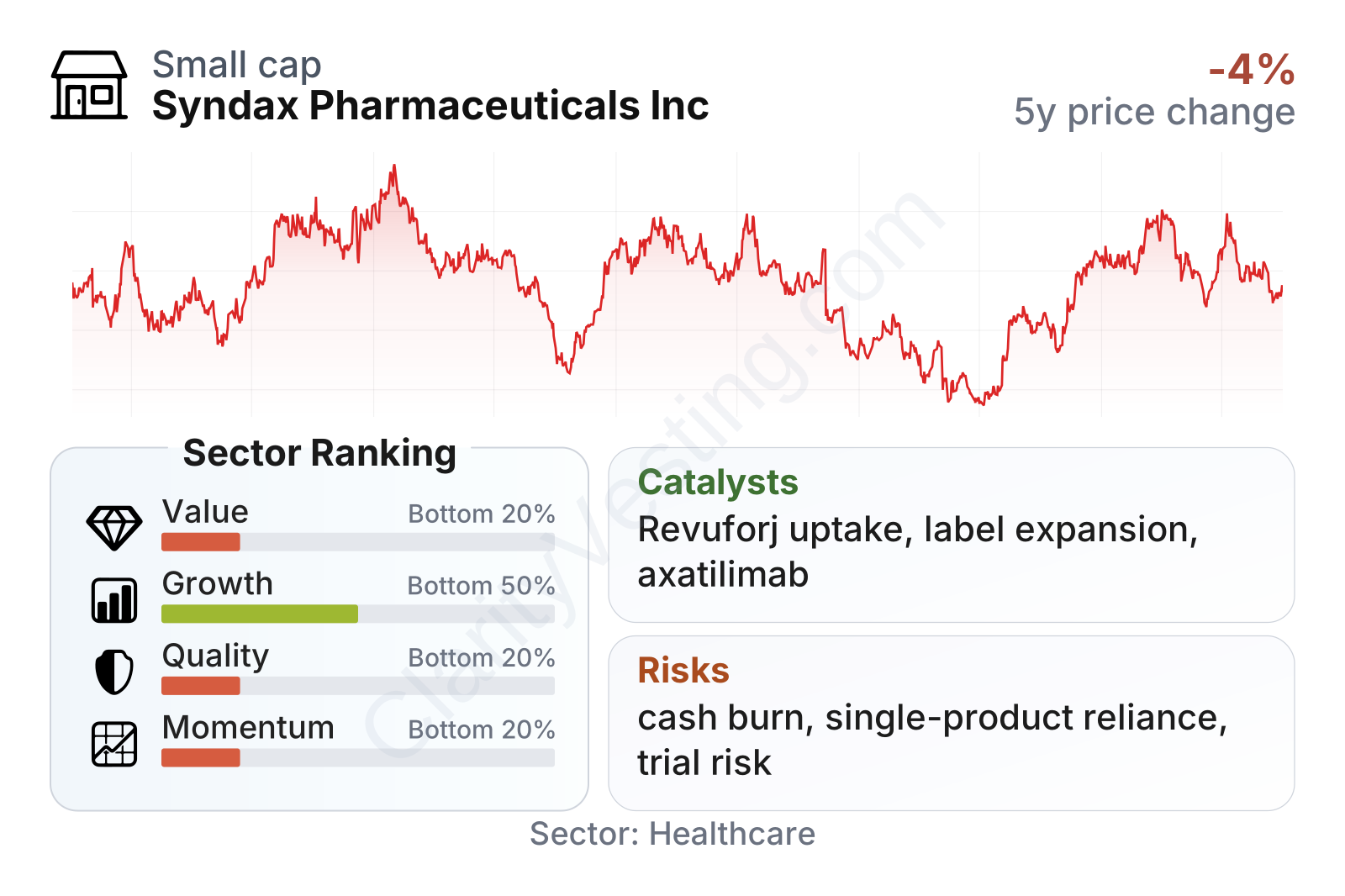
Syndax is a small-cap biotech with unusually weak current rankings on value, quality, and momentum versus the broader healthcare sector, which is not unusual for a company in the early phase of commercialization. Growth looks mixed: recent year-over-year revenue expansion has been strong, but longer-term profitability and cash generation remain deeply negative. The table also shows how far the company still is from mature operating performance, with returns on capital and margins well below sector norms.
The share price history shows large swings rather than a steady upward trend. That is common in biotech because expectations can change quickly around approvals, launch progress, and clinical trial milestones.
Growth
Syndax operates in an attractive long-term sector. Oncology remains one of the largest and most active areas in pharmaceuticals, and blood cancers are a field where targeted medicines can gain meaningful pricing power and medical relevance if they address hard-to-treat patient groups. Within that landscape, menin inhibition has become an important niche because it targets genetically defined leukemia subtypes with high unmet need.
The company’s strategy is logical. It is trying to build value in two layers: first, by increasing use of Revuforj in its approved setting; second, by expanding into additional lines of therapy and broader patient groups through clinical studies. On top of that, Syndax has axatilimab, partnered in chronic graft-versus-host disease, which adds another possible source of future economics and reduces the company’s dependence on a single mechanism.
Revenue growth has been strong because Syndax is coming off a low base and is now commercializing an approved product. That kind of growth can look dramatic early on, so the more important question is whether adoption remains durable as the launch matures and whether label expansion can keep the trajectory moving.
Cash flow tells a more cautious story. Free cash flow has remained deeply negative, reflecting heavy clinical spending, commercial buildout costs, and the fact that current sales are not yet large enough to support the full cost structure. For a biotech at this stage, investors typically watch whether revenue ramps faster than cash burn over the next several quarters.
A major catalyst is further development of revumenib beyond the first approved niche. Additional trial readouts, potential use in earlier treatment settings, and possible broader regulatory opportunities could materially increase the addressable market if the evidence stays positive. Another catalyst is the continued maturation of axatilimab-related economics, since success there could give Syndax more than one meaningful commercial pillar.
Recent company updates have reinforced that the business opportunity is tied less to current profits and more to execution on launch growth and pipeline expansion. In other words, the upside case depends on turning a promising first product into a broader leukemia franchise while advancing the second asset into a more meaningful financial contributor.
Risks
This article is for informational purposes only and does not constitute financial advice. Some content is AI-generated. See Disclaimer