Stock Analysis · Schneider National Inc (SNDR)
Overview
Schneider National is a large North American freight transportation and logistics company. In simple terms, it helps move goods for businesses using trucks, trailers, intermodal containers, and brokerage services. The company operates across truckload shipping, dedicated transportation for specific customers, less-than-truckload services, and logistics solutions that connect shippers with available trucking capacity.
Its business model is broader than a traditional trucking carrier. Schneider owns a large fleet and transportation equipment, but it also earns revenue by arranging shipments through third-party carriers and by offering supply chain services. That mix gives it exposure to both physical trucking operations and the more asset-light logistics side of freight.
Based on the company’s recent annual reporting structure, revenue mainly comes from the following areas:
- Truckload: approximately 36% of revenue. This includes standard full-truckload services and dedicated operations where Schneider provides committed capacity to customers.
- Intermodal: approximately 31% of revenue. This business combines rail and truck transport, often used for longer-haul freight where cost efficiency matters.
- Logistics: approximately 27% of revenue. This includes brokerage and supply chain services, where Schneider matches freight demand with carrier capacity and manages transportation solutions.
- Other: approximately 6% of revenue. This includes smaller activities such as equipment-related and ancillary transportation services.
The notable point is that Schneider is not dependent on just one freight lane or one customer type. Its mix across truckload, intermodal, and logistics gives it more flexibility than carriers focused on a single niche. At the same time, all of these activities remain tied to the health of freight markets and the broader economy.
Over the last several years, revenue has stayed in the multi-billion-dollar range, but profitability has tightened sharply. Costs consume a very large share of sales, and the gap between revenue and net income is much narrower than it was during the stronger freight environment of 2021 and 2022. That pattern matters because in transportation, even small changes in pricing, utilization, or costs can have an outsized effect on earnings.
The business has maintained substantial scale, but the more important change has been margin compression: revenue recovered in 2025 after a weaker 2023–2024 period, while earnings remained far below prior-cycle highs.
Key Figures
| Metric | Value | Sector ⓘ |
|---|---|---|
| Date | Oct 03, 2026 | |
| Context | ||
| Sector | Industrials | |
| Industry | Trucking | |
| Market Cap ⓘ | $5.61B | |
| Beta ⓘ | 1.18 | |
Value (Cheapness) | ||
| P/E Ratio ⓘ | 49.20 | 22.45 |
| P/B Ratio ⓘ | 1.83 | 1.98 |
| FCF Yield ⓘ | 3.91% | 6.31% |
| Dividend Yield ⓘ | 1.23% | 1.96% |
| EBIT / EV ⓘ | 3.13% | 4.81% |
| PEG ⓘ | 4.35 | |
Growth (Business expansion) | ||
| Revenue Growth ⓘ | 10.40% | 9.10% |
| RPS Growth (5Y CAGR) ⓘ | 0.60% | 7.75% |
| EPS Growth (5Y CAGR) ⓘ | -38.70% | -13.59% |
| BVPS Growth (5Y CAGR) ⓘ | 6.02% | 6.22% |
| Margin Growth (5Y Trend) ⓘ | -6.86% | 0.72% |
| FCF Growth (5Y CAGR) ⓘ | 63.63% | 10.98% |
| DPS Growth (5Y CAGR) ⓘ | 8.14% | 9.48% |
Quality (Business durability) | ||
| ROIC (Latest) ⓘ | 3.88% | 10.92% |
| ROA (Latest) ⓘ | 2.24% | 5.41% |
| ROIC (5Y Median) ⓘ | 14.37% | 9.21% |
| ROA (5Y Median) ⓘ | 5.37% | 4.94% |
| Net Debt / EBIT (Latest) ⓘ | 0.58 | 2.07 |
| Net Debt / EBIT (5Y Median) ⓘ | 0.62 | 2.28 |
| Net Debt / EBITDA (Latest) ⓘ | 0.17 | 1.43 |
| Net Debt / Assets ⓘ | 2.07% | 19.27% |
| EBITDA / Interest ⓘ | 19.91 | 9.53 |
| Operating Margin (Latest) ⓘ | 3.07% | 10.50% |
| Operating Margin (5Y Median) ⓘ | 5.82% | 10.27% |
| Debt to Equity (Latest) ⓘ | 12.95% | 65.48% |
| Profit Margin (Latest) ⓘ | 1.92% | 6.62% |
| Free Cash Flow (Latest) ⓘ | $219.40M | |
Momentum (Price trend) | ||
| 3Y Return ⓘ | +20.18% | +58.56% |
| 12M Return (excl. last month) ⓘ | +41.60% | +15.63% |
| 6M Return ⓘ | +21.50% | +4.19% |
| Price vs. 200-Day MA ⓘ | +1.56% | +0.93% |
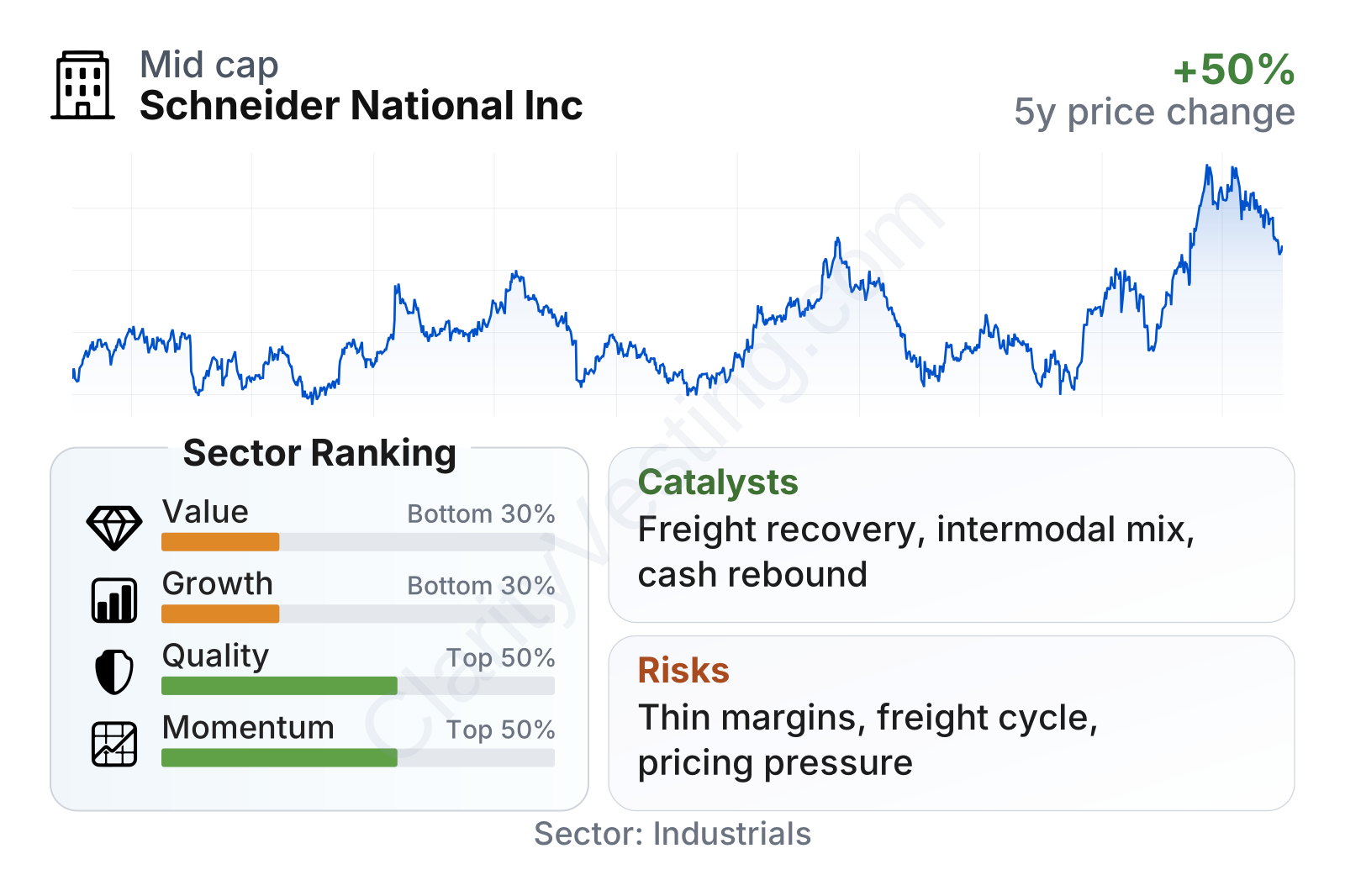
Schneider sits in the mid-cap range, with share-price behavior somewhat more volatile than the broader market. The overall financial picture is mixed. Balance-sheet strength is clearly better than many industrial peers, and momentum has improved recently, but value and growth measures rank weakly relative to the sector. Profitability is also below sector norms at the moment, which helps explain why the stock’s earnings multiple looks elevated.
The stock chart shows a business whose market value has not moved in a straight line. Shares were mostly range-bound for a long period, then rose sharply more recently. That rebound appears to reflect improving freight sentiment and recovering revenue trends rather than a full return to the profit levels seen earlier in the cycle.
Growth
Freight transportation is a mature industry, but it remains essential to the economy and still offers pockets of growth. E-commerce, supply chain redesign, nearshoring, and the need for more flexible shipping networks all support long-term demand for transportation and logistics services. Intermodal also benefits from customers looking for a lower-cost and often more fuel-efficient option than long-haul trucking alone.
Schneider’s strategy makes sense in that context. The company is not relying only on adding more trucks. It has built a more diversified platform with dedicated services, intermodal, and logistics. That matters because dedicated freight can be more stable than spot-market trucking, intermodal can benefit when customers focus on efficiency, and logistics can scale without requiring the same level of capital investment as owned equipment.
Revenue growth has been cyclical rather than consistently upward. After strong growth in 2021 and much of 2022, the company went through a prolonged contraction during 2023 and 2024, which matches the freight downturn seen across the industry. More recently, year-over-year sales growth turned positive again and is running a bit above the sector median, suggesting demand conditions have improved.
Cash generation has also improved after a volatile period. Free cash flow moved from a negative patch back into positive territory and has recently reached a healthier level. For a trucking and logistics company, that is important because fleet investment, trailer purchases, and technology spending can absorb a lot of cash. A rebound in free cash flow gives Schneider more room to refresh equipment, support dividends, and stay flexible on capital allocation.
A meaningful catalyst is any broader normalization in freight pricing and network utilization. Schneider does not need explosive industry growth to improve results; even moderate tightening in capacity, better contract rates, and stronger equipment use can lift margins from depressed levels. The company’s logistics and intermodal operations also create an opening if customers continue shifting toward integrated, cost-conscious supply chain solutions.
Recent company reporting has also pointed to ongoing efforts around operational efficiency, network discipline, and portfolio mix. Those are not dramatic one-time events, but in a cyclical industry they can matter a great deal. If freight demand firms while Schneider keeps a conservative balance sheet and disciplined cost structure, earnings recovery could be stronger than revenue growth alone would suggest.
Risks
This article is for informational purposes only and does not constitute financial advice. Some content is AI-generated. See Disclaimer


