Stock Analysis · Sonida Senior Living Inc (SNDA)
Overview
Sonida Senior Living Inc operates senior housing communities in the United States. The company focuses on housing and care services for older adults, mainly through independent living, assisted living, and memory care communities. In simple terms, it runs residences where seniors can live with varying levels of support, from relatively independent lifestyles to more intensive daily care.
Its revenue is generated primarily from resident fees rather than from drug development, insurance, or hospital procedures. Based on the company’s recent filings, the business is largely driven by monthly rental and service charges paid by residents and, to a smaller extent, management and other community-related fees.
- Resident revenue: approximately 95% to 98% of total revenue. This includes monthly rent, care charges, dining, and other services provided to residents in independent living, assisted living, and memory care.
- Management fees and other operating revenue: approximately 2% to 5% of total revenue. This typically includes fees from managing communities for third parties and miscellaneous community-related income.
The business model is fairly straightforward: keep communities occupied, raise average rates when possible, control labor and operating costs, and spread corporate overhead across a larger portfolio. Recent years have also included portfolio reshaping, with acquisitions and operational improvements playing a visible role in revenue growth.
One notable financial pattern is that revenue has climbed meaningfully since 2022, while profitability has been far less stable. Operating income improved into 2024, but bottom-line results remained pressured by interest expense and, more recently, weaker cost absorption. That makes Sonida a business whose topline progress is easier to see than its earnings quality.
The long-term trend shows a larger company by revenue than it was a few years ago, but with uneven conversion of that revenue into profits. That matters because senior housing can look attractive at the community level while still producing weak shareholder returns if financing costs and corporate expenses remain too high.
Key Figures
| Metric | Value | Sector ⓘ |
|---|---|---|
| Date | Oct 17, 2026 | |
| Context | ||
| Sector | Healthcare | |
| Industry | Medical Care Facilities | |
| Market Cap ⓘ | $1.72B | |
| Beta ⓘ | 0.74 | |
Value (Cheapness) | ||
| P/E Ratio ⓘ | N/A | 24.79 |
| P/B Ratio ⓘ | 1.96 | 3.08 |
| FCF Yield ⓘ | -3.07% | 3.15% |
| Dividend Yield ⓘ | N/A | 1.94% |
| EBIT / EV ⓘ | -2.02% | 0.57% |
| PEG ⓘ | 2.04 | |
Growth (Business expansion) | ||
| Revenue Growth ⓘ | 137.10% | 7.45% |
| RPS Growth (5Y CAGR) ⓘ | -29.36% | 8.61% |
| EPS Growth (5Y CAGR) ⓘ | -26.61% | -17.81% |
| BVPS Growth (5Y CAGR) ⓘ | N/A | 3.72% |
| Margin Growth (5Y Trend) ⓘ | -78.42% | -0.62% |
| FCF Growth (5Y CAGR) ⓘ | -30.72% | 1.04% |
| DPS Growth (5Y CAGR) ⓘ | 4.74% | 6.77% |
Quality (Business durability) | ||
| ROIC (Latest) ⓘ | -3.31% | 3.24% |
| ROA (Latest) ⓘ | -7.19% | 3.01% |
| ROIC (5Y Median) ⓘ | 2.20% | 4.60% |
| ROA (5Y Median) ⓘ | -3.29% | 1.89% |
| Net Debt / EBIT (Latest) ⓘ | N/A | 1.34 |
| Net Debt / EBIT (5Y Median) ⓘ | 18.69 | 1.84 |
| Net Debt / EBITDA (Latest) ⓘ | 60.35 | 1.00 |
| Net Debt / Assets ⓘ | 59.82% | 5.45% |
| EBITDA / Interest ⓘ | 0.45 | 9.64 |
| Operating Margin (Latest) ⓘ | -12.80% | 9.27% |
| Operating Margin (5Y Median) ⓘ | 5.98% | 7.38% |
| Debt to Equity (Latest) ⓘ | 182.61% | 28.58% |
| Profit Margin (Latest) ⓘ | -25.44% | 3.59% |
| Free Cash Flow (Latest) ⓘ | -$52.71M | |
Momentum (Price trend) | ||
| 3Y Return ⓘ | +312.30% | +42.80% |
| 12M Return (excl. last month) ⓘ | +47.77% | +18.50% |
| 6M Return ⓘ | +2.46% | +7.57% |
| Price vs. 200-Day MA ⓘ | -1.23% | +5.12% |
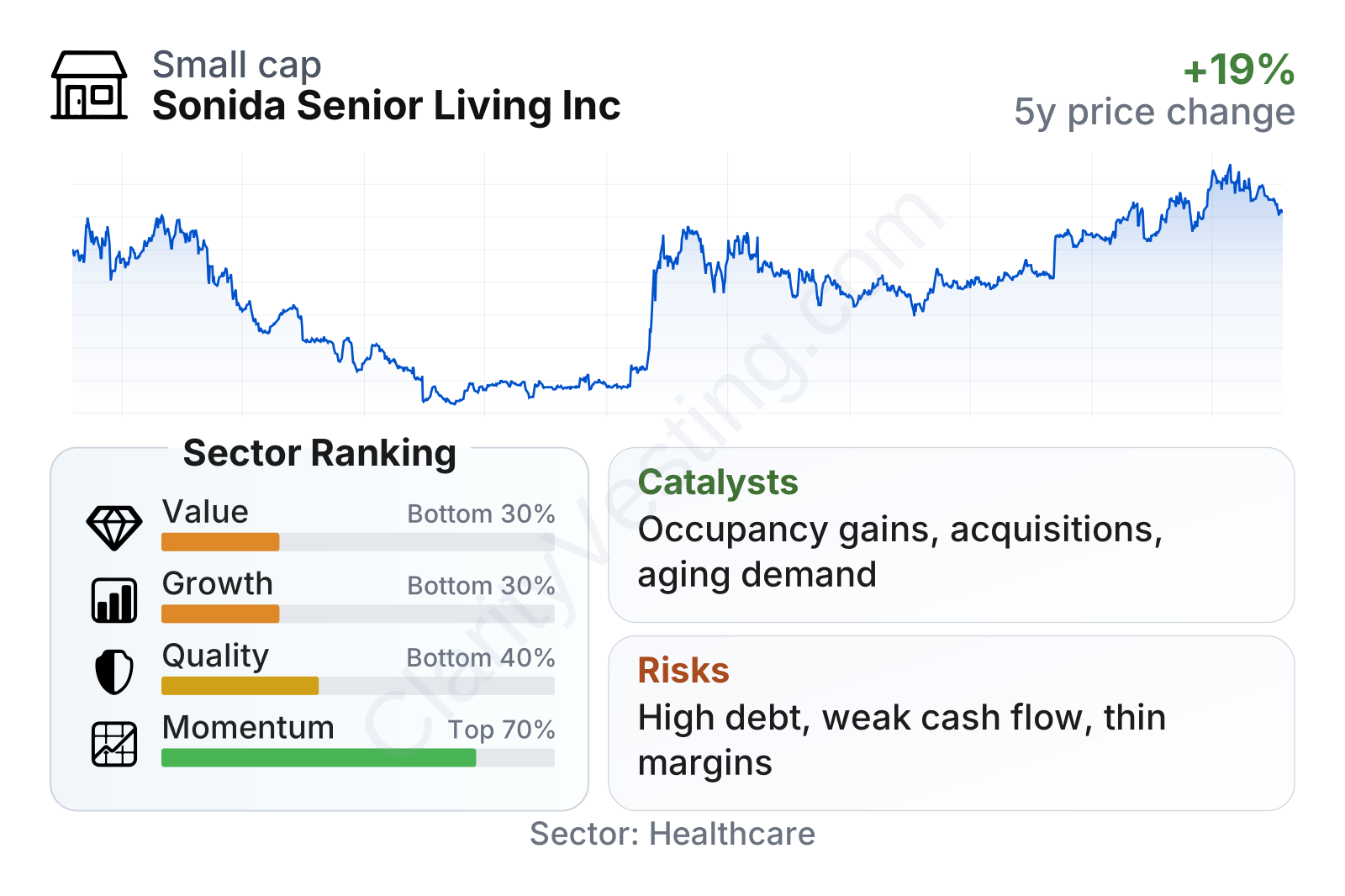
Sonida is now a mid-sized public company in market value terms, and its share price has been very volatile over the last several years. The stock recovered sharply from 2023 lows and has continued to move higher into 2026, suggesting that the market has been rewarding the company’s occupancy gains and portfolio expansion. Even so, the underlying fundamentals remain mixed.
The overall profile is unusual. Momentum has been stronger than much of the healthcare sector, but value, growth quality, and operating quality rank much lower. Revenue growth has recently been very strong, yet free cash flow is still negative and leverage remains elevated. In other words, market performance has improved faster than the financial foundation.
Growth
Senior housing is part of a sector with an important long-term tailwind: the aging U.S. population. As more people move into the 75-and-older age brackets over time, demand for assisted living and memory care should expand. That does not automatically guarantee success for every operator, but it creates a favorable background for companies that can fill buildings efficiently and maintain pricing discipline.
Sonida’s strategy broadly fits that opportunity. The company has been working on three clear levers: improving occupancy in existing communities, increasing rates where local demand allows, and expanding its portfolio through acquisitions and third-party management arrangements. In a business where many costs are fixed at the property level, better occupancy can meaningfully improve margins if execution is consistent.
The revenue trend has been especially strong recently. Year-over-year growth moved from ordinary levels in earlier periods to a much faster pace by late 2024 and into 2025 and 2026. Part of that appears linked to portfolio growth rather than only same-community improvement, but the acceleration still shows that Sonida has been expanding faster than the typical company in its healthcare peer group.
The weaker point is cash generation. Free cash flow has remained negative and recently worsened again, which suggests that growth has required meaningful spending, working capital support, or both. For a community operator, revenue growth is valuable, but it becomes much more compelling when it starts turning into stable cash after interest and capital needs.
Recent company communications have highlighted acquisitions, operating initiatives, and continued focus on occupancy and resident rate growth. Those are credible catalysts because they directly affect the two most important drivers in this industry: filled units and revenue per occupied room. If Sonida can keep integrating newly added communities while preserving service quality, it has room to scale into a stronger operating platform.
Risks
This article is for informational purposes only and does not constitute financial advice. Some content is AI-generated. See Disclaimer


