Stock Analysis · Sims Limited (SMUPF)
Overview
Sims Limited is a global metal recycling and circular-economy company headquartered in Australia. Its core business is collecting, processing, and selling recycled ferrous and non-ferrous metals, with operations across North America, Australia, New Zealand, and the United Kingdom. In practical terms, the company buys scrap from sources such as old cars, demolition sites, manufacturers, and municipal collection channels, then sorts, shreds, and prepares that material for steel mills, foundries, smelters, and industrial customers. It also has activities tied to electronics recovery and the reuse of secondary materials.
The business is largely driven by the sale of recycled metals, while smaller activities add diversification. Based on recent annual reporting, the revenue mix is approximately structured as follows:
- North America Metals: about 60% to 65% of group revenue. This is the company’s largest division and includes buying, processing, and exporting ferrous scrap and non-ferrous metals in the United States and Canada.
- Australia / New Zealand Metals: about 20% to 25% of revenue. This segment covers similar recycling and resale operations in those markets.
- United Kingdom Metals: about 8% to 12% of revenue. This business serves domestic and export customers and remains smaller than the North American platform.
- SIMS Lifecycle Services: about 3% to 6% of revenue. This unit focuses on electronics reuse, asset disposition, and data-center equipment processing.
- Other and secondary activities: generally below 5% of revenue. These include joint ventures, by-products, and emerging circular-material initiatives.
What matters most for understanding Sims is that it is not a traditional steel producer. It does not primarily make steel from iron ore; instead, it supplies recycled feedstock to the steel and metals system. That puts the company at the intersection of commodity markets, industrial activity, and environmental regulation.
The financial flow over the last several years shows a business with very large revenue but relatively thin operating margins, which is common in scrap processing. Revenue dropped sharply from the 2022 peak, then recovered into 2026. Profitability was much more volatile than sales, with losses at the net income line in 2024 and 2025 before a return to positive earnings in 2026. That pattern highlights how sensitive results are to scrap spreads, export conditions, and operating efficiency.
Key Figures
| Metric | Value | Sector ⓘ |
|---|---|---|
| Date | Oct 03, 2026 | |
| Context | ||
| Sector | Basic Materials | |
| Industry | Steel | |
| Market Cap ⓘ | $3.63B | |
| Beta ⓘ | 1.22 | |
Value (Cheapness) | ||
| P/E Ratio ⓘ | 21.14 | 17.61 |
| P/B Ratio ⓘ | 1.37 | 1.77 |
| FCF Yield ⓘ | 8.91% | 5.87% |
| Dividend Yield ⓘ | 1.83% | 2.06% |
| EBIT / EV ⓘ | N/A | 6.43% |
| PEG ⓘ | 0.29 | |
Growth (Business expansion) | ||
| Revenue Growth ⓘ | 3.50% | 11.30% |
| RPS Growth (5Y CAGR) ⓘ | -2.93% | 4.46% |
| EPS Growth (5Y CAGR) ⓘ | -1.35% | -13.11% |
| BVPS Growth (5Y CAGR) ⓘ | 1.87% | 5.51% |
| Margin Growth (5Y Trend) ⓘ | 0.84% | -1.57% |
| FCF Growth (5Y CAGR) ⓘ | -5.27% | 0.55% |
| DPS Growth (5Y CAGR) ⓘ | -21.33% | 6.02% |
Quality (Business durability) | ||
| ROIC (Latest) ⓘ | N/A | 9.31% |
| ROA (Latest) ⓘ | 4.91% | 4.94% |
| ROIC (5Y Median) ⓘ | 6.44% | 7.91% |
| ROA (5Y Median) ⓘ | 3.96% | 3.93% |
| Net Debt / EBIT (Latest) ⓘ | 2.45 | 1.40 |
| Net Debt / EBIT (5Y Median) ⓘ | 2.16 | 1.70 |
| Net Debt / EBITDA (Latest) ⓘ | 0.88 | 0.91 |
| Net Debt / Assets ⓘ | 13.69% | 13.69% |
| EBITDA / Interest ⓘ | 7.44 | 11.93 |
| Operating Margin (Latest) ⓘ | 1.70% | 13.07% |
| Operating Margin (5Y Median) ⓘ | 2.91% | 11.86% |
| Debt to Equity (Latest) ⓘ | 31.13% | 40.43% |
| Profit Margin (Latest) ⓘ | 3.05% | 6.57% |
| Free Cash Flow (Latest) ⓘ | $322.98M | |
Momentum (Price trend) | ||
| 3Y Return ⓘ | +96.43% | +65.06% |
| 12M Return (excl. last month) ⓘ | +123.89% | +36.05% |
| 6M Return ⓘ | +37.81% | +1.89% |
| Price vs. 200-Day MA ⓘ | +123.88% | +1.03% |
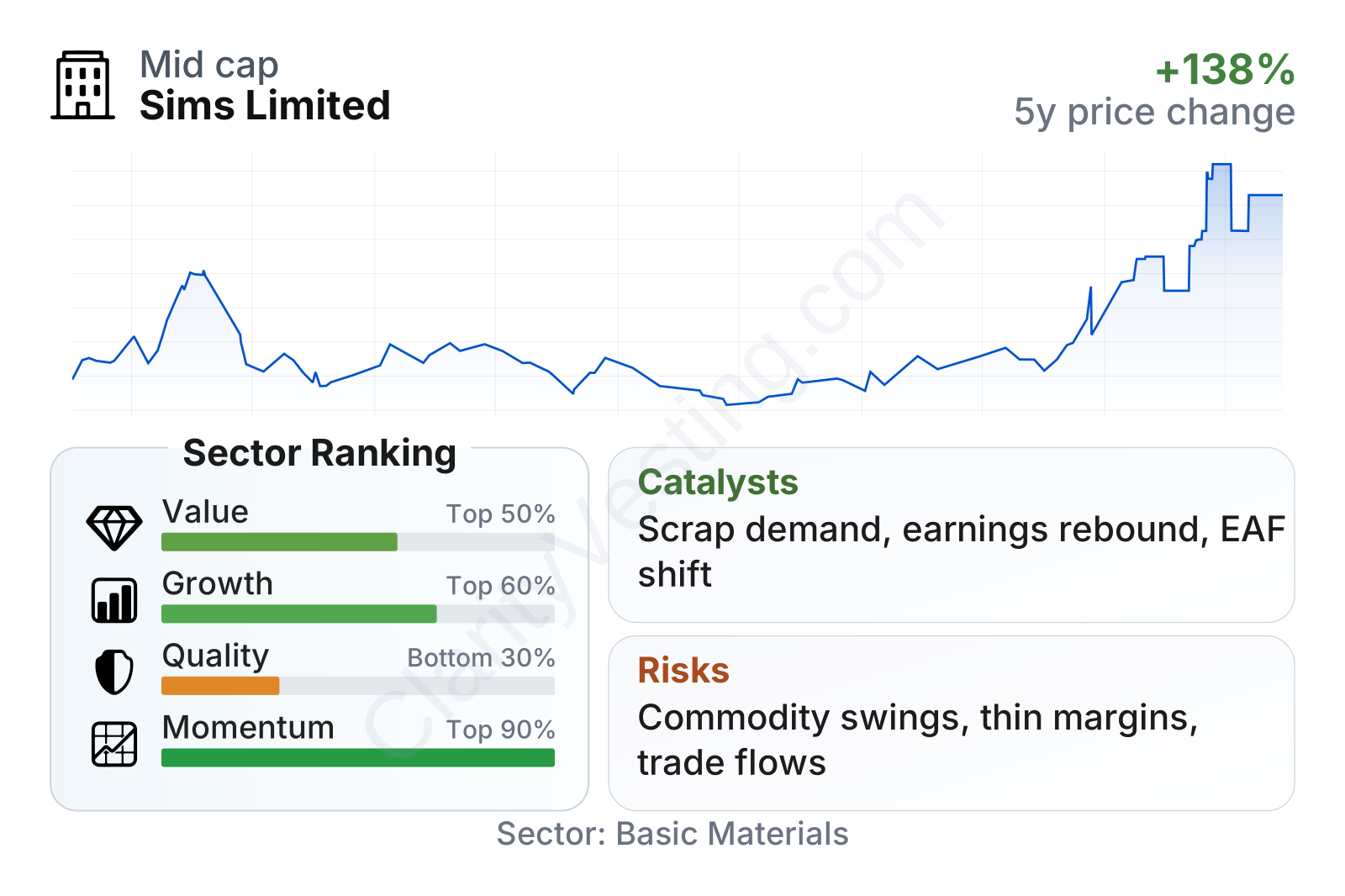
Sims sits in the mid-cap range and shows a mixed fundamental profile. Valuation metrics are not stretched on book value and cash flow, with free-cash-flow yield ahead of the sector median and price-to-book below the sector median, while the earnings multiple is somewhat above the median. Growth measures are also mixed: recent revenue growth has been positive but modest, and several five-year growth indicators remain weak because the business moved through a strong cycle, then a downturn, then a recovery.
Quality is the weakest area in the current profile. Operating margin and profit margin are clearly below the sector median, and interest coverage is lower than many peers, although leverage is not excessive on a balance-sheet basis. Debt to equity is actually below the sector median, and net debt to EBITDA remains manageable. Market momentum is the strongest factor by far, with the share price markedly outperforming the broader sector over the last 6 months, 12 months, and 3 years. That suggests the market has been reacting to improving conditions and a better earnings outlook after a difficult stretch.
Growth
Sims operates in a sector with meaningful long-term structural support. Steelmaking is under pressure to lower carbon intensity, and recycled scrap is an important part of that shift because electric arc furnaces generally use much more scrap than blast-furnace routes. Over time, tighter environmental standards, urbanization-related demolition, vehicle replacement, and broader resource-efficiency goals can all support scrap demand. This does not create a smooth growth path every year, but it does give the company exposure to a durable industrial trend.
The company’s strategy also makes sense in that context. Sims has been emphasizing processing efficiency, higher-value non-ferrous recovery, downstream services, and technology that improves sorting and metal recovery. Those initiatives matter because scrap recycling is often less about simple volume growth and more about improving spreads, yield, and cost control. Its electronics-related services business is smaller, but it adds another circular-economy angle that is less directly tied to steel-market pricing.
A notable catalyst is the recovery in earnings after the weak 2024 and 2025 period. Revenue moved back toward the $8 billion range in fiscal 2026, and operating income rebounded to around $300 million. That suggests conditions improved materially after a trough period. If ferrous export markets remain healthy and operating execution continues to normalize, the earnings base may look more stable than it did during the downturn.
Another positive factor is scale. Sims has an established yard network, logistics footprint, export capability, and long customer relationships across several regions. In recycling, scale helps with sourcing, transportation, and the ability to place material in multiple end markets. That does not eliminate cyclicality, but it can help Sims capture more value during stronger market conditions.
Risks
This article is for informational purposes only and does not constitute financial advice. Some content is AI-generated. See Disclaimer