Stock Analysis · Nuscale Power Corp (SMR)
Overview
NuScale Power is a U.S. nuclear technology company focused on small modular reactors, often called SMRs. Instead of building one very large nuclear reactor, the company’s approach is to design smaller factory-built reactor modules that can be combined into a power plant. The idea is to offer carbon-free electricity with a smaller physical footprint, potentially lower construction risk, and more flexible deployment for utilities, industrial sites, data centers, and government users.
The company is still in a pre-commercial stage. That means it is not yet generating recurring revenue from operating nuclear plants at scale. Its business today is mainly built around engineering work, licensing and development activities, customer support, and work tied to strategic partners rather than large electricity sales.
Based on recent company disclosures, revenue is concentrated in a small number of commercial and government-related activities rather than a broad installed base. Precise percentages can shift sharply from quarter to quarter, but the main sources can be summarized as follows:
- Engineering and licensing services: work related to reactor design, technical support, safety analysis, and regulatory activities for NuScale’s SMR technology. This appears to be the largest source of current revenue.
- Contract and development revenue from strategic partners: payments tied to technology development, supply chain preparation, commercialization support, and project-related milestones.
- Other service and collaboration revenue: smaller contributions from advisory, research, and commercialization-related agreements.
One important point for long-term readers is that NuScale’s current revenue base is still relatively small compared with its operating costs. The business model is therefore more about future commercialization potential than current earnings power. Financially, the company has shown periods of rising revenue from project activity, but expenses have remained far above sales as it continues to fund development, commercialization, and corporate infrastructure.
Over the last several years, revenue has stayed modest while research, development, and administrative spending has been much larger. That pattern is typical of a company trying to move a complex energy technology from licensing into commercial deployment, but it also explains why losses and cash burn remain central to the investment case.
The financial picture shows a business with very limited sales relative to expenses. Revenue improved at times, but spending on development and corporate overhead has consistently outweighed gross profit, keeping operating results deeply negative.
Key Figures
| Metric | Value | Sector ⓘ |
|---|---|---|
| Date | Oct 17, 2026 | |
| Context | ||
| Sector | Industrials | |
| Industry | Specialty Industrial Machinery | |
| Market Cap ⓘ | $2.66B | |
| Beta ⓘ | 2.37 | |
Value (Cheapness) | ||
| P/E Ratio ⓘ | N/A | 22.10 |
| P/B Ratio ⓘ | 0.45 | 1.97 |
| FCF Yield ⓘ | -29.17% | 6.38% |
| Dividend Yield ⓘ | N/A | 1.94% |
| EBIT / EV ⓘ | -27.83% | 4.79% |
| PEG ⓘ | N/A | |
Growth (Business expansion) | ||
| Revenue Growth ⓘ | -99.10% | 9.30% |
| RPS Growth (5Y CAGR) ⓘ | 30.83% | 7.81% |
| EPS Growth (5Y CAGR) ⓘ | -21.00% | -13.06% |
| BVPS Growth (5Y CAGR) ⓘ | 48.94% | 6.14% |
| Margin Growth (5Y Trend) ⓘ | N/A | 0.88% |
| FCF Growth (5Y CAGR) ⓘ | N/A | 11.01% |
| DPS Growth (5Y CAGR) ⓘ | N/A | 9.48% |
Quality (Business durability) | ||
| ROIC (Latest) ⓘ | -41.39% | 10.84% |
| ROA (Latest) ⓘ | -28.35% | 5.41% |
| ROIC (5Y Median) ⓘ | -51.26% | 9.38% |
| ROA (5Y Median) ⓘ | -35.51% | 4.95% |
| Net Debt / EBIT (Latest) ⓘ | N/A | 2.08 |
| Net Debt / EBIT (5Y Median) ⓘ | N/A | 2.27 |
| Net Debt / EBITDA (Latest) ⓘ | N/A | 1.39 |
| Net Debt / Assets ⓘ | -37.11% | 19.28% |
| EBITDA / Interest ⓘ | N/A | 9.58 |
| Operating Margin (Latest) ⓘ | -6484.62% | 10.50% |
| Operating Margin (5Y Median) ⓘ | -1199.36% | 10.29% |
| Debt to Equity (Latest) ⓘ | 0.29% | 65.48% |
| Profit Margin (Latest) ⓘ | N/A | 6.67% |
| Free Cash Flow (Latest) ⓘ | -$776.87M | |
Momentum (Price trend) | ||
| 3Y Return ⓘ | +0.87% | +61.68% |
| 12M Return (excl. last month) ⓘ | -76.58% | +12.58% |
| 6M Return ⓘ | -43.12% | 0.00% |
| Price vs. 200-Day MA ⓘ | -49.70% | +0.02% |
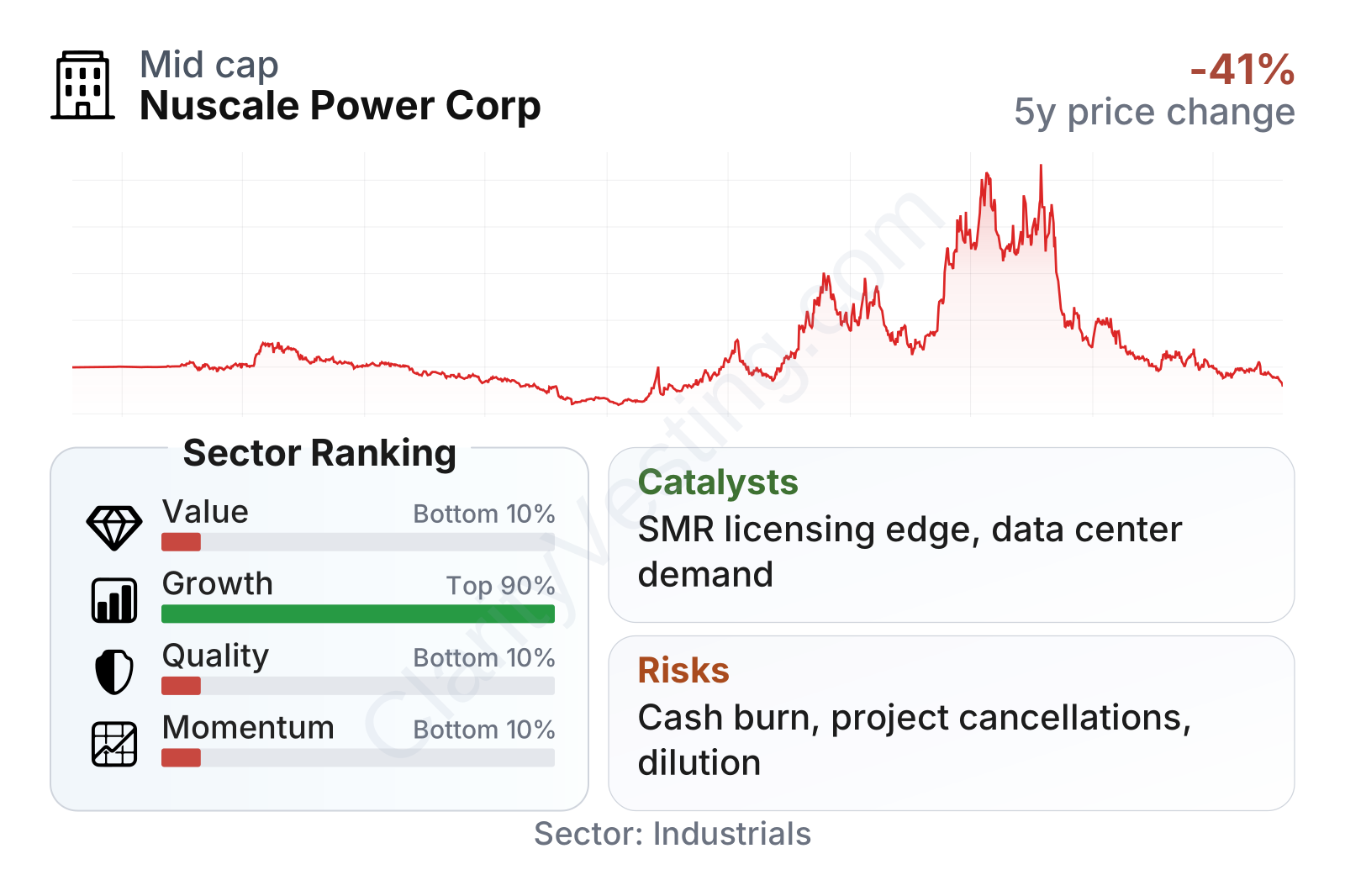
NuScale is a mid-sized public company by market value, but its operating profile looks much more like an early-stage technology developer than a mature industrial company. The table points to a mixed picture: growth-related measures rank strongly versus the broader industrial group over a multiyear period, while value, quality, and momentum rank near the bottom.
The weak quality and value readings are not surprising. The company remains unprofitable, free cash flow is heavily negative, and traditional earnings-based valuation measures are not very useful at this stage. At the same time, the balance sheet carries very little debt relative to equity, which reduces one major financial risk even though it does not solve the cash consumption problem.
The stock chart also highlights how speculative the name has been. After large swings upward in 2024 and 2025, the shares pulled back sharply into 2026. That volatility reflects how sensitive the market is to policy support, project announcements, commercialization milestones, and disappointment when near-term revenue falls short.
Growth
NuScale operates in a sector with meaningful long-term tailwinds. Interest in nuclear power has increased because utilities and governments want reliable electricity without direct carbon emissions, and because power demand is rising from electrification, manufacturing reshoring, and especially data center expansion. Small modular reactors are often discussed as a possible solution for places that need steady power but cannot easily support a very large conventional nuclear plant.
NuScale’s strategy is logical in that context. It spent years working through U.S. regulatory review and became the first SMR developer to obtain U.S. Nuclear Regulatory Commission design approval for its original design. It has also continued developing an uprated version of its reactor. That matters because licensing is one of the biggest barriers in nuclear energy, and early regulatory progress can become a real competitive asset if commercial demand turns into signed projects.
A major potential catalyst is the broader policy and industrial push behind domestic nuclear supply chains. The U.S. government has continued supporting advanced nuclear technologies through loan programs, grants, and public-private partnerships. NuScale’s relationships with suppliers, engineering firms, and international counterparties could help it translate that policy support into real projects if customers move from feasibility studies to binding deployment decisions.
Recent company updates have also centered on commercial momentum outside the canceled Carbon Free Power Project. Management has highlighted opportunities tied to data centers, industrial decarbonization, and international markets. In simple terms, the company is trying to move from “technology validation” to “customer conversion.” That shift is crucial because the next phase of value creation depends less on proving the reactor can be licensed and more on proving it can be ordered, financed, and built.
Revenue growth has been highly uneven. There were periods of very strong increases when project work accelerated, but the latest readings show an extremely sharp decline, which underlines how lumpy and contract-dependent the current business still is. That makes short-term revenue a poor guide to the company’s long-term opportunity, but it also shows that commercialization is far from steady.
Cash generation remains the biggest challenge to the growth thesis. Free cash flow has stayed deeply negative and worsened materially in the latest trailing period. In practical terms, NuScale is still spending heavily today for a business that it expects to monetize later. If future project awards arrive, this spending may eventually look like groundwork for scale. If not, the gap between ambition and financial results could remain wide for longer than expected.
Risks
This article is for informational purposes only and does not constitute financial advice. Some content is AI-generated. See Disclaimer


