Stock Analysis · Simply Good Foods Co (SMPL)
Overview
Simply Good Foods Co is a packaged food company focused on products positioned around nutrition, weight management, active lifestyles, and convenient better-for-you snacking. Its portfolio is centered on two main brands: Quest, which is known for protein bars, cookies, chips, shakes, and powders, and Atkins, which is built around low-carb meal replacement products, snacks, and shakes. The company sells mainly through retail channels in North America, including grocery, mass, club, convenience, drug, and e-commerce.
The business model is relatively easy to understand: create branded nutrition products, place them widely in retail, support them with marketing and innovation, and benefit from repeat purchases in categories where consumers often build habits.
Based on recent company reporting, revenue is largely concentrated in two brands.
- Quest: approximately 60% to 65% of revenue. This includes protein bars, salty snacks such as chips, sweet snacks like cookies, and ready-to-drink or powdered protein products. Quest has become the company’s main growth engine in recent years.
- Atkins: approximately 35% to 40% of revenue. This includes shakes, bars, confection, and other low-carb products aimed at weight management and everyday nutrition.
That concentration brings clarity: Simply Good Foods is not a sprawling food conglomerate. It is a focused branded nutrition company, which can be a strength when brand momentum is strong, but it also means performance depends heavily on a limited number of categories and brand franchises.
The multi-year financial flow shows a business that expanded revenue steadily from 2022 through 2025, with gross profit also growing, but 2026 stands out as a break in that pattern. Sales moved lower, operating expenses rose sharply, and the company posted an operating loss and net loss for the year, marking a meaningful deterioration after several years of positive profitability.
Key Figures
| Metric | Value | Sector ⓘ |
|---|---|---|
| Date | Nov 04, 2026 | |
| Context | ||
| Sector | Consumer Defensive | |
| Industry | Packaged Foods | |
| Market Cap ⓘ | $1.08B | |
| Beta ⓘ | 0.07 | |
Value (Cheapness) | ||
| P/E Ratio ⓘ | N/A | 18.59 |
| P/B Ratio ⓘ | 0.76 | 1.17 |
| FCF Yield ⓘ | 14.49% | 12.24% |
| Dividend Yield ⓘ | N/A | 2.75% |
| EBIT / EV ⓘ | -13.90% | 6.40% |
| PEG ⓘ | 1.64 | |
Growth (Business expansion) | ||
| Revenue Growth ⓘ | -9.70% | 4.10% |
| RPS Growth (5Y CAGR) ⓘ | 6.03% | 6.18% |
| EPS Growth (5Y CAGR) ⓘ | 0.16% | -12.34% |
| BVPS Growth (5Y CAGR) ⓘ | 2.40% | 3.13% |
| Margin Growth (5Y Trend) ⓘ | -27.78% | -0.27% |
| FCF Growth (5Y CAGR) ⓘ | 10.75% | 4.65% |
| DPS Growth (5Y CAGR) ⓘ | N/A | 6.56% |
Quality (Business durability) | ||
| ROIC (Latest) ⓘ | -7.51% | 11.79% |
| ROA (Latest) ⓘ | -6.95% | 6.32% |
| ROIC (5Y Median) ⓘ | 7.14% | 10.51% |
| ROA (5Y Median) ⓘ | 5.20% | 5.44% |
| Net Debt / EBIT (Latest) ⓘ | N/A | 1.94 |
| Net Debt / EBIT (5Y Median) ⓘ | 1.37 | 2.32 |
| Net Debt / EBITDA (Latest) ⓘ | N/A | 1.33 |
| Net Debt / Assets ⓘ | 12.72% | 20.43% |
| EBITDA / Interest ⓘ | N/A | 9.75 |
| Operating Margin (Latest) ⓘ | -13.28% | 8.88% |
| Operating Margin (5Y Median) ⓘ | 14.76% | 9.57% |
| Debt to Equity (Latest) ⓘ | 27.37% | 70.87% |
| Profit Margin (Latest) ⓘ | -11.49% | 5.40% |
| Free Cash Flow (Latest) ⓘ | $156.95M | |
Momentum (Price trend) | ||
| 3Y Return ⓘ | -66.78% | +18.58% |
| 12M Return (excl. last month) ⓘ | -60.17% | +1.75% |
| 6M Return ⓘ | -3.78% | +2.80% |
| Price vs. 200-Day MA ⓘ | -2.29% | +2.87% |
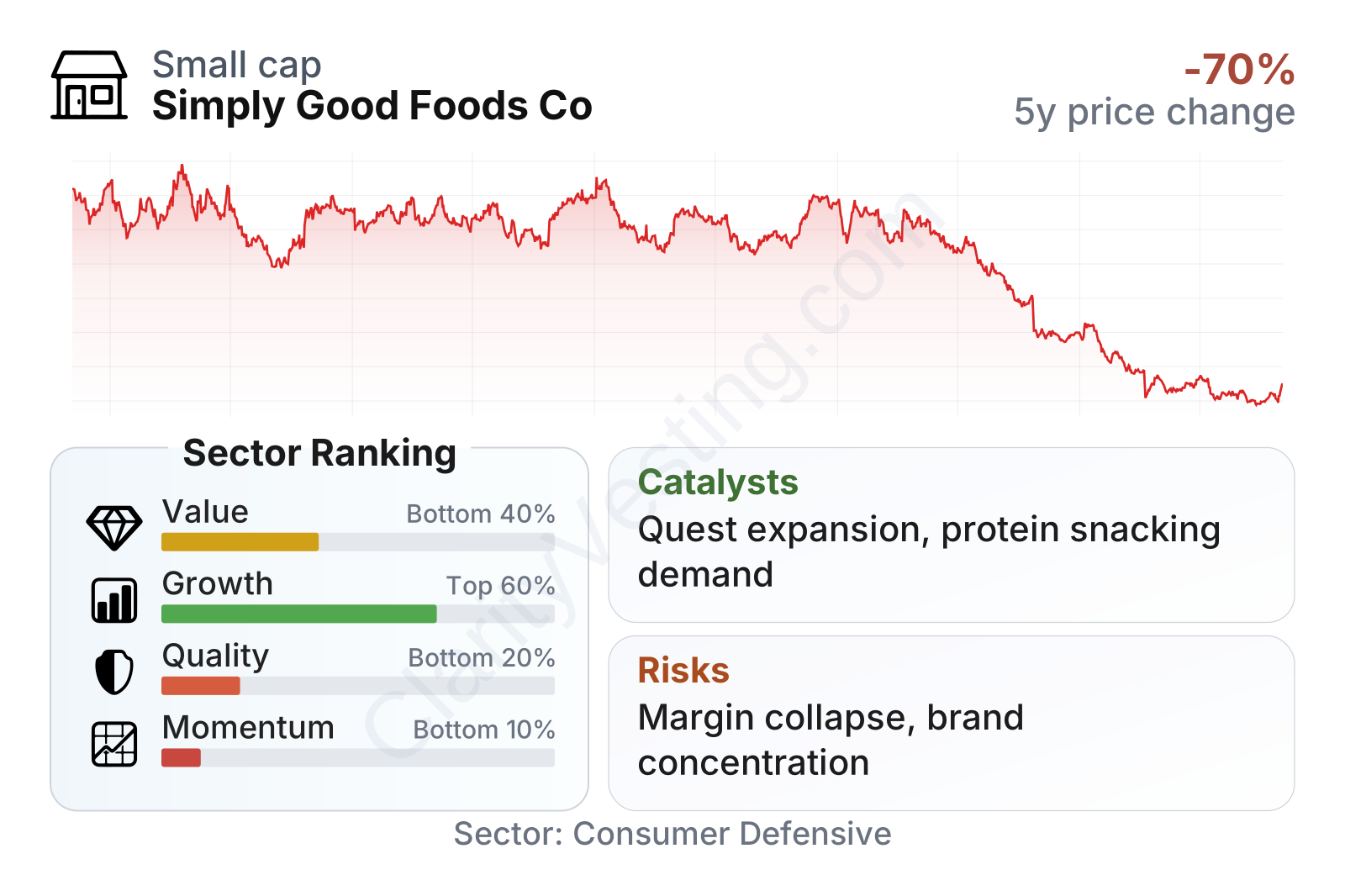
Simply Good Foods is a small-cap consumer staples company with unusually low share-price volatility, reflected in a beta close to zero. The broader factor profile is mixed. Valuation indicators are not clearly stretched on every measure, and free cash flow yield looks solid relative to the sector, but profitability and returns on capital have weakened sharply. Growth metrics also need to be read carefully: the five-year picture is respectable, yet the most recent year was much weaker, and market momentum has been very poor compared with the sector.
Growth
Simply Good Foods operates in a part of the food market that still has long-term appeal. Consumers continue to spend on convenient, protein-rich, low-sugar, and function-oriented foods, and retailers keep giving shelf space to brands that match those habits. That gives the company exposure to a structurally attractive niche within packaged foods, especially compared with slower-growing legacy center-store categories.
The strategy also makes sense on paper. Quest targets active and mainstream consumers looking for high-protein snacks, while Atkins serves weight-management and low-carb demand. Together, they cover adjacent occasions rather than identical ones, which helps the company reach multiple consumer segments without becoming overly diversified.
Even so, recent growth has lost momentum. After several periods of solid expansion, year-over-year revenue turned negative in 2026 and fell by around 10% in the latest reading, versus a sector median that remained positive. That does not automatically change the long-term category opportunity, but it does show that company execution and brand demand have recently been weaker than the broader peer group.
Cash generation still deserves attention. Free cash flow remained meaningful, and the five-year growth rate in free cash flow has been stronger than the sector median. Even with the recent earnings setback, the company has shown an ability over time to convert a fair amount of sales into cash, which matters in packaged foods because it supports debt reduction, brand investment, and product launches without relying heavily on outside financing.
One of the clearest long-term catalysts is continued expansion of protein-forward snacking. Quest is especially well placed here because it spans both sweet and salty formats, giving it more ways to gain shelf space and attract repeat purchases. Another potential opportunity is distribution expansion across convenience, club, and e-commerce, where portable nutrition products can perform well. Product innovation is also important: in this category, new flavors, formats, and line extensions can drive trial without requiring entirely new brands.
Recent company communications have also highlighted ongoing brand-building efforts and distribution execution. The opportunity is real, but the main question is whether the company can turn category tailwinds back into consistent reported growth after a difficult 2026.
Risks
This article is for informational purposes only and does not constitute financial advice. Some content is AI-generated. See Disclaimer