Stock Analysis · Standard Motor Products Inc (SMP)
Overview
Standard Motor Products is an automotive replacement-parts manufacturer and distributor. In simple terms, it sells parts used to repair and maintain vehicles after they have already been sold, rather than building parts mainly for new cars coming off assembly lines. That matters because demand for replacement parts is tied more to the size and age of the vehicle fleet, miles driven, and repair activity than to the more volatile cycle of new vehicle production.
The company operates through two main business lines: Vehicle Control and Temperature Control. It also has a smaller but increasingly relevant footprint in areas tied to electrification and advanced vehicle systems, including battery cables, connectors, thermal-management components, and other parts sold into repair channels.
Based on recent company reporting, revenue is concentrated in the following areas:
- Vehicle Control: approximately 65% to 75% of revenue. This segment includes ignition, emission-control, fuel-system, engine-management, electrical, safety, and driver-assistance related replacement parts.
- Temperature Control: approximately 25% to 35% of revenue. This business includes air-conditioning and engine-cooling products such as compressors, condensers, evaporators, radiators, and related components.
That mix gives Standard Motor Products exposure to both everyday repair needs and seasonal demand, especially in air-conditioning parts. It also means the company is not dependent on a single product family. Over the last several years, sales have trended upward overall, but rising operating costs and financing costs have taken a larger share of revenue, which has put pressure on earnings even as the top line expanded.
The long-term pattern shows revenue moving meaningfully higher from 2021 through 2025, while net income moved in the opposite direction. In other words, the business has been able to sell more, but not convert that growth into equally strong bottom-line improvement. That gap is one of the central issues for long-term analysis.
Key Figures
| Metric | Value | Sector ⓘ |
|---|---|---|
| Date | Nov 21, 2026 | |
| Context | ||
| Sector | Consumer Cyclical | |
| Industry | Auto Parts | |
| Market Cap ⓘ | $1.00B | |
| Beta ⓘ | 0.80 | |
Value (Cheapness) | ||
| P/E Ratio ⓘ | 11.13 | 17.13 |
| P/B Ratio ⓘ | 1.45 | 2.72 |
| FCF Yield ⓘ | 14.57% | 7.52% |
| Dividend Yield ⓘ | 2.17% | 2.43% |
| EBIT / EV ⓘ | 10.62% | 7.11% |
| PEG ⓘ | 0.53 | |
Growth (Business expansion) | ||
| Revenue Growth ⓘ | 1.80% | 5.30% |
| RPS Growth (5Y CAGR) ⓘ | 8.53% | 8.77% |
| EPS Growth (5Y CAGR) ⓘ | 1.24% | -11.05% |
| BVPS Growth (5Y CAGR) ⓘ | 3.33% | 5.47% |
| Margin Growth (5Y Trend) ⓘ | -2.20% | -0.16% |
| FCF Growth (5Y CAGR) ⓘ | -25.17% | 5.66% |
| DPS Growth (5Y CAGR) ⓘ | 5.46% | 9.76% |
Quality (Business durability) | ||
| ROIC (Latest) ⓘ | 8.90% | 11.36% |
| ROA (Latest) ⓘ | 3.48% | 5.53% |
| ROIC (5Y Median) ⓘ | 8.75% | 10.58% |
| ROA (5Y Median) ⓘ | 4.96% | 5.35% |
| Net Debt / EBIT (Latest) ⓘ | 3.11 | 2.11 |
| Net Debt / EBIT (5Y Median) ⓘ | 2.38 | 2.24 |
| Net Debt / EBITDA (Latest) ⓘ | 2.41 | 1.51 |
| Net Debt / Assets ⓘ | 24.60% | 21.74% |
| EBITDA / Interest ⓘ | 6.65 | 9.63 |
| Operating Margin (Latest) ⓘ | 8.57% | 9.20% |
| Operating Margin (5Y Median) ⓘ | 7.94% | 9.64% |
| Debt to Equity (Latest) ⓘ | 82.16% | 74.26% |
| Profit Margin (Latest) ⓘ | 3.77% | 5.47% |
| Free Cash Flow (Latest) ⓘ | $146.01M | |
Momentum (Price trend) | ||
| 3Y Return ⓘ | +33.17% | +15.79% |
| 12M Return (excl. last month) ⓘ | -6.24% | -0.63% |
| 6M Return ⓘ | +16.22% | +1.17% |
| Price vs. 200-Day MA ⓘ | +12.65% | +0.36% |
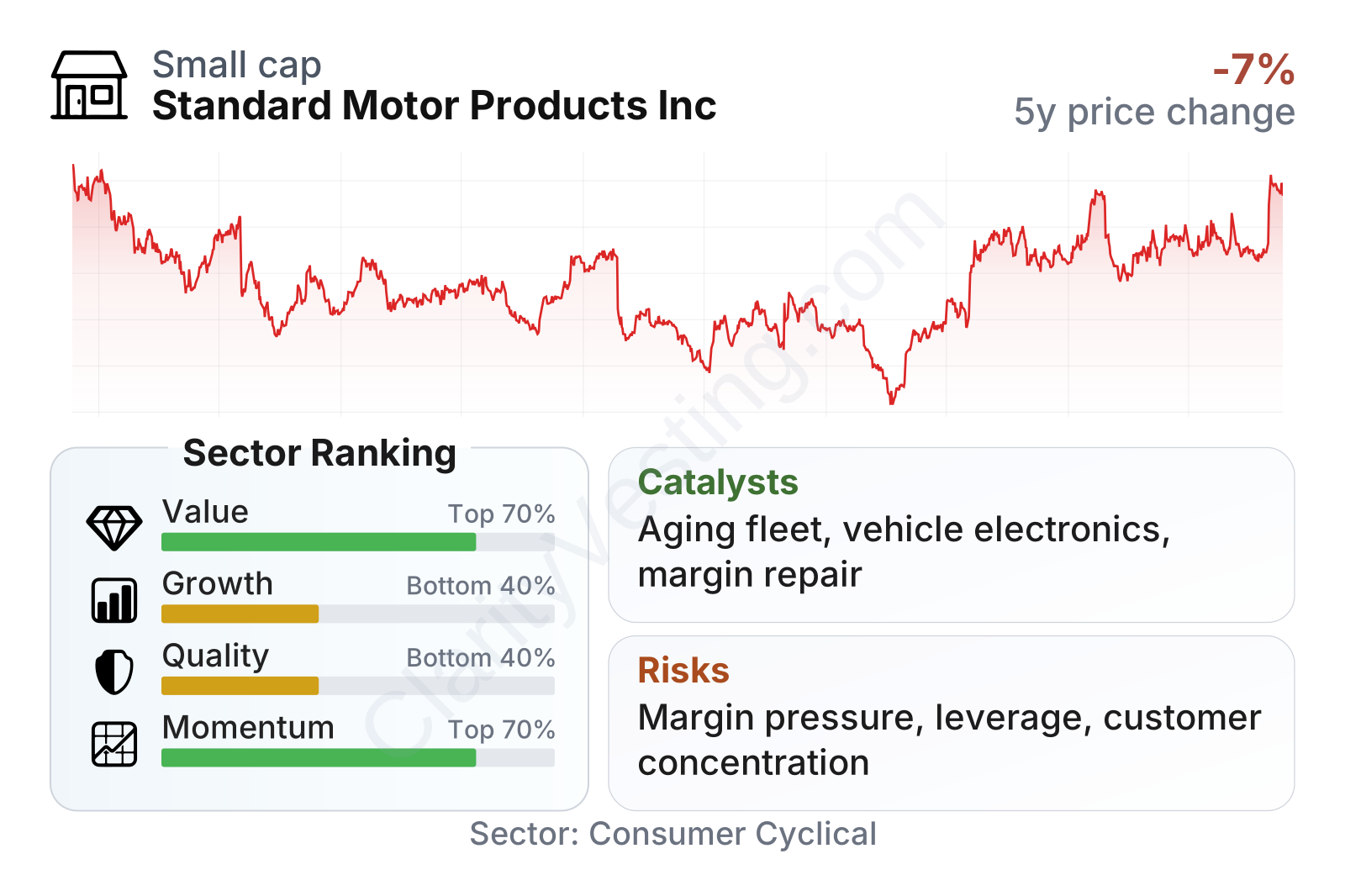
Standard Motor Products is a small-cap company with a share-price profile that has been uneven but more constructive recently. The stock has recovered from prior lows and has outperformed much of its sector over the last three years, although shorter-term performance has still been choppy.
The factor mix is also telling. Valuation looks relatively modest, with earnings and book-based multiples below sector medians and free-cash-flow yield above the group. At the same time, growth and quality rank weaker than the sector overall. That combination usually points to a company the market is pricing cautiously: not because sales do not exist, but because profitability, balance-sheet pressure, and consistency remain open questions.
Growth
The company operates in a part of the automotive industry that has durable long-term demand. The U.S. and broader North American vehicle fleets are aging, and older vehicles generally require more maintenance and replacement parts. That structural backdrop tends to support companies serving the aftermarket, especially those with broad catalogs, strong distribution relationships, and hard-to-source components. This is not a hyper-growth sector, but it can be resilient and cash generative when execution is strong.
Standard Motor Products’ strategy broadly fits that environment. The business emphasizes a wide replacement-parts portfolio, relationships with large retail and warehouse-distributor customers, and expansion into newer categories tied to increasingly complex vehicles. This matters because modern cars contain more electronics, sensors, thermal systems, and connectivity hardware than older generations did. As those vehicles age, the aftermarket opportunity can widen beyond traditional ignition and cooling parts.
Revenue growth has been highly uneven quarter to quarter, but the recent picture is better than the more difficult stretch seen in 2023. Growth accelerated sharply during 2024 and 2025 before slowing back to low single-digit rates in 2026. That suggests the company benefited from a period of stronger demand and possibly acquisition or category expansion effects, but it still has not established a consistently higher growth run rate.
Cash generation has also been volatile. Free cash flow moved from negative territory to positive levels over the period shown, which is encouraging, but the path has not been smooth. The latest trailing figure remains meaningful in absolute terms and supports the view that the business can still generate cash even while margins are under pressure. For long-term analysis, the main question is whether management can turn that cash generation into a steadier pattern rather than a rebound after weaker periods.
As for catalysts, the most important ones are operational rather than speculative. If management improves purchasing, pricing, and product mix while newer categories continue to scale, earnings could improve faster than revenue. Exposure to repair demand for older vehicles, ongoing complexity in vehicle electronics, and opportunities in thermal-management and electrical products all support a credible growth path. Company updates in recent periods have also pointed to continued portfolio development and customer-program activity, which can create incremental shelf space and category share.
Risks
This article is for informational purposes only and does not constitute financial advice. Some content is AI-generated. See Disclaimer


