Stock Analysis · Smoore International Holdings Limited (SMORF)
Overview
Smoore International Holdings Limited is a China-based manufacturer focused on vaping technology. Rather than mainly selling its own consumer brands, the company is best known as a large original design manufacturer for vaping devices and components used by global tobacco and nicotine companies. In simple terms, it designs and produces the hardware behind e-cigarettes, heated tobacco accessories, and related atomization products. It also has activities outside nicotine, including atomization technology for healthcare and other industrial uses, but vaping remains the core business.
The business is usually discussed through two main operating buckets: products made for enterprise customers and products sold under its own retail-oriented brands. Public filings also describe a broader push into healthcare atomization and special-purpose atomization, though those activities are still much smaller than nicotine-related manufacturing.
Based on recent company disclosures, revenue is primarily driven by the following sources:
- Enterprise customer vaping products: approximately 85% to 90% of revenue in recent years. This includes closed-system vaping devices, components, pods, and technology solutions supplied to large tobacco and nicotine companies.
- Self-branded vaping products: approximately 10% to 15% of revenue. This includes consumer-facing brands such as Vaporesso and other retail channels.
- Healthcare and other atomization applications: currently a small share of revenue. This covers inhalation and non-nicotine atomization technologies that management presents as future growth areas rather than current profit drivers.
This revenue mix matters because it shows that Smoore is less a traditional tobacco brand owner and more a specialized technology-and-manufacturing platform inside the vaping supply chain. That positioning gives it scale and customer reach, but it also ties performance to regulation and demand trends in the global vaping market.
The long-term pattern is mixed. Revenue recovered in 2025 after declines in 2022 through 2024, but profitability has compressed sharply from the peak years. Research and development spending has stayed elevated, which supports product leadership, yet operating income and net income have fallen much faster than sales. That suggests Smoore is still capable of generating large volumes, but at lower margins than before.
Key Figures
| Metric | Value | Sector ⓘ |
|---|---|---|
| Date | Oct 17, 2026 | |
| Context | ||
| Sector | Consumer Defensive | |
| Industry | Tobacco | |
| Market Cap ⓘ | $6.88B | |
| Beta ⓘ | 1.20 | |
Value (Cheapness) | ||
| P/E Ratio ⓘ | 37.00 | 17.88 |
| P/B Ratio ⓘ | 0.32 | 1.29 |
| FCF Yield ⓘ | 13.86% | 12.39% |
| Dividend Yield ⓘ | 31.53% | 2.85% |
| EBIT / EV ⓘ | N/A | 6.43% |
| PEG ⓘ | N/A | |
Growth (Business expansion) | ||
| Revenue Growth ⓘ | 19.90% | 4.10% |
| RPS Growth (5Y CAGR) ⓘ | 0.14% | 6.18% |
| EPS Growth (5Y CAGR) ⓘ | 54.71% | -13.59% |
| BVPS Growth (5Y CAGR) ⓘ | 3.10% | 3.20% |
| Margin Growth (5Y Trend) ⓘ | -37.58% | -0.15% |
| FCF Growth (5Y CAGR) ⓘ | N/A | 4.10% |
| DPS Growth (5Y CAGR) ⓘ | -12.52% | 6.79% |
Quality (Business durability) | ||
| ROIC (Latest) ⓘ | N/A | 12.34% |
| ROA (Latest) ⓘ | 8.38% | 6.30% |
| ROIC (5Y Median) ⓘ | 10.33% | 10.49% |
| ROA (5Y Median) ⓘ | 6.60% | 5.44% |
| Net Debt / EBIT (Latest) ⓘ | -1.18 | 1.96 |
| Net Debt / EBIT (5Y Median) ⓘ | -2.70 | 2.35 |
| Net Debt / EBITDA (Latest) ⓘ | -0.98 | 1.38 |
| Net Debt / Assets ⓘ | -12.82% | 21.51% |
| EBITDA / Interest ⓘ | N/A | 9.46 |
| Operating Margin (Latest) ⓘ | 10.02% | 8.87% |
| Operating Margin (5Y Median) ⓘ | 17.58% | 9.53% |
| Debt to Equity (Latest) ⓘ | 3.09% | 72.35% |
| Profit Margin (Latest) ⓘ | 7.40% | 5.40% |
| Free Cash Flow (Latest) ⓘ | $953.37M | |
Momentum (Price trend) | ||
| 3Y Return ⓘ | +29.24% | +20.92% |
| 12M Return (excl. last month) ⓘ | -7.42% | +2.13% |
| 6M Return ⓘ | -17.34% | +1.26% |
| Price vs. 200-Day MA ⓘ | -8.14% | +1.39% |
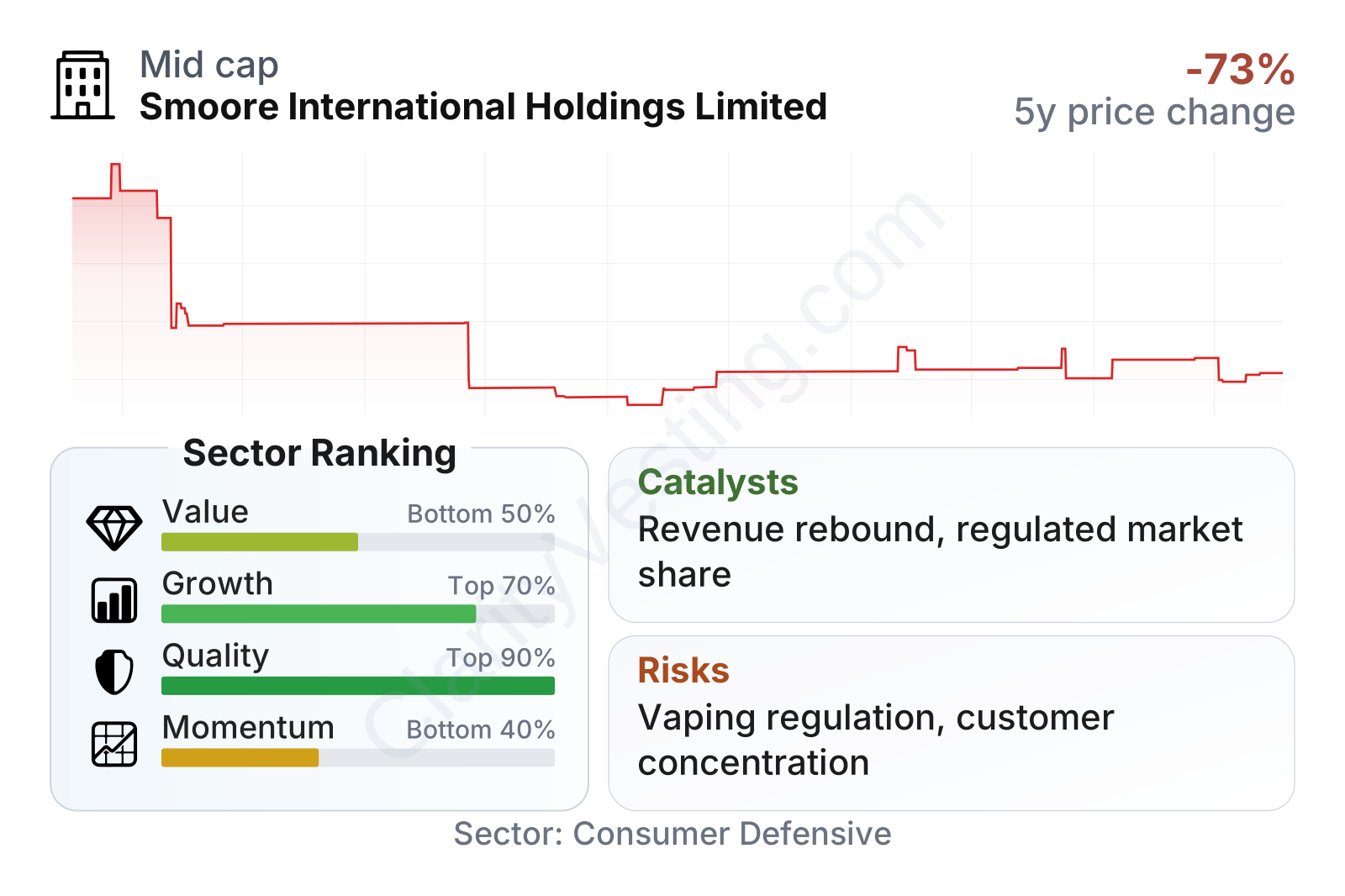
The current profile shows an unusual combination: strong balance-sheet quality, decent recent sales growth, and weak market momentum. Smoore stands out financially because it carries very little debt and in fact holds net cash, a rare advantage in a mature consumer category. Profitability is still above the sector median on several measures, but margins are well below the company’s own historical level. On valuation, the picture is split: the earnings multiple looks high relative to the sector, while the price-to-book ratio is very low and free-cash-flow yield is solid. That usually points to a market that is skeptical about how sustainable future profits will be.
The share price history reinforces that tension. The stock is still far below its 2021 level despite a recovery from the 2024 lows, which means the market has not fully regained confidence after the industry downturn and margin pressure. Recent returns have lagged the sector over shorter periods, even though the longer three-year comparison looks less severe.
Growth
Smoore operates in a sector that still has room to expand over the long run, but it is not a straight-line growth market. Global cigarette consumption continues to face structural pressure, and that supports interest in reduced-risk nicotine formats such as vaping and heated products. Within that shift, companies with strong manufacturing, regulatory know-how, and device technology can remain important. Smoore fits that description better than many smaller competitors because it has large-scale production, deep engineering capabilities, and established relationships with major customers.
Its strategy broadly makes sense for future growth. The company continues to invest heavily in research and development, especially around ceramic coil technology, closed-system products, and next-generation atomization. That spending has weighed on near-term margins, but it also helps defend its position as a specialist supplier rather than a low-cost assembler. If the industry becomes more regulated and more technically demanding, that can favor larger players that already meet stricter quality, compliance, and manufacturing standards.
Another growth angle is geographic and customer diversification. Smoore’s enterprise business depends heavily on large international customers, so any broadening of the client base or deeper penetration into compliant regulated markets could support revenue quality over time. The company has also been trying to develop healthcare atomization and other non-nicotine applications. Those businesses are still small, but they offer a path to reduce dependence on the vaping cycle if commercialization improves.
A notable catalyst is the rebound in recent revenue growth. The latest metrics indicate year-over-year revenue growth near 20%, which is much stronger than the sector median. That does not erase the weaker multiyear revenue trend, but it does suggest that demand may have stabilized after a difficult period. If that recovery comes with better product mix or improved utilization, earnings could eventually become less depressed than the market has been assuming.
There is also a structural catalyst in regulation itself. Regulation is often seen only as a threat, but stricter rules can also remove weaker operators and shift demand toward suppliers with testing, compliance, and manufacturing scale. For a company already working with major global accounts, that can become an advantage if legal-market products gain share versus gray-market supply.
Risks
This article is for informational purposes only and does not constitute financial advice. Some content is AI-generated. See Disclaimer


