Stock Analysis · Summerset Group Holdings Limited (SMGRF)
Overview
Summerset Group Holdings Limited is a New Zealand-based retirement village and aged-care operator. The company develops, owns, and runs integrated communities for older residents, typically combining independent living units, serviced apartments, and higher-care facilities such as rest homes, hospital-level care, and memory care. Its business model is not the same as a traditional nursing home operator in the United States: a large part of value creation comes from developing villages, selling occupation rights to residents, and then earning recurring income from care and village services.
Revenue is mainly tied to the retirement village model, with recurring contributions from care and resident services. Based on the company’s reporting structure and business model, the main economic drivers can be summarized as follows:
- Occupation right sales and resale gains – typically the largest source of operating cash generation. This includes the initial sale of occupation rights for villas, apartments, and serviced units, as well as gains when units are resold after residents leave.
- Deferred management fees – a major source of profitability. These fees are usually earned over the resident’s tenure and realized when a unit turns over.
- Care fees and accommodation charges – recurring income from rest home, hospital, dementia, and other aged-care services.
- Village service revenue – smaller recurring revenue from resident charges, support services, and related community operations.
- Development and valuation gains – important for reported earnings in some years, but less stable than recurring care and service income.
For a simple long-term view, the key point is that Summerset is both an operator and a property developer. That gives it more than one earnings engine, but it also means reported profit can be influenced by property valuations and development timing, not just day-to-day care operations.
Over the last five years, total revenue has moved steadily higher, rising from just above NZ$200 million in 2021 to about NZ$361 million in 2025. Gross profit has also expanded, showing that the company has continued to add scale. At the same time, administrative and operating costs have risen as the village network has grown, and interest expense has become a more meaningful factor.
The broad pattern is positive on the surface: revenue and gross profit have increased consistently. However, net income has been more uneven than revenue, which reflects how sensitive this type of business can be to financing costs, valuation movements, and the timing of development completions.
Key Figures
| Metric | Value | Sector ⓘ |
|---|---|---|
| Date | Oct 17, 2026 | |
| Context | ||
| Sector | Healthcare | |
| Industry | Medical Care Facilities | |
| Market Cap ⓘ | $1.01B | |
| Beta ⓘ | 0.34 | |
Value (Cheapness) | ||
| P/E Ratio ⓘ | 5.88 | 24.79 |
| P/B Ratio ⓘ | 0.27 | 3.08 |
| FCF Yield ⓘ | N/A | 3.15% |
| Dividend Yield ⓘ | 3.96% | 1.94% |
| EBIT / EV ⓘ | 0.45% | 0.57% |
| PEG ⓘ | N/A | |
Growth (Business expansion) | ||
| Revenue Growth ⓘ | 15.90% | 7.45% |
| RPS Growth (5Y CAGR) ⓘ | 14.03% | 8.61% |
| EPS Growth (5Y CAGR) ⓘ | -2.74% | -17.81% |
| BVPS Growth (5Y CAGR) ⓘ | 13.11% | 3.72% |
| Margin Growth (5Y Trend) ⓘ | 65.99% | -0.62% |
| FCF Growth (5Y CAGR) ⓘ | -0.94% | 1.04% |
| DPS Growth (5Y CAGR) ⓘ | 6.80% | 6.77% |
Quality (Business durability) | ||
| ROIC (Latest) ⓘ | N/A | 3.24% |
| ROA (Latest) ⓘ | N/A | 3.01% |
| ROIC (5Y Median) ⓘ | 7.13% | 4.60% |
| ROA (5Y Median) ⓘ | 5.00% | 1.89% |
| Net Debt / EBIT (Latest) ⓘ | N/A | 1.34 |
| Net Debt / EBIT (5Y Median) ⓘ | 4.07 | 1.84 |
| Net Debt / EBITDA (Latest) ⓘ | N/A | 1.00 |
| Net Debt / Assets ⓘ | 21.28% | 5.45% |
| EBITDA / Interest ⓘ | N/A | 9.64 |
| Operating Margin (Latest) ⓘ | N/A | 9.27% |
| Operating Margin (5Y Median) ⓘ | 118.80% | 7.38% |
| Debt to Equity (Latest) ⓘ | N/A | 28.58% |
| Profit Margin (Latest) ⓘ | 87.99% | 3.59% |
| Free Cash Flow (Latest) ⓘ | N/A | |
Momentum (Price trend) | ||
| 3Y Return ⓘ | -57.75% | +42.80% |
| 12M Return (excl. last month) ⓘ | -49.26% | +18.50% |
| 6M Return ⓘ | -26.50% | +7.57% |
| Price vs. 200-Day MA ⓘ | -29.27% | +5.12% |
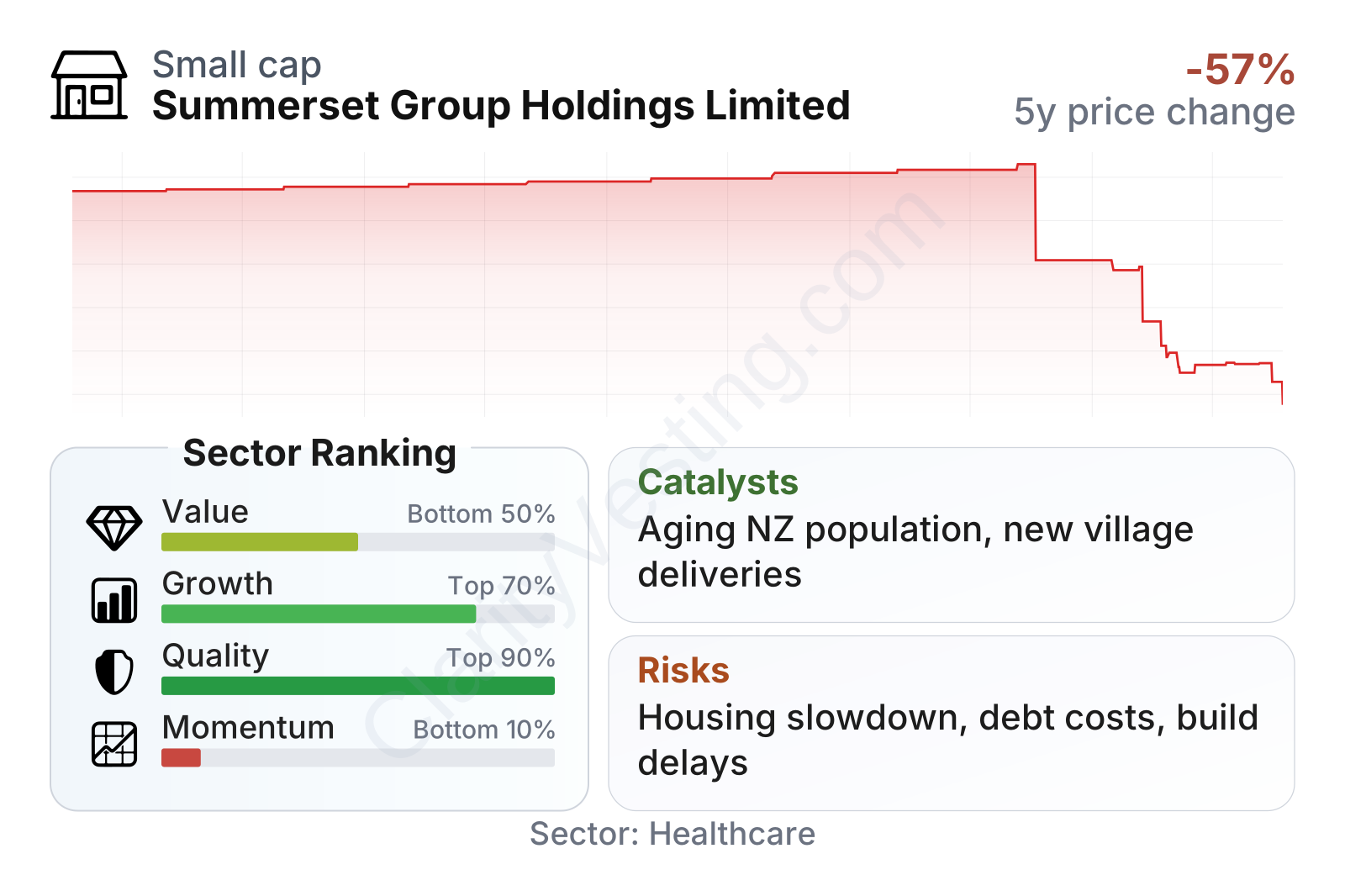
Summerset stands out on growth and long-term operating quality, but the market has clearly become more cautious. Revenue growth of about 16% year over year is well above the sector median, and five-year revenue-per-share growth has also been stronger than many peers. Book value per share has compounded at roughly 13% annually over five years, another sign that the asset base has been expanding.
Profitability metrics look unusually strong compared with much of the healthcare sector, although they should be read carefully because retirement village accounting can produce very high margins when development gains and revaluation effects flow through earnings. Even so, the company’s five-year median return on invested capital and return on assets both appear stronger than sector norms, suggesting the business has historically converted capital into earnings better than many healthcare facilities operators.
The weaker area is market performance and balance-sheet pressure. The stock has lost substantial ground over the past three years and also trails the sector over the past 12 months and 6 months. Leverage is not extreme for a property-backed retirement village business, but net debt relative to assets and earnings is higher than the sector median, which matters more in a higher-rate environment. The low beta suggests the shares have historically moved less than the broader market, but that has not prevented a deep share-price decline.
Growth
Summerset operates in a sector with a strong long-term demographic tailwind. New Zealand’s population is aging, and demand for senior housing, assisted living, and higher-care services is expected to rise over time. That creates a supportive backdrop for companies able to develop attractive villages in the right locations and maintain occupancy.
The company’s strategy is coherent for that environment. It has been building a network of retirement communities that serve residents across different stages of aging, from independent living to more intensive care. That model can strengthen resident retention because people do not necessarily need to leave the broader community as their needs increase. It also helps the company capture value across the full resident lifecycle rather than from a single service line.
A second growth driver is development. Summerset has historically added new villages and expanded existing ones, which increases the number of units available for sale and the pool of recurring care and service revenue. If execution remains solid, each new community can support earnings for many years, not just at opening.
Recent operating trends also point to continuing expansion. Revenue has kept rising, and long-term growth measures remain above sector medians. In practical terms, that suggests the company is still adding scale even though the market has turned much more skeptical about the valuation of retirement village operators.
An important catalyst is any improvement in housing turnover and financing conditions. Businesses like Summerset benefit when prospective residents can more easily sell their homes and move into retirement communities. Lower interest-rate pressure would also help development economics, debt servicing, and property-market sentiment. Another notable catalyst is continued delivery of new units and care capacity, because that directly increases the company’s earning base.
Risks
This article is for informational purposes only and does not constitute financial advice. Some content is AI-generated. See Disclaimer


