Stock Analysis · Sembcorp Marine Ltd (SMBMY)
Overview
Sembcorp Marine Ltd, now operating as Seatrium after its combination with Keppel Offshore & Marine, is a Singapore-based engineering and marine group serving the offshore energy, shipping, and infrastructure markets. Its work includes designing, building, repairing, upgrading, and converting offshore production units, vessels, and large energy-related structures. In simple terms, it is a heavy industrial contractor that helps customers build and maintain complex assets used in oil and gas, marine transport, and increasingly offshore wind and other energy-transition projects.
The business model is largely project-based. Revenue usually comes from large contracts that can run for several quarters or years, which means reported sales and profits can move sharply depending on project timing, execution, and milestone recognition. The company’s recent strategy has been to reduce dependence on traditional oil-related construction and expand into offshore renewables, cleaner energy infrastructure, and long-term service work.
Based on company reporting after the merger and the way Seatrium describes its activities, the main revenue sources can be summarized as follows:
- Shipbuilding, conversions, and major offshore construction: approximately 50% to 60% of revenue in recent years. This includes floating production units, offshore platforms, specialized vessels, and large fabrication work.
- Repairs, upgrades, and maintenance: approximately 25% to 35%. This covers vessel repair, life-extension work, retrofits, and recurring yard activity that is typically less cyclical than newbuild projects.
- Renewables and cleaner-energy infrastructure: approximately 10% to 20%, but rising. This includes offshore wind foundations and substations, and selected decarbonization-related marine projects.
- Other engineering and services: a smaller share, including specialized engineering support and project management.
The most important point for long-term readers is that this is no longer just a classic offshore oil-services name. The combined group is trying to position itself as a broader offshore and marine engineering platform with exposure to both conventional energy and the energy transition.
The operating picture has improved materially over the last several years. Revenue has expanded strongly since 2023, and the business moved from deep losses to positive operating income and net income by 2024 and 2025. That shift matters more than any single contract because it suggests restructuring, pricing discipline, and project execution have started to translate into a healthier earnings base.
Key Figures
| Metric | Value | Sector ⓘ |
|---|---|---|
| Date | Oct 03, 2026 | |
| Context | ||
| Sector | Energy | |
| Industry | Oil & Gas Equipment & Services | |
| Market Cap ⓘ | $5.22B | |
| Beta ⓘ | 0.24 | |
Value (Cheapness) | ||
| P/E Ratio ⓘ | 12.23 | 14.47 |
| P/B Ratio ⓘ | 0.72 | 1.70 |
| FCF Yield ⓘ | 11.16% | 8.66% |
| Dividend Yield ⓘ | 1.52% | 3.77% |
| EBIT / EV ⓘ | N/A | 7.46% |
| PEG ⓘ | 0.74 | |
Growth (Business expansion) | ||
| Revenue Growth ⓘ | 4.70% | 27.35% |
| RPS Growth (5Y CAGR) ⓘ | 137.82% | 6.75% |
| EPS Growth (5Y CAGR) ⓘ | N/A | -15.45% |
| BVPS Growth (5Y CAGR) ⓘ | 73.72% | 5.85% |
| Margin Growth (5Y Trend) ⓘ | N/A | 0.75% |
| FCF Growth (5Y CAGR) ⓘ | N/A | 3.62% |
| DPS Growth (5Y CAGR) ⓘ | -14.14% | 16.85% |
Quality (Business durability) | ||
| ROIC (Latest) ⓘ | N/A | 11.33% |
| ROA (Latest) ⓘ | 3.79% | 6.03% |
| ROIC (5Y Median) ⓘ | -2.29% | 10.16% |
| ROA (5Y Median) ⓘ | -2.89% | 5.34% |
| Net Debt / EBIT (Latest) ⓘ | 1.58 | 1.62 |
| Net Debt / EBIT (5Y Median) ⓘ | N/A | 1.91 |
| Net Debt / EBITDA (Latest) ⓘ | 0.89 | 1.06 |
| Net Debt / Assets ⓘ | 5.86% | 17.29% |
| EBITDA / Interest ⓘ | 6.38 | 9.64 |
| Operating Margin (Latest) ⓘ | 4.11% | 16.32% |
| Operating Margin (5Y Median) ⓘ | -4.33% | 19.53% |
| Debt to Equity (Latest) ⓘ | 37.98% | 54.41% |
| Profit Margin (Latest) ⓘ | 4.71% | 8.79% |
| Free Cash Flow (Latest) ⓘ | $582.90M | |
Momentum (Price trend) | ||
| 3Y Return ⓘ | -20.89% | +62.93% |
| 12M Return (excl. last month) ⓘ | -15.52% | +44.83% |
| 6M Return ⓘ | +3.08% | -1.62% |
| Price vs. 200-Day MA ⓘ | -3.74% | +5.18% |
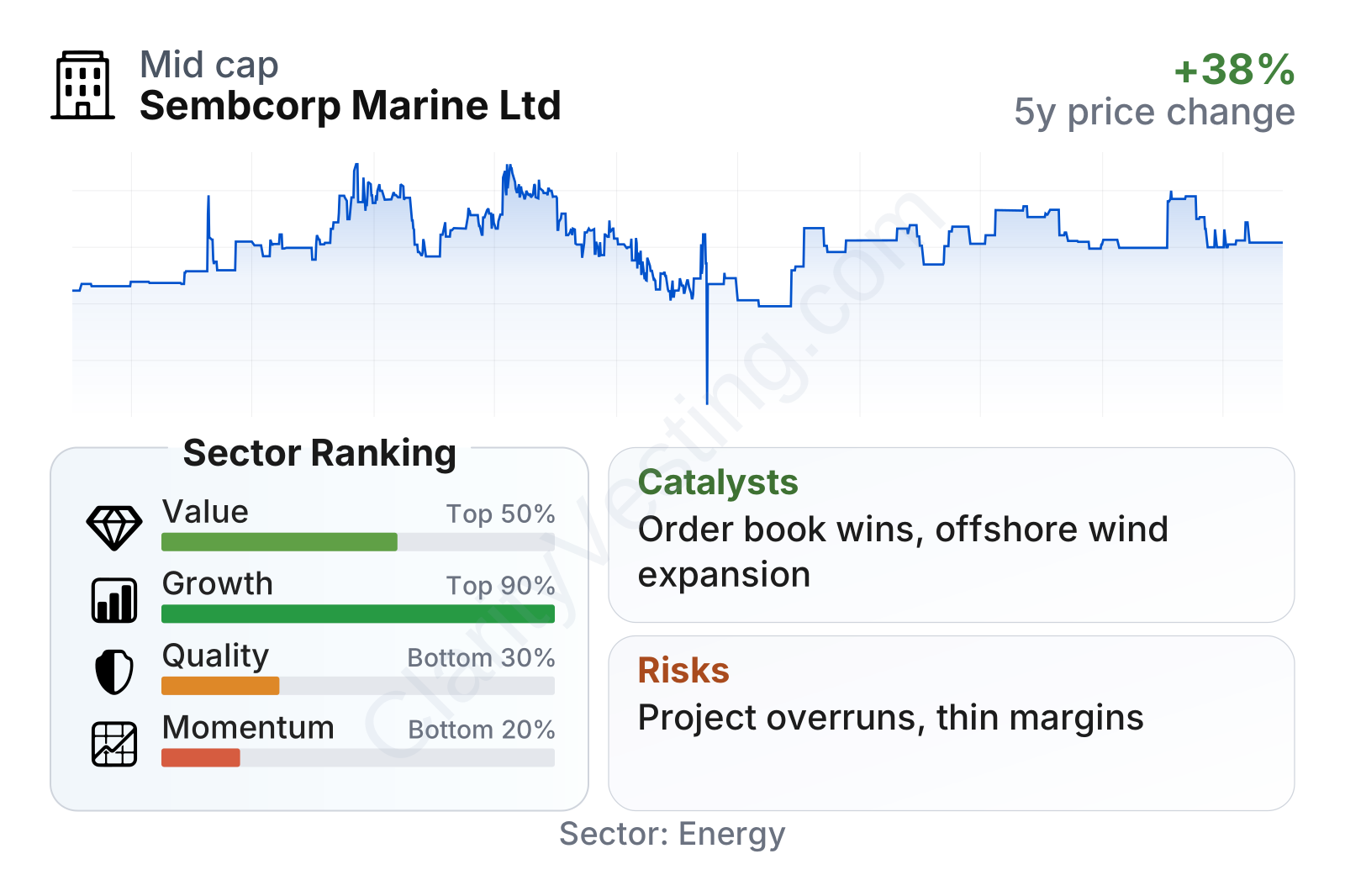
The overall profile is mixed but improving. On valuation, the shares screen cheaper than the sector on earnings and book value, while free cash flow yield is also ahead of the sector median. Growth metrics look unusually strong over a five-year view because the company rebounded from a weak base and was reshaped by the merger. Quality metrics are still below sector norms, especially on margins and returns on assets, which reflects the difficult history of losses and the low-margin nature of heavy engineering. Price performance has lagged much of the sector over one and three years, showing that the market still wants clearer proof that the turnaround is durable.
Sembcorp Marine, through Seatrium, is now a mid-sized listed industrial energy-services company rather than a niche contractor. The stock’s low beta suggests lower day-to-day trading volatility than many energy-linked names, but that does not remove the underlying business risk tied to major project execution.
Growth
The company operates in markets that should remain active for years, although not all parts will grow at the same speed. Traditional offshore oil and gas still supports demand for floating production units, upgrades, and maintenance. At the same time, offshore wind, grid-related marine infrastructure, and decarbonization projects are creating a second path for growth. That combination is important: it gives Seatrium exposure to current energy spending as well as to the long build-out of lower-carbon infrastructure.
The strategy broadly makes industrial sense. A larger combined platform can spread fixed yard costs across more projects, bid for bigger contracts, and cross-sell repair, upgrade, and engineering services. It also reduces reliance on any one market niche. For a business like this, scale matters because customers prefer contractors with balance-sheet capacity, technical depth, and yard availability for very large projects.
One clear catalyst is the company’s order book and contract pipeline. Public company updates have highlighted wins across floating production systems, vessel repair, offshore wind components, and specialized marine work. A healthy order book does not guarantee high margins, but it does improve revenue visibility in a business where future workload is a key driver of confidence.
Another encouraging sign is the earnings recovery already visible in the numbers. Revenue rose from about $9.2 billion in 2024 to about $11.3 billion in 2025, while net income remained positive and interest expense declined meaningfully. That combination suggests the business is not just growing sales but also stabilizing its financial structure.
Cash generation still deserves close attention. The latest trailing free cash flow reading is solidly positive, but the more recent chart points to negative free cash flow around the turn from 2024 into mid-2025. For a project-heavy contractor, that is not automatically alarming because working capital can swing sharply as projects advance. Still, sustained positive cash conversion would be one of the strongest signals that the turnaround is becoming more robust.
A recent opportunity comes from the continued build-out of offshore energy infrastructure in Asia, the Middle East, and selected Western markets. Few shipyards and offshore engineering groups have Seatrium’s combination of fabrication capacity, repair capability, and experience with large floating assets. If offshore wind and floating production demand remain firm, the company has a credible route to further volume growth.
Risks
This article is for informational purposes only and does not constitute financial advice. Some content is AI-generated. See Disclaimer


