Stock Analysis · Sembcorp Marine Ltd (SMBMF)
Overview
Sembcorp Marine Ltd, now operating under the Seatrium name after its combination with Keppel Offshore & Marine, is a Singapore-based offshore, marine, and energy engineering group. The company designs, builds, repairs, and upgrades complex assets used in oil and gas production, shipping, offshore wind, and other large-scale energy and industrial projects. In simple terms, it is a specialized heavy engineering contractor that works on difficult, high-value projects where safety, technical capability, and yard capacity matter a great deal.
Its business has become broader than a traditional shipyard model. In recent years, the company has been positioning itself around three large themes: offshore production assets, vessel repairs and upgrades, and infrastructure linked to the energy transition. That includes work on floating production units, rigs, specialized vessels, offshore wind foundations and substations, and carbon capture or cleaner-energy related projects.
Based on company reporting after the merger, revenue is mainly generated from project-based engineering and yard work rather than recurring subscription-like income. Public disclosures typically group activity by major business lines rather than giving a perfectly fixed revenue mix every year, because project timing can shift meaningfully from one period to another. The broad revenue picture is centered on the following activities:
- Offshore and floating production solutions — generally the largest contributor in most recent reporting periods. This includes floating production storage and offloading units, floating natural gas assets, platforms, and other offshore production systems for energy customers.
- Repairs, upgrades, and conversions — a major source of turnover. This covers ship repair, life-extension work, vessel conversions, offshore asset upgrades, and maintenance-related yard services.
- Renewables and new energy projects — a growing but still smaller share than the traditional core. This includes offshore wind structures, substations, and selected decarbonization-related engineering work.
- Specialized shipbuilding and other engineering services — a smaller contribution, depending on project awards and delivery schedules.
The available financial flow over the last several years shows a business that went through a difficult restructuring period and then moved back into positive operating profit and net income. Revenue climbed from about $1.9 billion in 2021 to about $11.5 billion in 2025, while profitability improved from deep losses to positive earnings. That turnaround matters more than any single contract because it suggests the combined group has been filling its yards better and executing work more effectively than before.
The long-term pattern here is a sharp improvement in scale and profitability. Earlier years were marked by negative gross profit and heavy losses, while 2024 and 2025 show a return to positive gross profit, operating income, and net income. That does not remove cyclicality, but it does indicate that the business has moved out of its weakest phase.
Key Figures
| Metric | Value | Sector ⓘ |
|---|---|---|
| Date | Oct 17, 2026 | |
| Context | ||
| Sector | Energy | |
| Industry | Oil & Gas Equipment & Services | |
| Market Cap ⓘ | $5.93B | |
| Beta ⓘ | 0.25 | |
Value (Cheapness) | ||
| P/E Ratio ⓘ | 13.46 | 15.44 |
| P/B Ratio ⓘ | 0.69 | 1.73 |
| FCF Yield ⓘ | 18.85% | 8.20% |
| Dividend Yield ⓘ | 1.71% | 3.59% |
| EBIT / EV ⓘ | N/A | 7.46% |
| PEG ⓘ | 0.75 | |
Growth (Business expansion) | ||
| Revenue Growth ⓘ | 4.70% | 26.90% |
| RPS Growth (5Y CAGR) ⓘ | 138.74% | 6.90% |
| EPS Growth (5Y CAGR) ⓘ | N/A | -15.73% |
| BVPS Growth (5Y CAGR) ⓘ | 73.70% | 6.07% |
| Margin Growth (5Y Trend) ⓘ | N/A | 0.58% |
| FCF Growth (5Y CAGR) ⓘ | N/A | 1.86% |
| DPS Growth (5Y CAGR) ⓘ | -14.01% | 16.79% |
Quality (Business durability) | ||
| ROIC (Latest) ⓘ | N/A | 11.40% |
| ROA (Latest) ⓘ | 4.49% | 6.06% |
| ROIC (5Y Median) ⓘ | -2.29% | 10.30% |
| ROA (5Y Median) ⓘ | -2.89% | 5.42% |
| Net Debt / EBIT (Latest) ⓘ | 1.26 | 1.64 |
| Net Debt / EBIT (5Y Median) ⓘ | N/A | 1.83 |
| Net Debt / EBITDA (Latest) ⓘ | 0.67 | 1.08 |
| Net Debt / Assets ⓘ | 5.86% | 17.29% |
| EBITDA / Interest ⓘ | 6.76 | 9.64 |
| Operating Margin (Latest) ⓘ | 3.93% | 16.27% |
| Operating Margin (5Y Median) ⓘ | -4.33% | 20.39% |
| Debt to Equity (Latest) ⓘ | 37.98% | 54.76% |
| Profit Margin (Latest) ⓘ | 4.71% | 8.82% |
| Free Cash Flow (Latest) ⓘ | $1.12B | |
Momentum (Price trend) | ||
| 3Y Return ⓘ | -19.89% | +67.38% |
| 12M Return (excl. last month) ⓘ | -2.26% | +49.19% |
| 6M Return ⓘ | -23.26% | +7.07% |
| Price vs. 200-Day MA ⓘ | -9.30% | +9.56% |
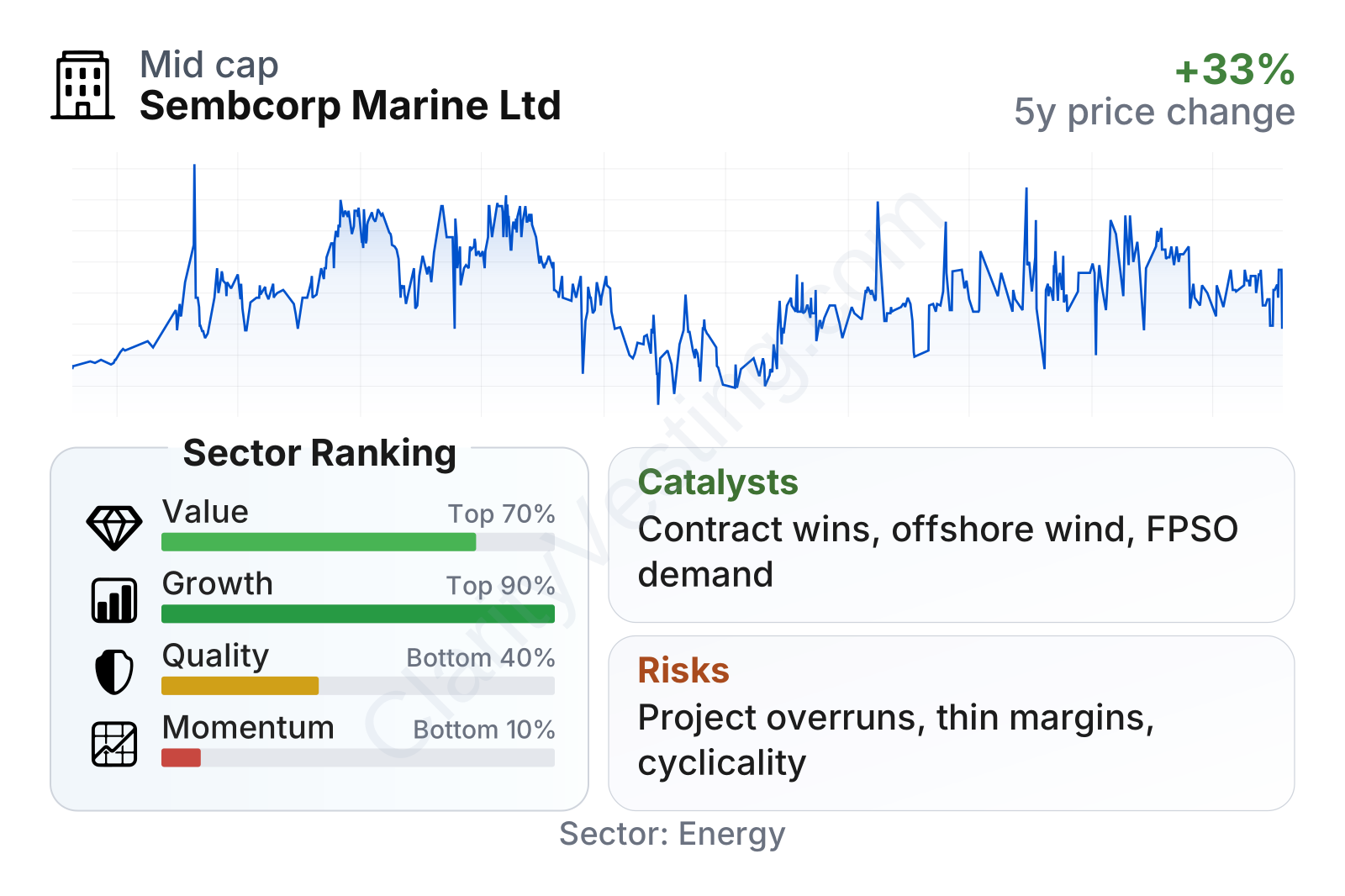
The stock’s path has been uneven. It rose strongly into 2023, then gave back a meaningful part of those gains before stabilizing and recovering somewhat. That weak recent momentum stands in contrast to the company’s improving operations, which helps explain why the valuation still looks moderate rather than stretched.
On valuation, the shares appear inexpensive compared with much of the sector. The earnings multiple is below the sector median, the price-to-book ratio is notably lower, and free cash flow yield is well above the typical peer level. Growth metrics are unusually strong over a five-year view, largely reflecting the rebound from a depressed base and the expansion created by the merger. The weaker area is quality: profitability margins and returns on assets remain below many peers, even though leverage looks more controlled than the sector median. In short, the market is recognizing the recovery, but it is still discounting the business for its lower margins, project risk, and inconsistent share-price performance.
Growth
The company operates in sectors that should remain active for years, although not all of that growth is smooth. Offshore oil and gas still requires maintenance, upgrades, and new production infrastructure, especially where operators want long-life assets with lower unit costs. At the same time, offshore wind, cleaner marine solutions, and selected decarbonization projects are creating additional demand for engineering capacity, fabrication yards, and project execution skills. This gives Seatrium exposure to both conventional energy spending and parts of the energy transition.
Its strategy broadly makes sense for future growth because it is not tied to a single niche. The combination with Keppel Offshore & Marine created larger yard capacity, broader customer relationships, and a wider product set. That should improve the ability to bid for larger contracts and smooth demand across different end markets. For a project contractor, backlog quality and execution discipline matter more than simple volume, but scale can still be an advantage when customers prefer established partners for technically demanding work.
A visible catalyst is the ongoing shift toward larger and more complex offshore developments. Floating production systems, gas-related infrastructure, and offshore wind components all favor companies with engineering depth and fabrication space. Another positive factor is the improvement in the company’s own finances: the move back to positive net income and strong free cash flow gives management more flexibility than during the loss-making years.
Recent company announcements have also pointed to continuing contract wins and a healthy order book, including work tied to offshore production and renewable-related infrastructure. That does not guarantee smooth earnings, since project timing can move between periods, but it does support the view that customer demand is still present and that the combined platform remains relevant in global tendering.
Risks
This article is for informational purposes only and does not constitute financial advice. Some content is AI-generated. See Disclaimer


