Stock Analysis · SmartStop Self Storage REIT Inc (SMA)
Overview
SmartStop Self Storage REIT Inc is a real estate investment trust focused on self-storage properties. In simple terms, it owns storage facilities and rents units to individuals and businesses that need extra space. The company operates in the United States and Canada and also has a property management platform, which means it does not only collect rent from buildings it owns, but also earns fees by managing stores for other owners.
Its business model is built around recurring rental income. Self-storage is generally a straightforward real estate segment: customers pay monthly rent, operating costs are relatively contained compared with several other property types, and demand can come from everyday life events such as moving, downsizing, divorce, inheritance, business inventory needs, and urban space constraints.
The company’s revenue sources are mainly concentrated in property operations, with a smaller contribution from management and ancillary activities. Based on recent public company disclosures and the structure of the business, the mix is approximately:
- Self-storage rental income from owned properties: about 85% to 92% — monthly rent paid by customers for storage units.
- Tenant insurance and other property-related income: about 4% to 8% — insurance-related income, late fees, administrative fees, and other on-site charges.
- Management and advisory fees: about 3% to 8% — fees from managing properties for third parties and related platform services.
That mix matters because it shows SmartStop is primarily a real estate landlord, but with an added operating platform that can support scale and create an additional source of fee income beyond pure rent collection.
Over the last several years, total revenue has moved higher overall, but the profit flow has been less smooth. Operating income has stayed positive, while interest expense has absorbed a meaningful share of earnings. That pattern is typical of leveraged REITs, but it is especially important here because debt costs have had a visible effect on bottom-line profitability.
Key Figures
| Metric | Value | Sector ⓘ |
|---|---|---|
| Date | Oct 17, 2026 | |
| Context | ||
| Sector | Real Estate | |
| Industry | REIT - Industrial | |
| Market Cap ⓘ | $1.87B | |
| Beta ⓘ | -0.04 | |
Value (Cheapness) | ||
| P/E Ratio ⓘ | 62.67 | 17.38 |
| P/B Ratio ⓘ | 1.79 | 0.85 |
| FCF Yield ⓘ | 5.90% | 7.38% |
| Dividend Yield ⓘ | 2.40% | 4.85% |
| EBIT / EV ⓘ | 2.99% | 3.78% |
| PEG ⓘ | N/A | |
Growth (Business expansion) | ||
| Revenue Growth ⓘ | 11.40% | 5.30% |
| RPS Growth (5Y CAGR) ⓘ | 29.33% | 6.02% |
| EPS Growth (5Y CAGR) ⓘ | N/A | -11.37% |
| BVPS Growth (5Y CAGR) ⓘ | 31.32% | 0.45% |
| Margin Growth (5Y Trend) ⓘ | 14.25% | -0.22% |
| FCF Growth (5Y CAGR) ⓘ | 9.66% | 5.40% |
| DPS Growth (5Y CAGR) ⓘ | 37.50% | 5.02% |
Quality (Business durability) | ||
| ROIC (Latest) ⓘ | 3.51% | 5.69% |
| ROE (Latest) ⓘ | 2.63% | 7.56% |
| ROA (Latest) ⓘ | 1.19% | 2.85% |
| ROIC (5Y Median) ⓘ | N/A | 4.22% |
| ROE (5Y Median) ⓘ | -1.19% | 6.03% |
| ROA (5Y Median) ⓘ | -0.07% | 2.44% |
| Net Debt / EBIT (Latest) ⓘ | 12.75 | 7.59 |
| Net Debt / EBIT (5Y Median) ⓘ | 17.38 | 8.40 |
| Net Debt / EBITDA (Latest) ⓘ | 6.60 | 5.27 |
| Net Debt / Assets ⓘ | 44.36% | 37.76% |
| EBITDA / Interest ⓘ | 3.13 | 4.10 |
| Operating Margin (Latest) ⓘ | 52.84% | 35.29% |
| Operating Margin (5Y Median) ⓘ | 28.66% | 37.31% |
| Debt to Equity (Latest) ⓘ | 96.82% | 88.87% |
| Profit Margin (Latest) ⓘ | 10.17% | 19.61% |
| Free Cash Flow (Latest) ⓘ | $110.33M | |
Momentum (Price trend) | ||
| 3Y Return ⓘ | N/A | +30.75% |
| 12M Return (excl. last month) ⓘ | -12.99% | +4.36% |
| 6M Return ⓘ | +9.38% | -2.52% |
| Price vs. 200-Day MA ⓘ | +6.74% | -2.34% |
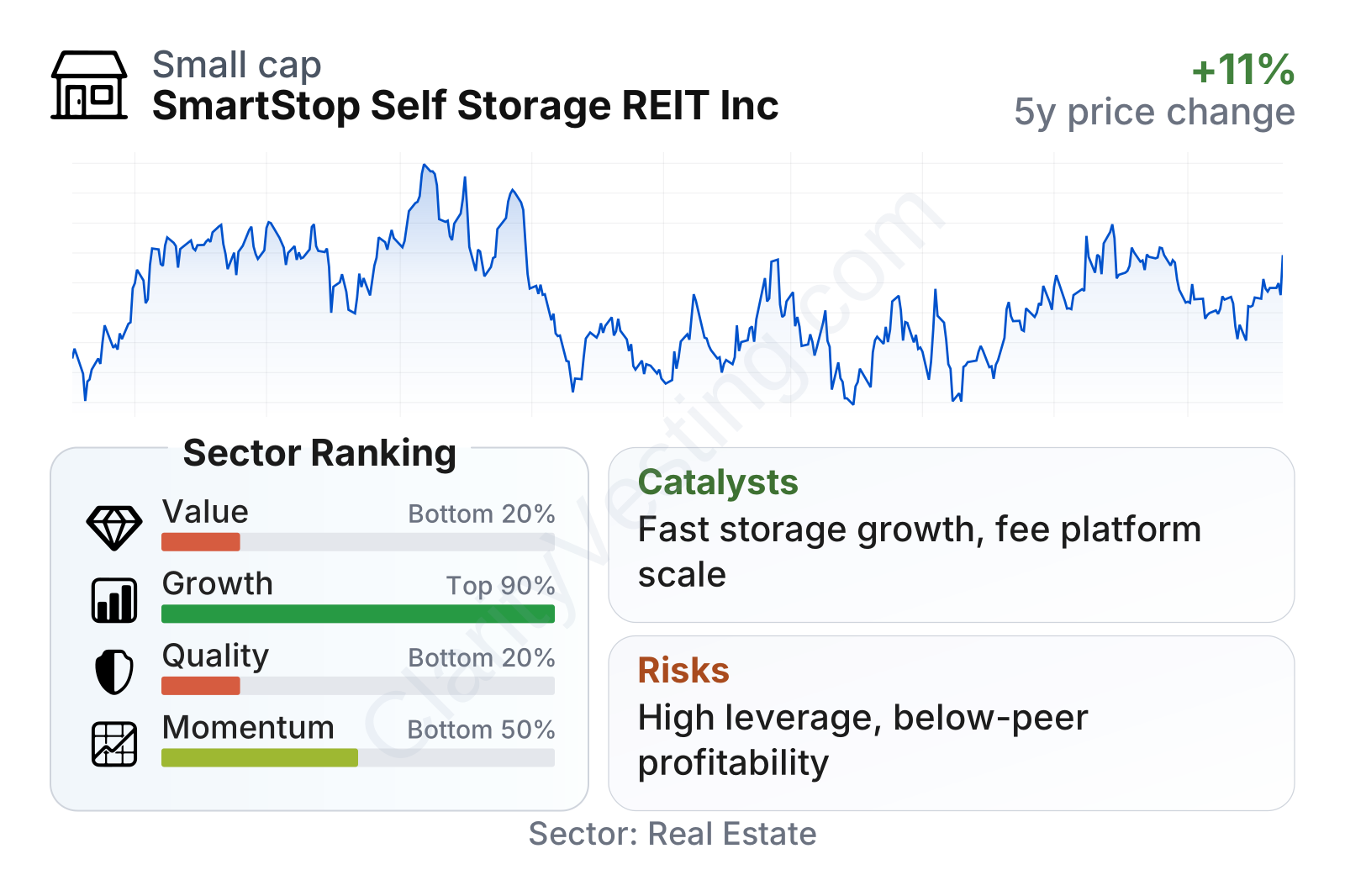
SmartStop is a mid-sized REIT by market value. The recent profile is mixed: growth measures are strong relative to the real estate sector, but value and quality measures are weak. Revenue growth is running above the sector median, and five-year revenue-per-share growth is notably strong. At the same time, profitability on assets and equity remains below sector norms, leverage is elevated, and the dividend yield is below the sector median. The stock’s recent trading trend has improved over the last six months, but the broader valuation still looks richer than much of the sector.
Growth
Self-storage has generally been a resilient real estate niche. It benefits from recurring, needs-based demand rather than purely discretionary spending. People often need storage during transitions, and those transitions happen in both strong and weak economic periods. Compared with office or some retail formats, self-storage can also adapt more quickly because leases are short and pricing can be adjusted faster.
SmartStop’s strategy is logical for this sector. It combines owned properties with a management platform, which can support expansion without requiring every dollar of growth to come from direct property purchases. That structure can help in several ways: it broadens market presence, provides fee revenue, and may create acquisition opportunities over time if managed properties are later purchased.
The company’s growth profile stands out in the sector. Recent year-over-year revenue growth is above the industry median, and the five-year growth rate in revenue per share is far ahead of most peers. Book value per share and free cash flow have also expanded at a faster pace than the median REIT in its sector.
The sharp upward move in revenue per share suggests more than just routine rent increases. It points to a combination of portfolio expansion, operational scaling, and possibly structural changes tied to the company’s public-market transition. Even allowing for some one-time effects, the broader direction indicates that SmartStop has been growing materially faster than the average property REIT in its peer group.
Income distributions have also increased strongly over a multiyear period, although the path has not been perfectly smooth from year to year. That makes the dividend growth record more encouraging than the current yield alone might suggest.
One recent opportunity is the company’s newer public listing status, which can improve access to capital, broaden visibility, and support future transactions. In real estate, scale often matters because larger operators can spread marketing, technology, call-center, and revenue-management costs across more properties. If SmartStop continues to build density in its existing markets, that could strengthen margins over time.
Risks
This article is for informational purposes only and does not constitute financial advice. Some content is AI-generated. See Disclaimer


