Stock Analysis · Solaris Resources Inc (SLSR)
Overview
Solaris Resources Inc. is a mineral exploration and development company focused on discovering and advancing large copper-gold deposits. Its main asset is the Warintza project in southeastern Ecuador, where the company has been defining a sizeable copper resource and studying how it could eventually become a mine. Unlike an operating miner, Solaris is not currently producing metals at commercial scale. That means the business is still in the project-building phase rather than the cash-generating phase.
At this stage, the company does not have recurring operating revenue from selling copper, gold, or other minerals. Financial statements have shown no meaningful revenue in recent years, which is typical for a pre-production mining developer. Instead, the economic case depends on the value of its mineral resources, the quality of future engineering studies, access to permits, financing capacity, and the possibility of bringing Warintza into production over time.
In practical terms, Solaris is trying to turn underground mineral potential into a future long-life mining asset. For long-term readers, that makes it very different from a traditional materials company with existing sales and profits: the company is being valued mostly on what Warintza could become, not on what the business earns today.
- Project development value: approximately 100% of the company’s current business focus is tied to the advancement of the Warintza copper project in Ecuador, including resource expansion, engineering, permitting, community agreements, and strategic financing.
- Current operating revenue: 0% based on recent annual financial reporting, as the company remains in the exploration and development stage.
The cost structure also reflects that profile. Operating expenses have been meaningful for several years despite the absence of revenue, and losses have been driven by exploration, administration, studies, and financing-related costs. Recent years show expense swings as the company adjusts drilling and development activity, while interest costs have become more noticeable as funding needs have evolved.
The business model is therefore straightforward but high-risk: spend capital now to increase the value and certainty of a large copper deposit, then seek a path to construction through partnerships, financing, or a future development decision.
Key Figures
| Metric | Value | Sector ⓘ |
|---|---|---|
| Date | Oct 17, 2026 | |
| Context | ||
| Sector | Basic Materials | |
| Industry | Other Precious Metals & Mining | |
| Market Cap ⓘ | $1.07B | |
| Beta ⓘ | 2.30 | |
Value (Cheapness) | ||
| P/E Ratio ⓘ | N/A | 16.90 |
| P/B Ratio ⓘ | N/A | 1.65 |
| FCF Yield ⓘ | 0.57% | 5.76% |
| Dividend Yield ⓘ | N/A | 2.13% |
| EBIT / EV ⓘ | -2.13% | 6.30% |
| PEG ⓘ | N/A | |
Growth (Business expansion) | ||
| Revenue Growth ⓘ | N/A | 11.10% |
| RPS Growth (5Y CAGR) ⓘ | N/A | 4.49% |
| EPS Growth (5Y CAGR) ⓘ | -49.10% | -13.47% |
| BVPS Growth (5Y CAGR) ⓘ | N/A | 5.51% |
| Margin Growth (5Y Trend) ⓘ | N/A | -1.54% |
| FCF Growth (5Y CAGR) ⓘ | N/A | 0.37% |
| DPS Growth (5Y CAGR) ⓘ | N/A | 6.08% |
Quality (Business durability) | ||
| ROIC (Latest) ⓘ | N/A | 9.26% |
| ROA (Latest) ⓘ | -36.40% | 4.91% |
| ROIC (5Y Median) ⓘ | N/A | 7.70% |
| ROA (5Y Median) ⓘ | -81.73% | 3.86% |
| Net Debt / EBIT (Latest) ⓘ | N/A | 1.40 |
| Net Debt / EBIT (5Y Median) ⓘ | N/A | 1.70 |
| Net Debt / EBITDA (Latest) ⓘ | N/A | 0.95 |
| Net Debt / Assets ⓘ | N/A | 13.69% |
| EBITDA / Interest ⓘ | N/A | 12.34 |
| Operating Margin (Latest) ⓘ | N/A | 13.20% |
| Operating Margin (5Y Median) ⓘ | N/A | 11.80% |
| Debt to Equity (Latest) ⓘ | N/A | 40.56% |
| Profit Margin (Latest) ⓘ | N/A | 6.43% |
| Free Cash Flow (Latest) ⓘ | $6.05M | |
Momentum (Price trend) | ||
| 3Y Return ⓘ | +50.73% | +68.89% |
| 12M Return (excl. last month) ⓘ | +37.27% | +30.21% |
| 6M Return ⓘ | -37.23% | -4.16% |
| Price vs. 200-Day MA ⓘ | -26.70% | -1.27% |
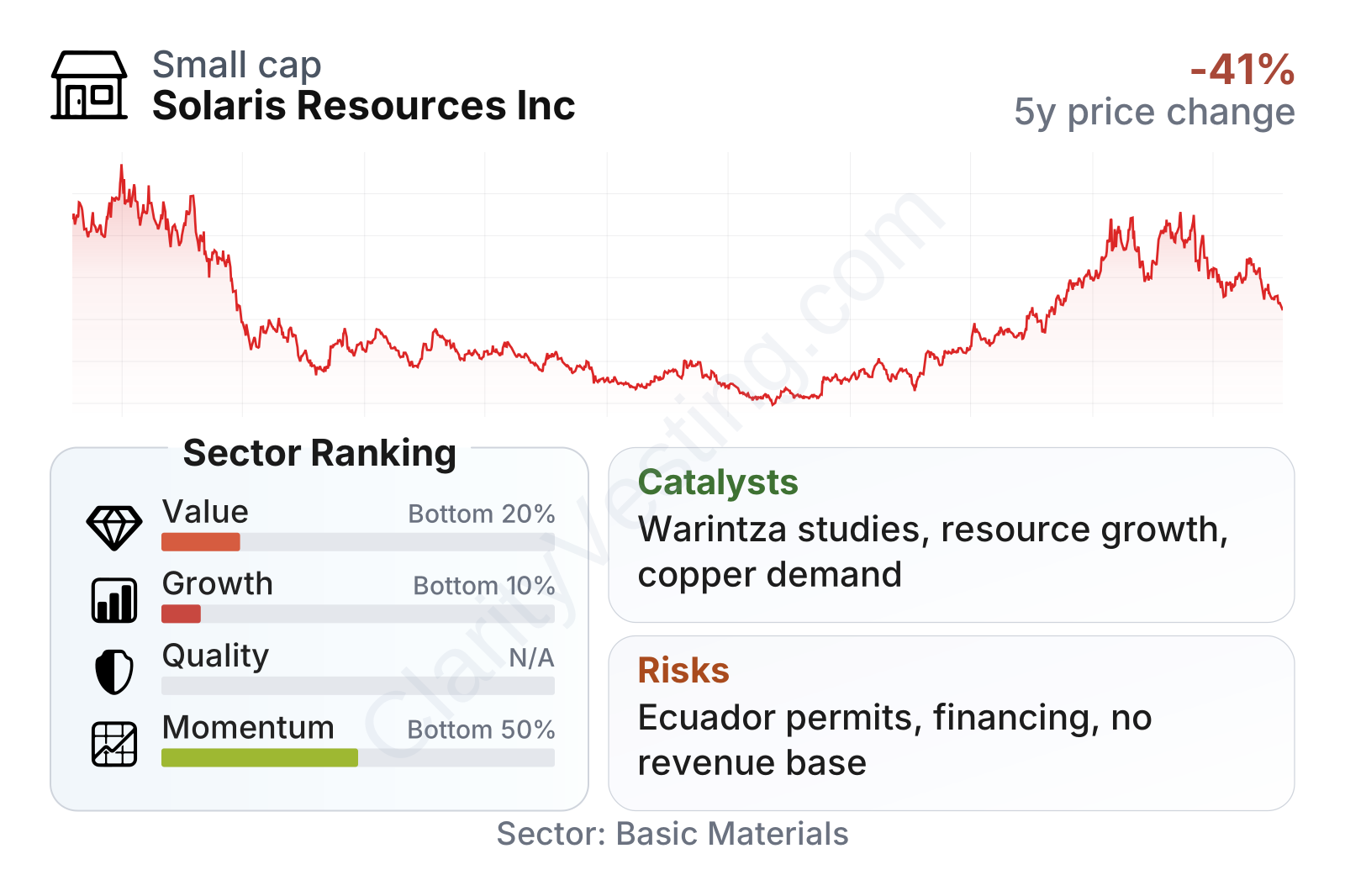
Solaris is a mid-sized mining developer by market value, but its financial profile looks much weaker than most established materials companies because it has no operating revenue and remains loss-making. On value and growth measures, it sits near the bottom of the sector, which is not unusual for a company still proving out a major deposit. Quality metrics are also distorted by this pre-production stage, with negative returns on assets and no current profit margin.
One point stands out positively: free cash flow has recently improved sharply after being deeply negative in earlier periods. That does not mean the company has reached a stable self-funding model, but it does show that financing inflows and spending patterns have become more supportive in the near term. Market behavior has also been volatile. The shares performed strongly over the last three years and over most of the past year, but the more recent trend has weakened, and the stock has fallen below its long-term moving average. That combination suggests a company with substantial long-range expectations but uneven shorter-term confidence.
The share price history reinforces that picture. Solaris traded much higher in 2021 and early 2022, then went through a long reset, followed by a strong recovery into 2026 before another pullback. For a long-term view, this pattern reflects how strongly the stock responds to drilling results, project milestones, financing developments, and broader copper sentiment rather than current earnings.
Growth
Solaris operates in a part of the mining industry with clear long-term demand support. Copper is widely seen as a critical metal for power grids, electric vehicles, renewable energy infrastructure, and broader electrification. That does not guarantee attractive economics for every project, but it does mean the company is exposed to a commodity with stronger structural demand arguments than many other mined materials.
The company’s strategy is logical for that backdrop. Instead of spreading itself across many unrelated assets, Solaris has concentrated attention on Warintza, where it has continued drilling, resource work, technical studies, and engagement with local communities. For a development-stage miner, focus matters: the largest value changes usually come from resource growth, better mine plans, improved economics, and a clearer route toward permitting and construction.
A major catalyst is the scale potential of Warintza itself. Large copper systems are relatively scarce, and bigger deposits can attract strategic partners because scale can justify the massive capital needed to build a mine. If resource updates, engineering studies, or infrastructure planning continue to improve the project, the company’s long-term position could strengthen materially. Another positive factor is Ecuador’s appeal as an emerging copper jurisdiction, where successful large discoveries can become especially important at the national level.
Recent corporate developments have also mattered. Solaris has highlighted progress in technical work, community relationships, and financing arrangements around Warintza, all of which are essential in moving a project from exploration toward development. For a company without current production, these milestones are more important than quarterly sales because they shape whether the asset becomes financeable and buildable.
The recent swing in free cash flow is encouraging at a high level because it suggests a period of stronger funding support relative to spending. Even so, this should be read carefully. In a mine developer, cash flow can change sharply depending on equity raises, asset transactions, partner payments, and timing of exploration programs. It is more useful here as a signal of financial flexibility than as proof of a durable operating improvement.
Overall, the growth case depends less on near-term income statement expansion and more on de-risking a potentially large copper project in a sector with favorable long-term demand conditions.
Risks
This article is for informational purposes only and does not constitute financial advice. Some content is AI-generated. See Disclaimer


