Stock Analysis · Sanlam Limited (SLMAF)
Overview
Sanlam Limited is a South Africa-based financial services group focused mainly on insurance, savings, investment management, and lending. Its roots are in life insurance, but today it operates as a broader financial platform serving individuals, affluent clients, institutions, and businesses across South Africa, the rest of Africa, India, and selected international markets. The company’s model is built around collecting premiums and savings inflows, investing those funds, earning fees for managing assets, and generating underwriting profits from insurance operations.
Its revenue mix can look complex because insurance groups report both premium-related income and investment-related income. At a high level, the business is centered on a few large engines.
- Life and savings businesses in South Africa: approximately the largest contributor, driven by life insurance, retirement products, funeral cover, recurring savings, and related risk products sold through Sanlam Life and linked operations.
- General insurance: a meaningful contributor through Santam, the major non-life insurance subsidiary, covering motor, property, agriculture, engineering, and commercial insurance.
- Asset management and investment income: fees from managing client assets as well as investment returns generated on shareholder and policyholder funds.
- Rest of Africa, India, and other emerging market operations: growing operations outside South Africa across life insurance, health, credit, and savings products, including joint ventures and associates.
- Credit and other financial services: a smaller source that includes unsecured lending, transactional products, and other supporting financial activities.
Based on Sanlam’s recent annual reporting structure, South Africa still accounts for the majority of group earnings and business volumes, while the rest of Africa and India provide an increasingly important growth layer. The group’s earnings are therefore spread across both mature and faster-growing markets, which helps diversify risk compared with a purely domestic insurer.
Another useful way to view Sanlam is as a collection of franchises rather than a single-product insurer. It combines traditional life cover, short-term insurance, wealth management, and cross-border expansion. That breadth gives it multiple ways to grow, although it also makes the company less straightforward to analyze than a simpler insurer.
The business has shown a clear rebound in scale and profitability since the weak 2022 period. Revenue and operating income improved strongly through 2023 and 2024, and total revenue moved higher again in 2025. Net income softened in 2025 versus 2024, which suggests that growth is not perfectly linear, but the broader direction over several years still points to a larger and more diversified group.
Key Figures
| Metric | Value | Sector ⓘ |
|---|---|---|
| Date | Oct 24, 2026 | |
| Context | ||
| Sector | Financial Services | |
| Industry | Insurance - Life | |
| Market Cap ⓘ | $6.79B | |
| Beta ⓘ | 0.51 | |
Value (Cheapness) | ||
| P/E Ratio ⓘ | 11.21 | 12.46 |
| P/B Ratio ⓘ | 0.01 | 1.25 |
| FCF Yield ⓘ | -23.28% | 9.82% |
| Dividend Yield ⓘ | 3.53% | 2.94% |
| EBIT / EV ⓘ | N/A | 8.11% |
| PEG ⓘ | N/A | |
Growth (Business expansion) | ||
| Revenue Growth ⓘ | -11.30% | 9.10% |
| RPS Growth (5Y CAGR) ⓘ | 120.56% | 12.31% |
| EPS Growth (5Y CAGR) ⓘ | -44.72% | -6.97% |
| BVPS Growth (5Y CAGR) ⓘ | 115.62% | 5.02% |
| Margin Growth (5Y Trend) ⓘ | 2.60% | -4.00% |
| FCF Growth (5Y CAGR) ⓘ | N/A | 4.71% |
| DPS Growth (5Y CAGR) ⓘ | 186.33% | 8.92% |
Quality (Business durability) | ||
| ROIC (Latest) ⓘ | N/A | 9.18% |
| ROE (Latest) ⓘ | 43.23% | 13.93% |
| ROA (Latest) ⓘ | 3.52% | 1.57% |
| ROIC (5Y Median) ⓘ | 14.76% | 7.80% |
| ROE (5Y Median) ⓘ | 17.32% | 12.15% |
| ROA (5Y Median) ⓘ | 1.31% | 1.28% |
| Net Debt / EBIT (Latest) ⓘ | -0.29 | 1.02 |
| Net Debt / EBIT (5Y Median) ⓘ | -0.92 | 0.72 |
| Net Debt / EBITDA (Latest) ⓘ | -0.28 | 0.88 |
| Operating Margin (Latest) ⓘ | 13.40% | 22.30% |
| Operating Margin (5Y Median) ⓘ | 10.10% | 24.50% |
| Debt to Equity (Latest) ⓘ | 20.91% | 59.34% |
| Profit Margin (Latest) ⓘ | 8.15% | 26.42% |
| Free Cash Flow (Latest) ⓘ | -$1.58B | |
Momentum (Price trend) | ||
| 3Y Return ⓘ | +49.86% | +95.73% |
| 12M Return (excl. last month) ⓘ | +54.68% | +17.30% |
| 6M Return ⓘ | -23.71% | +6.07% |
| Price vs. 200-Day MA ⓘ | -0.15% | +5.36% |
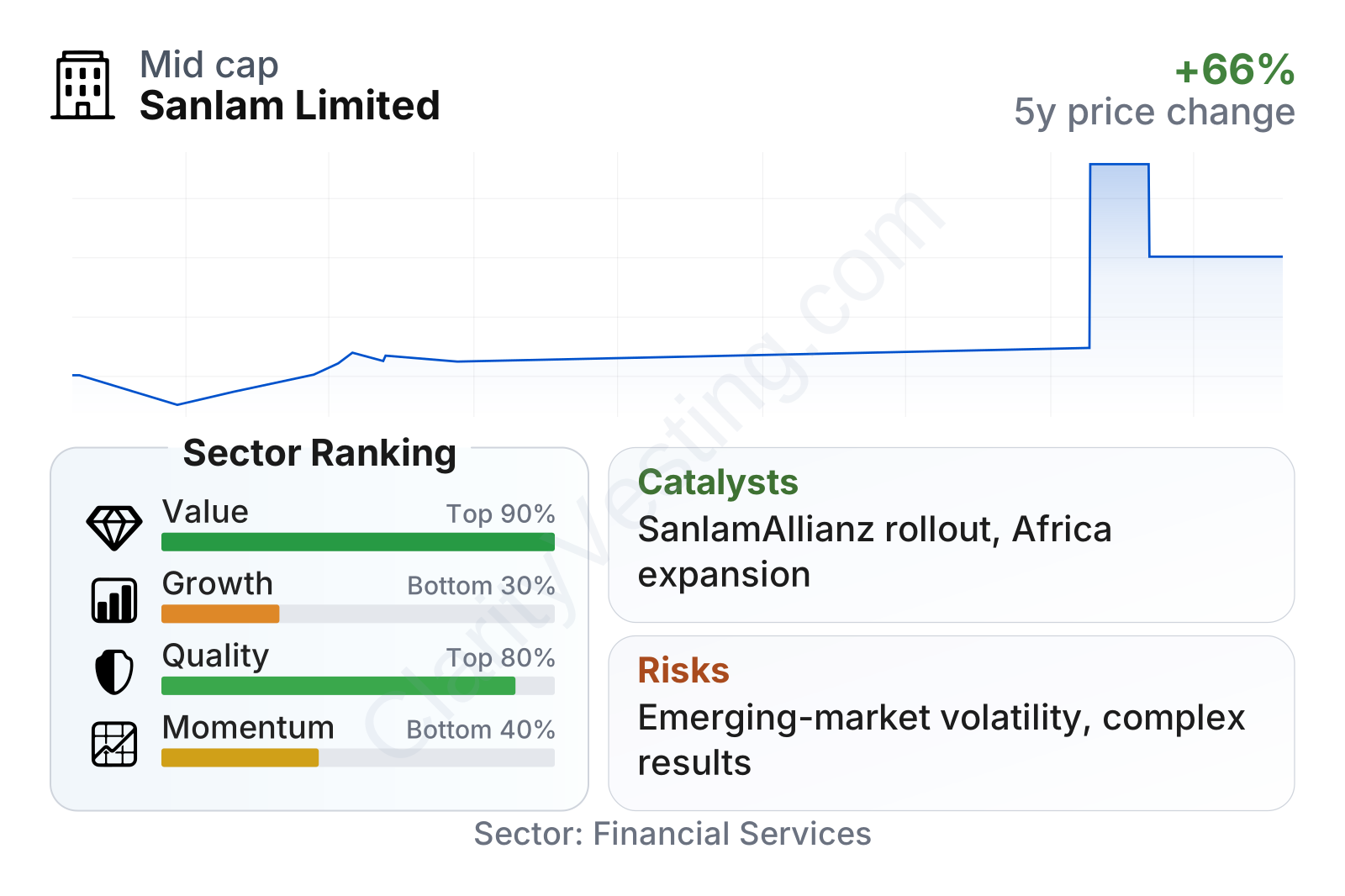
Sanlam stands out more for balance-sheet strength and profitability than for near-term growth. The quality profile is strong relative to much of the financial sector, helped by high returns on equity and assets, conservative leverage, and net cash rather than heavy net debt. Debt to equity is around 21%, well below the sector median near 60%, which gives the group flexibility in a cyclical and regulated industry.
The weaker area is recent growth. Revenue was down about 11% year over year in the latest reading, and earnings growth over five years has been uneven. At the same time, longer-term growth in revenue per share, book value per share, and dividends has been very strong, which points to a business that has been building underlying value even if reported earnings have been volatile.
Valuation metrics look unusual. The earnings multiple is near the sector median, while the dividend yield is slightly above it. The price-to-book reading is extremely low versus peers, which often signals either a data distortion common with insurers listed over the counter in the U.S. or a market discount related to geography, complexity, and reporting structure. The negative free cash flow figure should also be read carefully because cash flow measures are less intuitive for insurers than for industrial companies.
Growth
Sanlam operates in a sector with long-term structural support. Rising insurance penetration, growing middle-class savings needs, retirement planning, healthcare financing, and business risk coverage are all durable themes in Africa and other emerging markets. These markets remain underinsured compared with developed economies, which leaves room for expansion over many years if distribution, pricing, and risk management are handled well.
The company’s strategy broadly fits that opportunity. It already has a strong base in South Africa, one of the continent’s most developed insurance markets, and it has spent years extending into the rest of Africa and India through partnerships, local brands, and ownership stakes. That matters because insurance growth is often driven less by technology disruption and more by trust, regulation, and distribution reach. Sanlam’s existing footprint gives it a practical path to compound premium income and assets under management.
A second growth lever is cross-selling. A customer who starts with funeral cover or basic life products can later be offered investment products, retirement solutions, credit, and short-term insurance. This is one of the advantages of operating across multiple financial lines rather than relying on one category. If execution remains solid, customer value can rise even without very rapid client acquisition.
The latest earnings picture still requires some caution. Reported earnings have not moved in a smooth upward line, and the most recent annual net income was below the prior year’s peak. That said, profitability remains meaningful, and the company’s long-term returns indicate that the business is not simply growing revenue without economic value. For a long-duration financial institution, consistency of capital generation often matters more than one strong year.
Book value per share has risen strongly over the longer term, despite some irregular jumps in the reported history. For an insurer, book value is especially important because it reflects capital accumulation, underwriting discipline, and the ability to support future business. Combined with dividend growth over five years, this points to a company that has been building shareholder value even though short-term earnings have been uneven.
In terms of catalysts, recent corporate communication has continued to emphasize operational resilience, capital generation, and growth outside South Africa. The group also benefits from its exposure to SanlamAllianz, a platform intended to broaden reach across African markets by combining local presence with a larger pan-African insurance structure. If this expansion improves distribution and product depth, it could become one of the more important medium-term drivers.
Risks
This article is for informational purposes only and does not constitute financial advice. Some content is AI-generated. See Disclaimer


