Stock Analysis · SkyWest Inc (SKYW)
Overview
SkyWest Inc is a regional airline company that operates flights for major U.S. airlines rather than selling most tickets under its own brand. Its core role is to provide aircraft, crews, maintenance, and day-to-day regional flight operations under long-term agreements with larger carriers. This makes SkyWest different from a typical airline: its business is tied less to direct ticket pricing and more to service contracts with major partners.
The company mainly serves the regional networks of large U.S. airlines, helping connect smaller cities to larger hubs. That business model can reduce some of the volatility faced by airlines that depend heavily on consumer ticket sales, although it still leaves SkyWest exposed to airline industry cycles, pilot availability, and partner concentration.
Based on recent company reporting, revenue is overwhelmingly generated by flying agreements with major airline partners. A smaller portion comes from leasing aircraft and other related activities.
- Contract flying for major airlines: approximately 90% to 95% of revenue. This includes fixed-fee regional operations, where SkyWest flies routes on behalf of larger carriers and is compensated under contractual terms rather than relying mainly on passenger fares.
- Aircraft leasing and other revenue: approximately 5% to 10% of revenue. This includes leasing aircraft to third parties and a limited amount of other aviation-related income.
Over the past several years, the business has shown a meaningful recovery in revenue and profitability. Annual revenue rose from roughly $2.7 billion in 2021 to more than $4.0 billion in 2025, while net income improved sharply after a weaker 2023. That pattern suggests the company benefited from stronger utilization, better contract economics, and improved operating conditions after the industry’s pilot shortage and post-pandemic disruption.
The long-term trend is notable: revenue has expanded, operating income has improved materially since 2023, and interest expense has become less burdensome relative to profit. That combination points to a business that has moved from recovery into a more productive earnings phase.
Key Figures
| Metric | Value | Sector ⓘ |
|---|---|---|
| Date | Oct 17, 2026 | |
| Context | ||
| Sector | Industrials | |
| Industry | Airlines | |
| Market Cap ⓘ | $3.67B | |
| Beta ⓘ | 1.48 | |
Value (Cheapness) | ||
| P/E Ratio ⓘ | 9.45 | 22.10 |
| P/B Ratio ⓘ | 1.34 | 1.97 |
| FCF Yield ⓘ | 8.59% | 6.38% |
| Dividend Yield ⓘ | N/A | 1.94% |
| EBIT / EV ⓘ | 10.85% | 4.79% |
| PEG ⓘ | 1.66 | |
Growth (Business expansion) | ||
| Revenue Growth ⓘ | 6.50% | 9.30% |
| RPS Growth (5Y CAGR) ⓘ | 16.36% | 7.81% |
| EPS Growth (5Y CAGR) ⓘ | 39.43% | -13.06% |
| BVPS Growth (5Y CAGR) ⓘ | 10.39% | 6.14% |
| Margin Growth (5Y Trend) ⓘ | 6.42% | 0.88% |
| FCF Growth (5Y CAGR) ⓘ | 17.53% | 11.01% |
| DPS Growth (5Y CAGR) ⓘ | -50.34% | 9.48% |
Quality (Business durability) | ||
| ROIC (Latest) ⓘ | 9.35% | 10.84% |
| ROA (Latest) ⓘ | 5.61% | 5.41% |
| ROIC (5Y Median) ⓘ | 5.33% | 9.38% |
| ROA (5Y Median) ⓘ | 1.56% | 4.95% |
| Net Debt / EBIT (Latest) ⓘ | 3.62 | 2.08 |
| Net Debt / EBIT (5Y Median) ⓘ | 11.28 | 2.27 |
| Net Debt / EBITDA (Latest) ⓘ | 2.26 | 1.39 |
| Net Debt / Assets ⓘ | 29.88% | 19.28% |
| EBITDA / Interest ⓘ | 9.78 | 9.58 |
| Operating Margin (Latest) ⓘ | 14.61% | 10.50% |
| Operating Margin (5Y Median) ⓘ | 10.09% | 10.29% |
| Debt to Equity (Latest) ⓘ | 83.16% | 65.48% |
| Profit Margin (Latest) ⓘ | 9.78% | 6.67% |
| Free Cash Flow (Latest) ⓘ | $315.17M | |
Momentum (Price trend) | ||
| 3Y Return ⓘ | +133.00% | +61.68% |
| 12M Return (excl. last month) ⓘ | -9.83% | +12.58% |
| 6M Return ⓘ | -5.78% | 0.00% |
| Price vs. 200-Day MA ⓘ | -4.12% | +0.02% |
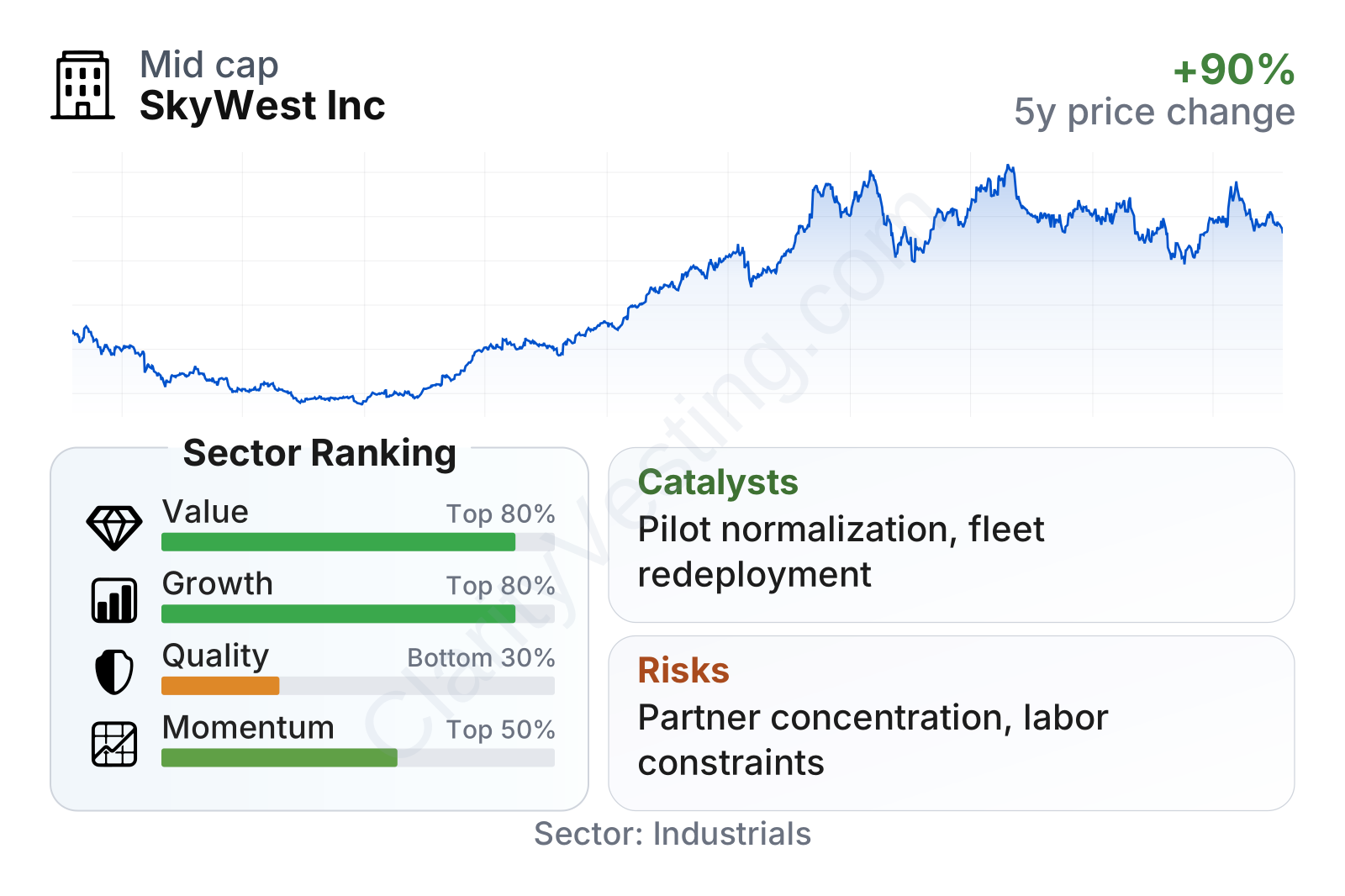
SkyWest sits in the mid-cap range and carries above-average share price volatility, which is common for airline-related businesses. On valuation and growth measures, it ranks well versus much of the industrial sector universe, with a low earnings multiple, a modest price-to-book ratio, and free cash flow yield above the sector median. Growth metrics are also solid over a multiyear period, especially in earnings, revenue per share, and cash generation. The weaker area is balance-sheet and capital-efficiency quality, where leverage remains higher than many peers even after recent improvement.
Growth
Regional air service remains an important part of the U.S. aviation system because major airlines rely on smaller aircraft to feed passengers into larger hubs. That does not make regional flying a high-growth niche every year, but it does make it strategically necessary. SkyWest’s position in this ecosystem is significant: it is one of the largest regional airline operators in North America, with scale that smaller competitors may struggle to match.
The company’s strategy for growth is fairly clear. It focuses on long-term flying partnerships, fleet optimization, and maintaining a broad operating platform across multiple major airline partners. That approach makes sense in a sector where reliability, crew availability, and operational execution matter as much as pricing. If major carriers want regional capacity without owning and staffing every aircraft themselves, operators like SkyWest remain central to that model.
Recent revenue growth has cooled from the very strong rebound phase seen in 2024 and 2025, but it remains positive. The current pace is no longer exceptional, yet it still suggests the company is growing rather than stalling. Over five years, revenue per share growth has clearly outpaced the sector median, which indicates that expansion has not been purely nominal.
Cash generation is another important part of the growth picture. Free cash flow was negative earlier in the cycle, then turned strongly positive and has remained positive even as it came down from peak levels. That is a healthier pattern than growth fueled only by accounting earnings, because it shows the business has recently been able to translate operations into actual cash.
As for catalysts, one of the biggest is the continued normalization of regional airline staffing and fleet utilization. SkyWest has spent several years working through pilot shortages that limited industry capacity. If labor availability continues to improve, the company can keep flying more efficiently and support better aircraft use. Another catalyst is aircraft leasing and redeployment: SkyWest has shown it can extract value from owned aircraft through leasing, sales, or placement into contract service. Stronger contract terms with major airline partners could also support margins if demand for dependable regional capacity remains firm.
Recent company updates have also pointed to active fleet management and ongoing alignment with major carriers’ network needs. For a business like SkyWest, those developments matter because incremental improvements in utilization and contract structure can have an outsized effect on profit.
Risks
This article is for informational purposes only and does not constitute financial advice. Some content is AI-generated. See Disclaimer


