Stock Analysis · Skydance Corporation (SKYD)
Overview
Skydance Corporation operates in entertainment and media. In practice, the business profile behind the ticker reflects a large-scale content and distribution platform built around filmed entertainment, television, and direct-to-consumer streaming. The company develops and distributes movies and series, licenses content, and earns revenue from subscription and advertising activity tied to its media platforms.
Based on recent public reporting and the company’s financial structure, its revenue mix is led by a few major categories:
- Direct-to-consumer streaming and related digital distribution: approximately 45% to 50% of revenue. This usually includes subscription revenue, advertising tied to streaming services, and digital content delivery.
- TV media networks and affiliate-related revenue: approximately 25% to 30% of revenue. This generally includes carriage fees and advertising from linear television channels.
- Filmed entertainment: approximately 15% to 20% of revenue. This includes theatrical releases, home entertainment, and licensing of film content.
- Content licensing and other media activities: approximately 5% to 10% of revenue. This can include third-party licensing, consumer products, and other ancillary activities.
The company is therefore not a narrow single-franchise business. It is a diversified media group whose economics depend on audience scale, content performance, advertising markets, and the ability to monetize intellectual property across multiple channels. That gives it breadth, but it also means results can be affected by shifts in viewing habits and by heavy content spending.
The recent financial path shows that revenue has remained large and fairly stable, but profitability has been much more volatile. Gross profit has recovered from weaker levels, while operating and net income have been under pressure. That combination suggests a business still capable of generating substantial sales, but one that has not yet fully translated scale into steady earnings.
The financial flow over the last several years points to a business with resilient revenue near the same broad range, but with margins that deteriorated sharply after 2022. More recently, gross profit improved, which is encouraging, yet operating performance has remained weak enough to keep overall earnings under pressure.
Key Figures
| Metric | Value | Sector ⓘ |
|---|---|---|
| Date | Oct 31, 2026 | |
| Context | ||
| Sector | Communication Services | |
| Industry | Entertainment | |
| Market Cap ⓘ | $37.77B | |
| Beta ⓘ | 1.55 | |
Value (Cheapness) | ||
| P/E Ratio ⓘ | N/A | 18.47 |
| FCF Yield ⓘ | 1.17% | 14.23% |
| Dividend Yield ⓘ | 2.57% | 2.78% |
| EBIT / EV ⓘ | -9.47% | 4.73% |
| PEG ⓘ | 2.41 | |
Growth (Business expansion) | ||
| Revenue Growth ⓘ | 0.90% | 6.10% |
| RPS Growth (5Y CAGR) ⓘ | -17.18% | 4.57% |
| EPS Growth (5Y CAGR) ⓘ | -30.57% | -17.96% |
| Margin Growth (5Y Trend) ⓘ | N/A | 1.32% |
| FCF Growth (5Y CAGR) ⓘ | -14.31% | 5.75% |
| DPS Growth (5Y CAGR) ⓘ | -57.52% | 5.19% |
Quality (Business durability) | ||
| ROIC (Latest) ⓘ | -16.90% | 9.19% |
| ROIC (5Y Median) ⓘ | N/A | 8.24% |
| Net Debt / EBIT (Latest) ⓘ | N/A | 1.92 |
| Net Debt / EBIT (5Y Median) ⓘ | N/A | 2.88 |
| Net Debt / EBITDA (Latest) ⓘ | N/A | 1.22 |
| Net Debt / Assets ⓘ | 30.46% | 18.63% |
| EBITDA / Interest ⓘ | N/A | 8.36 |
| Operating Margin (Latest) ⓘ | -16.85% | 15.68% |
| Operating Margin (5Y Median) ⓘ | -1.12% | 13.39% |
| Debt to Equity (Latest) ⓘ | 128.76% | 59.65% |
| Profit Margin (Latest) ⓘ | -2.13% | 8.74% |
| Free Cash Flow (Latest) ⓘ | $440.00M | |
Momentum (Price trend) | ||
| 3Y Return ⓘ | -23.77% | +46.16% |
| 12M Return (excl. last month) ⓘ | -46.38% | +1.26% |
| 6M Return ⓘ | -26.13% | 0.00% |
| Price vs. 200-Day MA ⓘ | -22.94% | +0.87% |
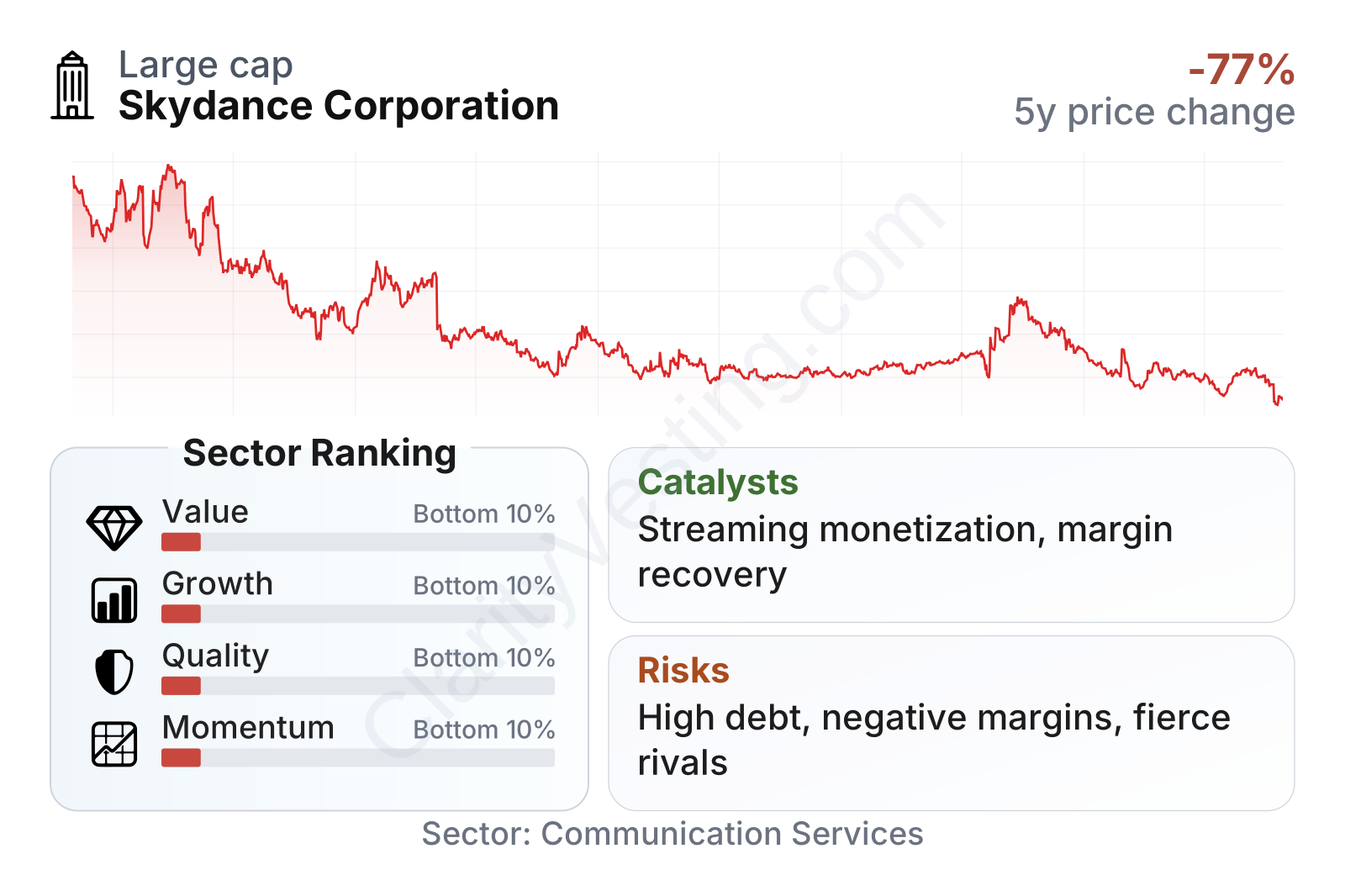
The overall picture is weak relative to the broader Communication Services sector. On value, growth, and quality measures, the company ranks near the bottom of its peer group. Revenue growth is positive but modest, free cash flow yield is low, margins are negative, and leverage is elevated. The market is therefore not rewarding the company for current fundamentals, and the recent share-price trend shows that confidence remains fragile.
Skydance is still a large company by market value, but its risk profile is higher than average. A beta above 1.5 suggests the stock has been more volatile than the market, which fits with the uneven operating results and sharp swings visible in the longer-term price chart.
Growth
The company operates in a sector that still has long-term growth drivers. Global demand for streaming content, franchise-based entertainment, and monetization of large content libraries remains significant. Audiences continue shifting from traditional television toward on-demand platforms, and major media groups are trying to capture that shift through scale, pricing, advertising-supported tiers, and tighter control of production spending.
That backdrop gives Skydance a credible strategic logic. A company with broad entertainment assets can use content across theaters, television, and streaming, while also extending successful titles into licensing and other formats. In theory, that model creates a flywheel: strong intellectual property draws audiences, audiences support subscriptions and advertising, and those cash flows help fund new releases. The challenge is execution, because the sector increasingly rewards only the players with either very strong franchises, very efficient cost structures, or both.
Recent revenue growth appears positive but slow, running around 1% to 2% year over year in the latest periods. That is below the sector median and suggests the company is participating in industry growth less effectively than many peers. For a media business going through digital transition, low top-line growth limits flexibility because content, marketing, and platform costs do not fall easily.
Free cash flow remains positive, which matters. Even with earnings under pressure, the business is still generating cash rather than consuming it at an extreme rate. That said, the recent level has been only a few hundred million dollars on a company of this size, so the cash cushion does not yet look strong enough to fully offset concerns about debt, profitability, and the need for ongoing investment in content.
A meaningful catalyst would be any sustained improvement in monetization from streaming, better performance of major releases, or a clearer turnaround in operating discipline. In the current media landscape, companies that show they can grow direct-to-consumer revenue while controlling content costs often get a much better market response than those that only maintain scale.
Risks
This article is for informational purposes only and does not constitute financial advice. Some content is AI-generated. See Disclaimer


