Stock Analysis · SEEK Limited (SKLTF)
Overview
SEEK Limited is an online employment marketplace company best known for connecting job seekers with employers and recruiters. Its core business is digital job advertising, but the platform has expanded beyond simple listings into hiring tools, employer branding, talent sourcing, and adjacent HR technology services. The group is headquartered in Australia and has a strong presence in Australia, New Zealand, and parts of Asia, with additional exposure through investments and partner platforms.
The business model is relatively straightforward: employers pay to advertise roles and access recruiting tools, while SEEK benefits from the network effect created by a large base of job seekers and hiring organizations. In practice, that means revenue depends heavily on labor market activity, hiring demand, and the company’s ability to keep its platforms useful enough to justify pricing and product upgrades.
Based on recent company reporting, revenue is mainly generated from online employment marketplaces and related hiring solutions. The broad mix can be summarized as follows:
- ANZ employment marketplace: approximately 55% to 65% of group revenue. This includes job ads, candidate services, and employer hiring products in Australia and New Zealand, which remain the company’s economic core.
- Asian employment platforms: approximately 15% to 25%. This includes SEEK’s regional online job platforms and related recruitment technology operations across Asia.
- Investments, partner earnings, and other services: approximately 15% to 25%. This bucket can include contributions from strategic stakes, associated entities, and adjacent HR or education-related activities depending on the reporting period.
One notable financial characteristic is that SEEK is a high gross-margin platform business at the operating level, but reported net income has recently been much more volatile than revenue because of non-cash items, investment revaluations, impairments, and finance costs. That distinction matters for long-term analysis: the underlying marketplace can still produce solid cash flow even when accounting profit looks weak.
The operating profile shows that revenue rebounded strongly in the latest year after a softer period, while selling and administrative costs remain the largest expense line. Gross profit is still substantial relative to revenue, which is typical for digital marketplace models, but recent bottom-line swings show how much reported earnings can be affected by items below the gross profit line.
Key Figures
| Metric | Value | Sector ⓘ |
|---|---|---|
| Date | Oct 31, 2026 | |
| Context | ||
| Sector | Communication Services | |
| Industry | Internet Content & Information | |
| Market Cap ⓘ | $3.51B | |
| Beta ⓘ | 0.96 | |
Value (Cheapness) | ||
| P/E Ratio ⓘ | N/A | 18.47 |
| FCF Yield ⓘ | 20.46% | 14.23% |
| Dividend Yield ⓘ | 5.31% | 2.78% |
| EBIT / EV ⓘ | 15.43% | 4.73% |
| PEG ⓘ | 1.57 | |
Growth (Business expansion) | ||
| Revenue Growth ⓘ | 20.60% | 6.10% |
| RPS Growth (5Y CAGR) ⓘ | 3.34% | 4.57% |
| EPS Growth (5Y CAGR) ⓘ | -35.38% | -17.96% |
| Margin Growth (5Y Trend) ⓘ | -10.88% | 1.32% |
| FCF Growth (5Y CAGR) ⓘ | N/A | 5.75% |
| DPS Growth (5Y CAGR) ⓘ | 3.33% | 5.19% |
Quality (Business durability) | ||
| ROIC (Latest) ⓘ | N/A | 9.19% |
| ROIC (5Y Median) ⓘ | 7.41% | 8.24% |
| Net Debt / EBIT (Latest) ⓘ | 1.63 | 1.92 |
| Net Debt / EBIT (5Y Median) ⓘ | 3.29 | 2.88 |
| Net Debt / EBITDA (Latest) ⓘ | 1.12 | 1.22 |
| Net Debt / Assets ⓘ | 28.14% | 18.63% |
| EBITDA / Interest ⓘ | 6.45 | 8.36 |
| Operating Margin (Latest) ⓘ | 29.05% | 15.68% |
| Operating Margin (5Y Median) ⓘ | 30.03% | 13.39% |
| Debt to Equity (Latest) ⓘ | 59.53% | 59.65% |
| Profit Margin (Latest) ⓘ | -28.91% | 8.74% |
| Free Cash Flow (Latest) ⓘ | $717.49M | |
Momentum (Price trend) | ||
| 3Y Return ⓘ | -24.14% | +46.16% |
| 12M Return (excl. last month) ⓘ | -43.40% | +1.26% |
| 6M Return ⓘ | -4.89% | 0.00% |
| Price vs. 200-Day MA ⓘ | N/A | +0.87% |
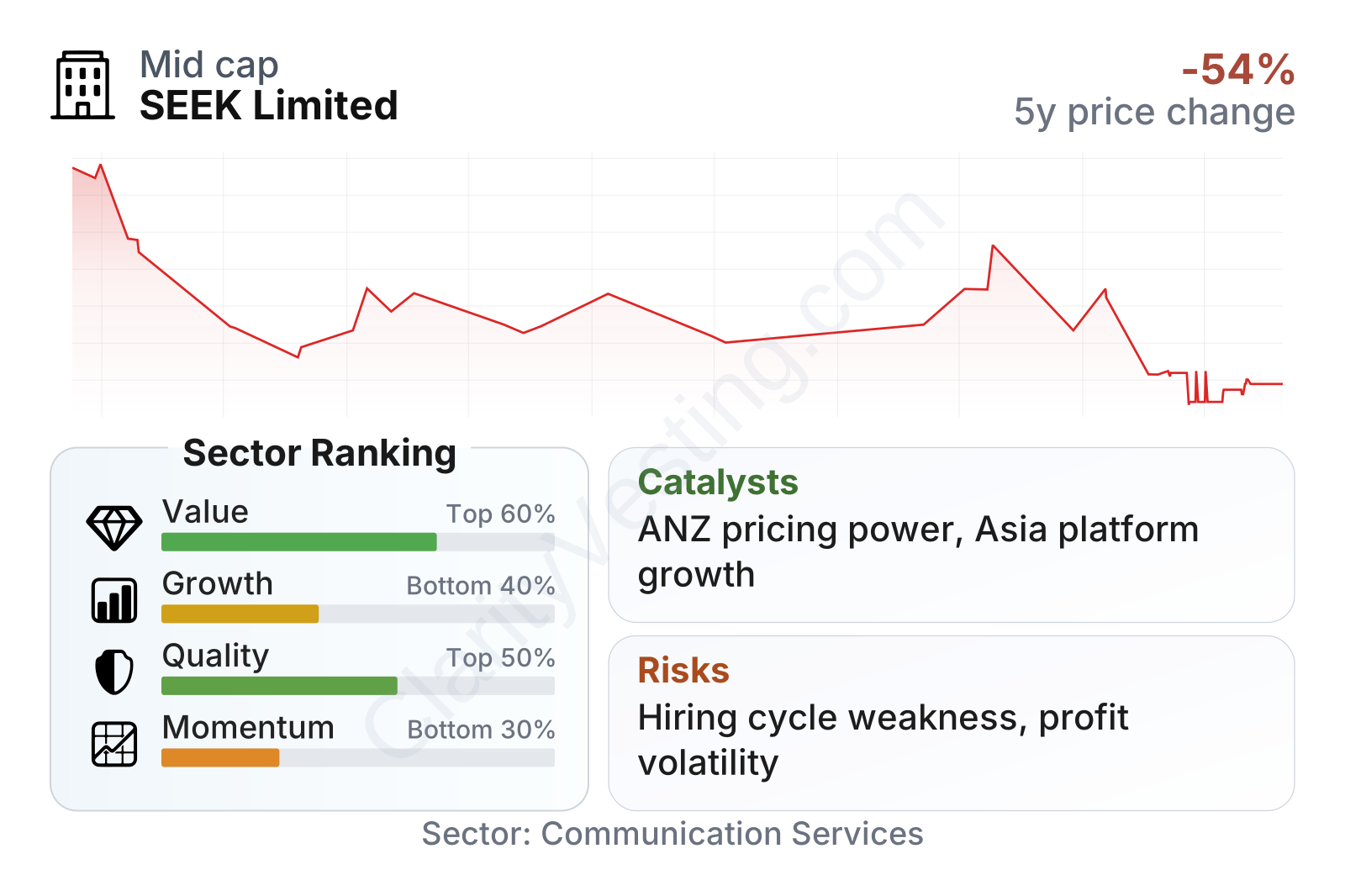
SEEK sits in the mid-sized range by market value and has shown lower share-price volatility than many internet-related companies, as suggested by a beta below 1. On valuation and cash generation, the profile looks stronger than much of its sector: free cash flow yield, dividend yield, and EBIT relative to enterprise value all stand above sector medians. Quality is more mixed but still respectable, with operating margins clearly above the sector median and leverage that looks manageable rather than aggressive.
The weak spot is the combination of earnings volatility and market momentum. Recent revenue growth has been strong, but the longer five-year trend in revenue per share and earnings per share has been less impressive, and share performance has lagged the sector by a wide margin over both one-year and three-year periods. In other words, the business has healthy cash characteristics, but the market remains cautious about the durability and visibility of profit growth.
Growth
SEEK operates in a sector with durable long-term relevance. Hiring is a recurring business need, and recruitment has steadily shifted from print and offline channels to digital platforms, data-driven matching tools, and integrated hiring software. That broader direction still supports online employment marketplaces, especially those with established local brand recognition and large user bases.
SEEK’s strategy also makes sense in that context. The company is not only selling job ads; it is trying to deepen its role in the hiring process through product bundling, employer tools, and platform improvements. That can strengthen monetization even if job volumes are not rising every year. A company with entrenched position in Australia and New Zealand has room to grow by improving average revenue per customer, adding workflow products, and using data to improve matching and conversion.
The latest growth picture is better than the longer-term averages suggest. Recent year-over-year revenue growth of roughly 21% is well ahead of the sector median, indicating that SEEK has regained momentum operationally. The more cautious interpretation is that five-year growth measures are still modest, so the recent acceleration needs to become more consistent before it clearly changes the long-range pattern.
A meaningful catalyst is the company’s ability to translate scale into product pricing and higher customer spend. SEEK benefits when employers view its platform as essential rather than optional, because that supports premium listings, broader recruiting packages, and recurring use of hiring tools. Another possible catalyst is improvement in Asian operations and strategic investments, which could expand the addressable market beyond the mature ANZ base.
Recent company updates have also highlighted ongoing investment in platform capabilities and product development. For a marketplace business, that matters because the long-term winners tend to be those that keep both sides of the platform engaged: employers must feel they are getting effective hiring outcomes, and candidates must continue to see SEEK as one of the first places to search for roles.
Risks
This article is for informational purposes only and does not constitute financial advice. Some content is AI-generated. See Disclaimer


