Stock Analysis · Sonic Healthcare Ltd (SKHHY)
Overview
Sonic Healthcare Ltd is a global medical diagnostics company. Its core business is laboratory testing: doctors, hospitals, and other healthcare providers send patient samples to Sonic’s labs, which then analyze them and return results used for diagnosis, treatment decisions, and monitoring. The group also operates radiology centers and a smaller portfolio of medical services. Sonic was founded in Australia and has expanded across several major healthcare markets, including Australia, Germany, the United Kingdom, Switzerland, Belgium, and the United States.
Its revenue is mainly generated by routine and specialized pathology testing, with radiology and other healthcare services making up smaller portions. Based on recent annual reporting, the business mix is approximately:
- Laboratory / pathology services: about 85% to 90% of revenue. This includes routine blood testing, anatomic pathology, microbiology, genetics, and other diagnostic services performed for hospitals, physicians, and community patients.
- Radiology services: about 10% to 15% of revenue. This includes imaging such as MRI, CT, ultrasound, X-ray, and related outpatient radiology services, mainly in Australia.
- Other medical services: low single-digit share of revenue. This includes smaller healthcare activities that are not central to the group.
Geographically, Sonic is fairly diversified. Australia is an important profit center, but Europe is also a major contributor and the United States adds scale. That spread helps reduce dependence on one healthcare system, although it also exposes the company to multiple reimbursement and regulatory environments.
The business model is relatively straightforward for long-term readers: Sonic earns recurring revenue from very high volumes of medically necessary tests, but its results depend heavily on reimbursement rates, operating efficiency, labor availability, and the mix between ordinary testing and unusually profitable surges such as pandemic-era COVID testing.
The long-term picture shows a business that has regained revenue growth after the post-pandemic reset, but with profitability still well below the unusually high levels reached during COVID testing. Revenue has moved back above prior peaks, while net income has recovered more slowly, suggesting that volume growth is real but margins remain under pressure from wages, financing costs, and a more normal test mix.
Key Figures
| Metric | Value | Sector ⓘ |
|---|---|---|
| Date | Oct 03, 2026 | |
| Context | ||
| Sector | Healthcare | |
| Industry | Diagnostics & Research | |
| Market Cap ⓘ | $6.57B | |
| Beta ⓘ | 0.58 | |
Value (Cheapness) | ||
| P/E Ratio ⓘ | 15.02 | 24.06 |
| P/B Ratio ⓘ | 0.76 | 3.08 |
| FCF Yield ⓘ | 19.47% | 3.07% |
| Dividend Yield ⓘ | 5.84% | 2.05% |
| EBIT / EV ⓘ | 16.99% | 0.63% |
| PEG ⓘ | N/A | |
Growth (Business expansion) | ||
| Revenue Growth ⓘ | 8.90% | 7.50% |
| RPS Growth (5Y CAGR) ⓘ | 2.96% | 8.70% |
| EPS Growth (5Y CAGR) ⓘ | N/A | -18.20% |
| BVPS Growth (5Y CAGR) ⓘ | 3.42% | 3.95% |
| Margin Growth (5Y Trend) ⓘ | -12.92% | -0.58% |
| FCF Growth (5Y CAGR) ⓘ | -19.97% | 0.88% |
| DPS Growth (5Y CAGR) ⓘ | 2.00% | 6.80% |
Quality (Business durability) | ||
| ROIC (Latest) ⓘ | N/A | 3.29% |
| ROA (Latest) ⓘ | 6.12% | 3.02% |
| ROIC (5Y Median) ⓘ | 7.71% | 4.75% |
| ROA (5Y Median) ⓘ | 3.62% | 1.93% |
| Net Debt / EBIT (Latest) ⓘ | 2.93 | 1.33 |
| Net Debt / EBIT (5Y Median) ⓘ | 3.54 | 1.83 |
| Net Debt / EBITDA (Latest) ⓘ | 1.60 | 0.99 |
| Net Debt / Assets ⓘ | 30.91% | 5.33% |
| EBITDA / Interest ⓘ | 9.65 | 9.63 |
| Operating Margin (Latest) ⓘ | 9.79% | 9.25% |
| Operating Margin (5Y Median) ⓘ | 9.92% | 7.80% |
| Debt to Equity (Latest) ⓘ | 70.03% | 28.99% |
| Profit Margin (Latest) ⓘ | 5.60% | 3.60% |
| Free Cash Flow (Latest) ⓘ | $1.28B | |
Momentum (Price trend) | ||
| 3Y Return ⓘ | -22.93% | +37.48% |
| 12M Return (excl. last month) ⓘ | -6.40% | +20.85% |
| 6M Return ⓘ | -6.32% | +9.73% |
| Price vs. 200-Day MA ⓘ | -9.59% | +4.69% |
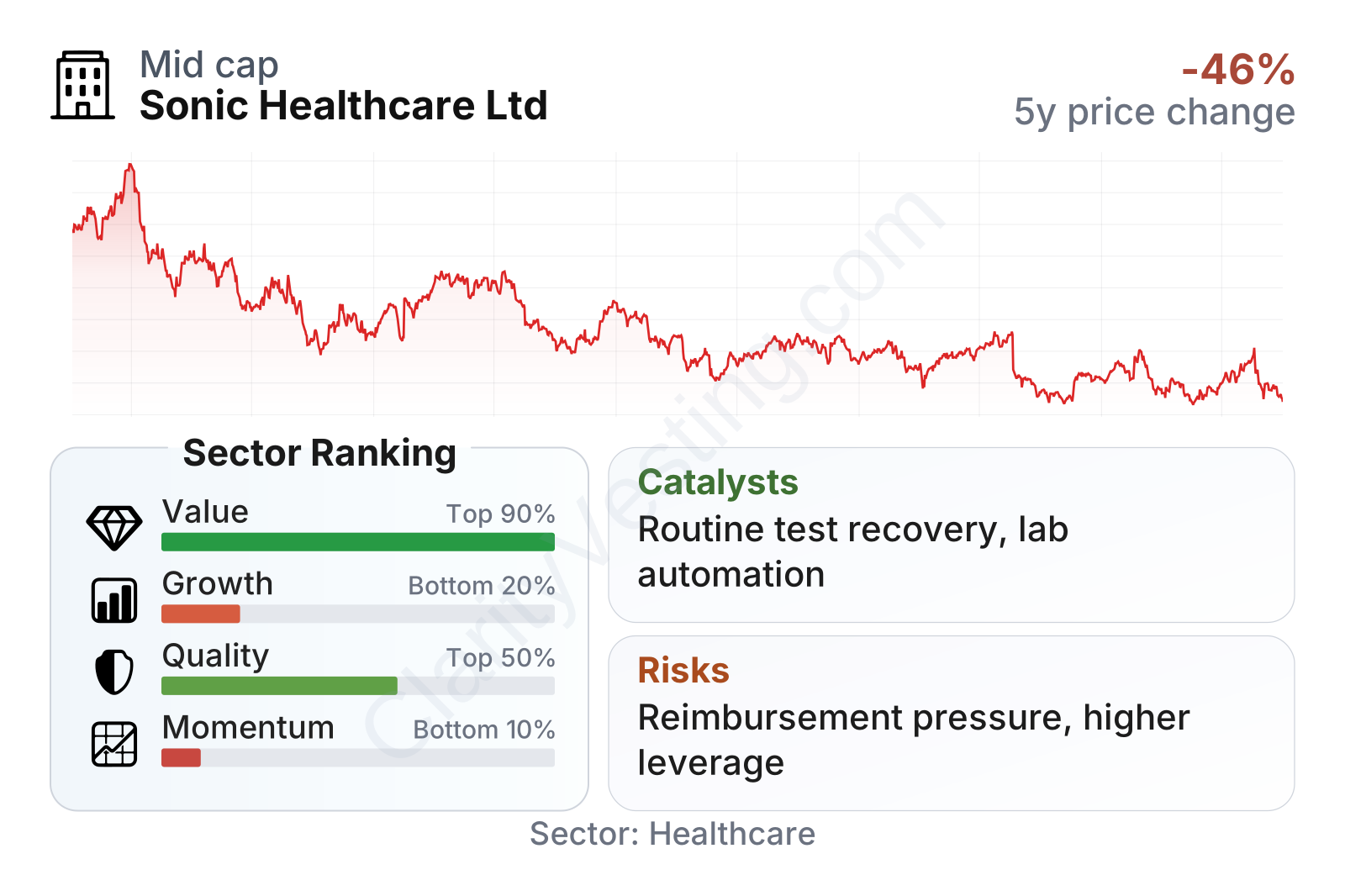
Sonic looks inexpensive relative to much of the healthcare sector on several common measures. Its earnings multiple, book value multiple, free cash flow yield, and dividend yield all sit in favorable territory versus sector medians. Quality is more mixed but still solid overall: profitability remains better than the sector median and returns on assets have been healthy, while debt is clearly higher than average. Growth and share-price momentum are the weaker areas, reflecting the difficult comparison period after pandemic testing faded and the market’s muted view of the recovery pace.
The stock’s beta is low, which fits the defensive nature of diagnostics demand. At the same time, the share price has trended down over the last few years, so the market has not rewarded the company for its resilience yet. That combination often points to a business viewed as stable, but currently lacking a strong growth narrative.
Growth
Healthcare diagnostics is generally a growing sector over the long run. Demand tends to rise with aging populations, higher chronic disease prevalence, broader use of preventive screening, and growing reliance on lab data in everyday medical decision-making. Testing is also deeply embedded in the healthcare system, which makes it more durable than many elective healthcare categories.
Sonic’s strategy is sensible for this type of industry. The company has built scale across multiple countries, which can support purchasing power, laboratory automation, logistics efficiency, and the ability to spread technology and compliance costs over a large volume base. In diagnostics, size matters because many costs are fixed, so additional volume can improve economics when the network is well utilized.
Revenue growth has been uneven in recent years because the business first benefited from extraordinary COVID-related testing and then faced the unwind of that temporary demand. More recently, growth has normalized, and the latest annual revenue level indicates that the underlying business is still expanding. That is encouraging, but it is important to separate normal operating growth from pandemic distortions when judging the company’s trajectory.
Cash generation remains one of the more constructive points in the case. Free cash flow has come down from earlier highs, but it is still meaningful in absolute terms and supports dividends, debt servicing, and selective acquisitions. In diagnostics, the ability to turn accounting profit into cash is especially important because the business requires ongoing investment in labs, IT systems, and equipment.
One of the clearest catalysts is operational recovery in routine pathology. If volumes continue to improve and pricing keeps pace with cost inflation, earnings growth can outpace revenue growth. Another potential tailwind is consolidation: Sonic has a long history of acquisitions, and fragmented diagnostic markets can create opportunities to add labs or specialist capabilities. Technology could also help, especially automation and digital workflow tools that reduce labor intensity and improve turnaround times.
Recent company reporting also points to ongoing investment in laboratory infrastructure, efficiency programs, and selective expansion in core markets. None of these is a dramatic one-off event, but together they support a practical long-term growth path based on scale, productivity, and steady healthcare demand rather than speculative breakthroughs.
Risks
This article is for informational purposes only and does not constitute financial advice. Some content is AI-generated. See Disclaimer