Stock Analysis · Sonic Healthcare Limited (SKHCF)
Overview
Sonic Healthcare Limited is a medical diagnostics company best known for pathology and clinical laboratory testing. It processes blood, tissue, and other samples for doctors, hospitals, and health systems, and it also operates radiology centers in selected markets. The group has a broad international footprint, with major operations in Australia, Germany, the United Kingdom, Switzerland, Belgium, and the United States. Its business is built around essential healthcare services that are used every day, which usually makes demand steadier than in many other parts of healthcare.
The company’s main revenue sources are primarily geographic and service-based. Based on recent annual reporting, the mix is roughly as follows:
- Laboratory / pathology services: about 85% to 90% of revenue. This includes routine clinical testing, specialty testing, hospital laboratory services, and physician-ordered diagnostics.
- Radiology services: about 10% to 15% of revenue. This includes imaging such as MRI, CT, ultrasound, and X-ray, mainly in Australia.
- By geography, Europe and Australia are the largest contributors, with the United States also meaningful but smaller than the company’s biggest regional operations. The exact mix can move year to year with acquisitions, currency, and testing volumes.
Sonic’s business model is fairly simple to understand: collect samples or imaging requests, process them at scale, and earn revenue per test or scan. Scale matters because a larger network can spread equipment, logistics, and lab infrastructure over more volume. That is one reason the company has spent years building a multi-country platform through acquisitions and local market positions.
Recent financial flows suggest revenue has recovered well from the post-pandemic reset, with total sales rising again after the sharp drop that followed unusually high COVID testing volumes. Profitability has not fully returned to earlier peak levels, but operating income and net income improved in the latest fiscal year while cash generation remains strong.
The overall picture is a business with large recurring healthcare activity, but one that is still working through the margin effects of labor inflation, mix changes, and the normalization of pandemic-era testing demand.
Key Figures
| Metric | Value | Sector ⓘ |
|---|---|---|
| Date | Oct 24, 2026 | |
| Context | ||
| Sector | Healthcare | |
| Industry | Diagnostics & Research | |
| Market Cap ⓘ | $7.15B | |
| Beta ⓘ | 0.57 | |
Value (Cheapness) | ||
| P/E Ratio ⓘ | 16.27 | 25.42 |
| P/B Ratio ⓘ | 0.80 | 3.08 |
| FCF Yield ⓘ | 24.26% | 3.12% |
| Dividend Yield ⓘ | 5.65% | 1.85% |
| EBIT / EV ⓘ | 19.49% | 0.56% |
| PEG ⓘ | N/A | |
Growth (Business expansion) | ||
| Revenue Growth ⓘ | 8.90% | 7.50% |
| RPS Growth (5Y CAGR) ⓘ | 3.40% | 8.60% |
| EPS Growth (5Y CAGR) ⓘ | 18.97% | -17.73% |
| BVPS Growth (5Y CAGR) ⓘ | 3.38% | 3.72% |
| Margin Growth (5Y Trend) ⓘ | -13.17% | -0.57% |
| FCF Growth (5Y CAGR) ⓘ | N/A | 0.96% |
| DPS Growth (5Y CAGR) ⓘ | 2.53% | 6.69% |
Quality (Business durability) | ||
| ROIC (Latest) ⓘ | N/A | 3.17% |
| ROA (Latest) ⓘ | 6.98% | 2.98% |
| ROIC (5Y Median) ⓘ | 7.78% | 4.56% |
| ROA (5Y Median) ⓘ | 3.70% | 1.87% |
| Net Debt / EBIT (Latest) ⓘ | 2.56 | 1.34 |
| Net Debt / EBIT (5Y Median) ⓘ | 3.52 | 1.86 |
| Net Debt / EBITDA (Latest) ⓘ | 1.40 | 1.00 |
| Net Debt / Assets ⓘ | 30.91% | 5.06% |
| EBITDA / Interest ⓘ | 9.66 | 9.55 |
| Operating Margin (Latest) ⓘ | 9.82% | 9.25% |
| Operating Margin (5Y Median) ⓘ | 9.92% | 7.33% |
| Debt to Equity (Latest) ⓘ | 70.03% | 26.68% |
| Profit Margin (Latest) ⓘ | 5.60% | 3.34% |
| Free Cash Flow (Latest) ⓘ | $1.73B | |
Momentum (Price trend) | ||
| 3Y Return ⓘ | -17.36% | +51.61% |
| 12M Return (excl. last month) ⓘ | -8.03% | +19.90% |
| 6M Return ⓘ | -7.38% | +10.10% |
| Price vs. 200-Day MA ⓘ | -6.54% | +6.44% |
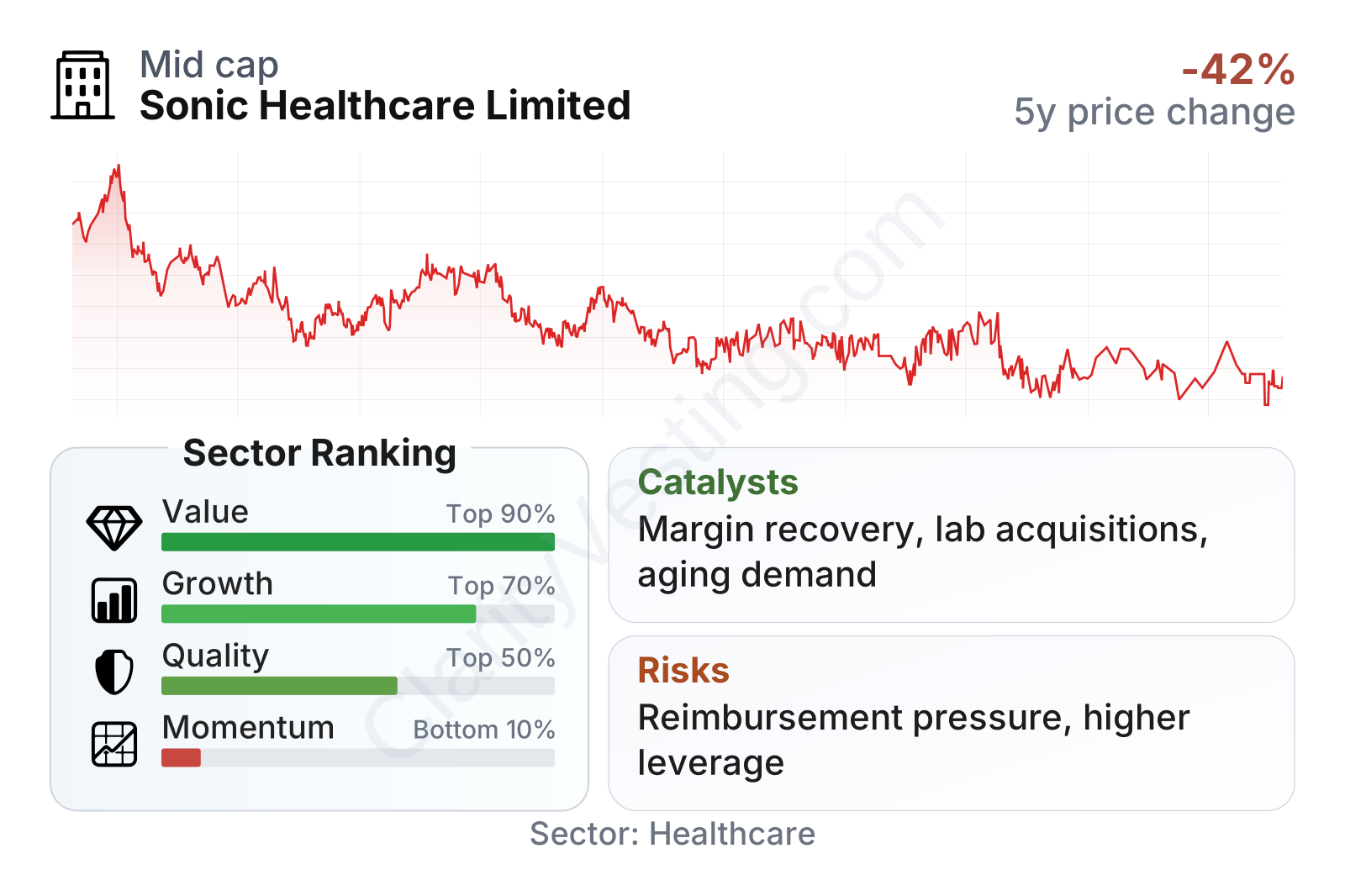
Sonic Healthcare sits in the larger end of the diagnostics space and has shown relatively low share-price volatility, with a beta well below 1. The quality profile is solid rather than exceptional: returns on assets and long-term operating margins compare well with much of the healthcare sector, while interest coverage remains comfortable. At the same time, leverage is higher than the sector median, with debt-to-equity near 70% and net debt measures above many peers.
The value metrics stand out more clearly. The earnings multiple is well below the sector median, the price-to-book ratio is also much lower, and the trailing free cash flow yield is unusually high. Growth is mixed: recent revenue growth is decent and earnings growth over five years has been strong on a compounded basis, but revenue per share growth has been modest and margin trends over five years have weakened. Market performance has been the weakest area, with the stock trailing the sector over six months, twelve months, and three years.
Growth
The company operates in a sector with durable long-term demand. Aging populations, higher rates of chronic disease, more preventive screening, and the growing use of diagnostic information in routine care all support steady testing volumes over time. Diagnostics is not usually a hypergrowth industry, but it can offer resilient expansion when linked to population health needs and rising test complexity.
Sonic’s strategy is broadly consistent with that backdrop. The company has long relied on network scale, disciplined acquisitions, and local laboratory density to strengthen market position. In diagnostics, scale can improve turnaround times, purchasing power, specialist capability, and utilization of expensive lab equipment. That gives large operators a structural advantage over smaller stand-alone labs, especially in fragmented markets.
A notable growth angle is the normalization period after COVID testing faded. During the pandemic, earnings were temporarily boosted by extraordinary testing demand. Since then, the business has been rebuilding around its core routine and specialist testing base. The latest year points to renewed top-line growth, and the improvement in operating income suggests the reset phase may be easing.
Another useful catalyst is the company’s acquisition pipeline and integration experience. Sonic has a long record of buying laboratories and folding them into a broader network. In a fragmented industry, that can remain a practical source of growth, particularly when public healthcare systems and private providers push for efficiency.
There is also a financial catalyst in the current valuation context. If margins stabilize and the latest revenue recovery continues, the gap between Sonic’s valuation multiples and sector averages becomes easier to notice. That does not guarantee a rerating, but it does mean future execution matters more than optimism alone.
Risks
This article is for informational purposes only and does not constitute financial advice. Some content is AI-generated. See Disclaimer


