Stock Analysis · SITC International Holdings Company Limited (SITIY)
Overview
SITC International Holdings Company Limited is an intra-Asia shipping and logistics company focused on moving containerized cargo around East Asia, Southeast Asia, and nearby regional trade lanes. The business is built around short- to medium-haul routes, which is different from the very large global carriers that depend more heavily on long-distance east-west trade. This narrower regional focus has helped SITC develop dense port coverage, frequent sailings, and close relationships with customers that need regular, predictable service inside Asia.
The company’s revenue is mainly generated from container shipping services, with logistics and related support activities making up a smaller share. Based on the company’s recent annual reporting structure, the revenue mix is approximately:
- Ocean freight transportation: about 90% to 95% — container shipping services across intra-Asia routes, including freight charges and core liner operations.
- Logistics and related services: about 5% to 10% — freight forwarding, agency, depot, warehousing, trucking, and other supply-chain support services linked to the shipping network.
SITC’s earnings profile can swing with freight rates, vessel utilization, and fuel costs, but its business model has shown an ability to remain highly profitable even after the extraordinary shipping boom of 2021-2022 faded. Over the last several years, revenue and profit moved sharply with industry conditions: sales climbed strongly in 2022, dropped in 2023 as rates normalized, then recovered in 2024 and again in 2025. Costs have remained relatively controlled, which has allowed a large portion of gross profit to reach operating income and net income.
The flow of revenue to profit shows an unusually efficient model for a shipping company. Even after the post-boom reset in 2023, operating expenses outside direct shipping costs stayed modest, and profitability recovered meaningfully in 2024 and 2025. That supports the view that SITC is not just benefiting from one-off pricing spikes, but also from disciplined route management and cost control.
Key Figures
| Metric | Value | Sector ⓘ |
|---|---|---|
| Date | Oct 17, 2026 | |
| Context | ||
| Sector | Industrials | |
| Industry | Marine Shipping | |
| Market Cap ⓘ | $17.86B | |
| Beta ⓘ | 1.03 | |
Value (Cheapness) | ||
| P/E Ratio ⓘ | 15.12 | 22.10 |
| P/B Ratio ⓘ | 6.94 | 1.97 |
| FCF Yield ⓘ | 12.62% | 6.38% |
| Dividend Yield ⓘ | 4.80% | 1.94% |
| EBIT / EV ⓘ | 13.41% | 4.79% |
| PEG ⓘ | N/A | |
Growth (Business expansion) | ||
| Revenue Growth ⓘ | 10.70% | 9.30% |
| RPS Growth (5Y CAGR) ⓘ | 3.04% | 7.81% |
| EPS Growth (5Y CAGR) ⓘ | 7.30% | -13.06% |
| BVPS Growth (5Y CAGR) ⓘ | 12.95% | 6.14% |
| Margin Growth (5Y Trend) ⓘ | -5.96% | 0.88% |
| FCF Growth (5Y CAGR) ⓘ | 3.07% | 11.01% |
| DPS Growth (5Y CAGR) ⓘ | 14.04% | 9.48% |
Quality (Business durability) | ||
| ROIC (Latest) ⓘ | N/A | 10.84% |
| ROA (Latest) ⓘ | 63.60% | 5.41% |
| ROIC (5Y Median) ⓘ | 44.86% | 9.38% |
| ROA (5Y Median) ⓘ | 36.64% | 4.95% |
| Net Debt / EBIT (Latest) ⓘ | 0.05 | 2.08 |
| Net Debt / EBIT (5Y Median) ⓘ | -0.23 | 2.27 |
| Net Debt / EBITDA (Latest) ⓘ | 0.05 | 1.39 |
| Net Debt / Assets ⓘ | 3.18% | 19.28% |
| EBITDA / Interest ⓘ | N/A | 9.58 |
| Operating Margin (Latest) ⓘ | 34.64% | 10.50% |
| Operating Margin (5Y Median) ⓘ | 34.10% | 10.29% |
| Debt to Equity (Latest) ⓘ | 11.56% | 65.48% |
| Profit Margin (Latest) ⓘ | 35.37% | 6.67% |
| Free Cash Flow (Latest) ⓘ | $2.25B | |
Momentum (Price trend) | ||
| 3Y Return ⓘ | +506.28% | +61.68% |
| 12M Return (excl. last month) ⓘ | +62.33% | +12.58% |
| 6M Return ⓘ | +72.48% | 0.00% |
| Price vs. 200-Day MA ⓘ | +60.58% | +0.02% |
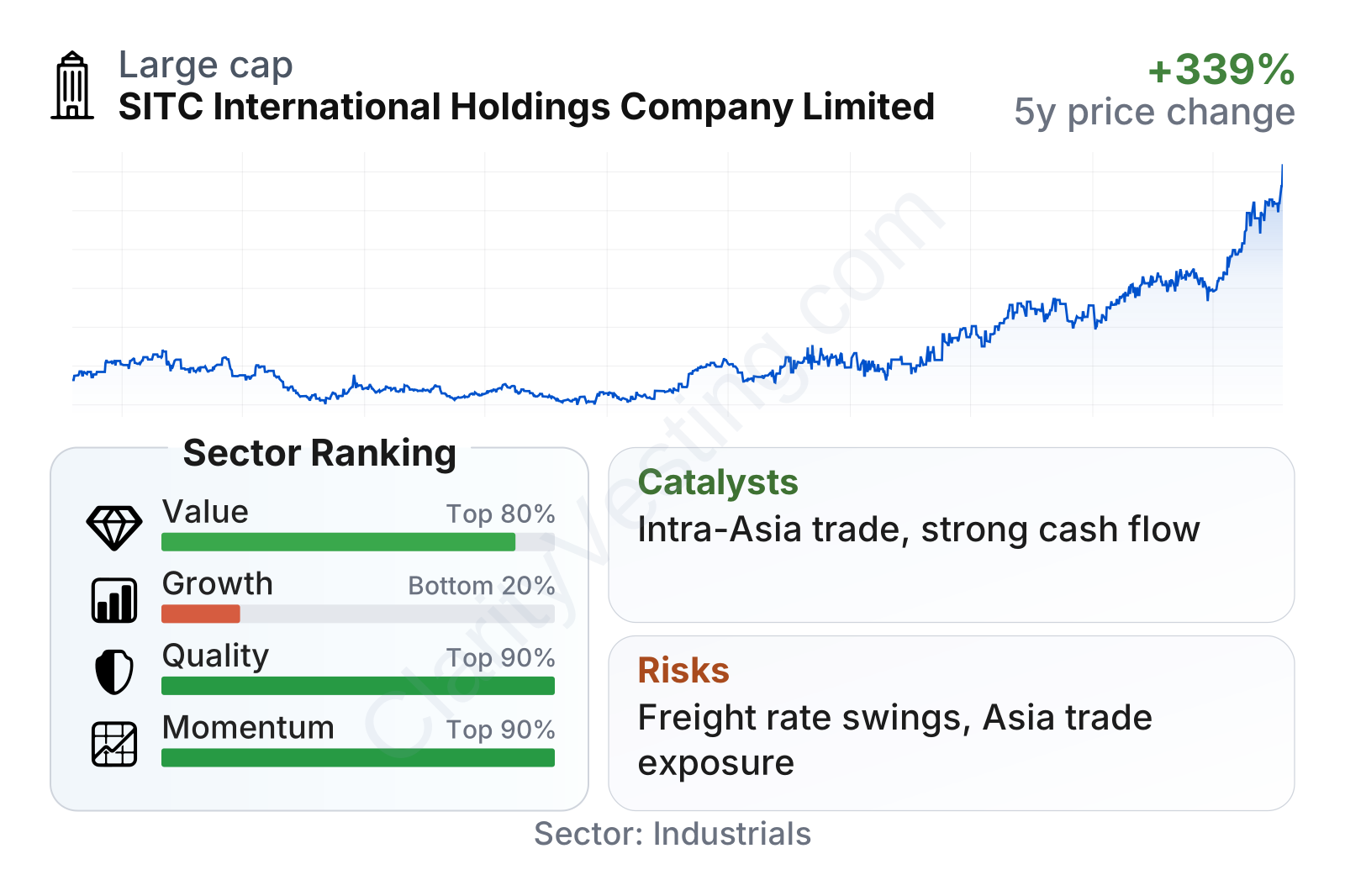
SITC stands out for balance-sheet strength, cash generation, and profitability. Relative to the broader industrial shipping group, its valuation is mixed: the earnings multiple is below the sector median, while the book-value multiple is much higher, reflecting the market’s willingness to pay more for a business with stronger margins and lower leverage. Quality measures are particularly strong, with very high returns on assets, robust operating margins, and very low net debt. Growth measures are less impressive over a five-year period because the shipping cycle has been volatile, but recent revenue growth has still been slightly ahead of the sector median. Momentum is also very strong, showing that the market has recently rewarded the company’s rebound in earnings and cash flow.
Growth
Marine shipping is not a simple straight-line growth sector, because results are heavily influenced by trade activity, freight rates, and fleet supply. Even so, SITC operates in an area with durable long-term demand drivers: intra-Asia trade, regional supply-chain diversification, manufacturing shifts toward Southeast Asia, and the need for reliable feeder and short-haul container services. These trends support cargo flows even when global long-haul shipping is uneven.
SITC’s strategy appears coherent for that environment. The company concentrates on a regional network where scale comes from frequency, route density, and operational familiarity rather than from owning the world’s biggest ships. That can be an advantage because customers moving goods inside Asia often care more about schedule reliability and port coverage than about ultra-large vessel economics. Its logistics activities also complement the shipping arm by helping retain customers inside a broader service offering.
Recent business performance suggests the company is still growing, but not in a smooth way. Year-over-year revenue has been positive again, and annual sales recovered from the 2023 downturn to a level above $3.0 billion in 2024 and higher again in 2025. That pattern matters because it shows earnings were not stuck at post-boom lows. A further support for future growth is capital flexibility: with very low net debt and strong free cash flow, SITC has room to expand services, renew vessels, or navigate market weakness without the same financing pressure seen at more leveraged peers.
A meaningful catalyst is continued regionalization of trade in Asia. As manufacturers spread production across China, Vietnam, Indonesia, Thailand, and other nearby markets, the demand for short-sea container links can rise alongside it. Another possible catalyst is tighter industry capacity discipline in regional shipping, which can support freight rates if demand remains resilient. The company’s strong dividend growth over time also signals confidence in cash generation, although dividends in shipping can remain cyclical.
Risks
This article is for informational purposes only and does not constitute financial advice. Some content is AI-generated. See Disclaimer


