Stock Analysis · Sprott Inc (SII)
Overview
Sprott Inc. is a specialized asset manager focused mainly on precious metals and other critical materials used in mining, energy transition, and resource development. In simple terms, it manages investment products for clients who want exposure to areas such as gold, silver, uranium, copper, and broader mining-related businesses. The company also earns money from brokerage and advisory activities tied to the natural resources sector, giving it a more focused profile than a traditional diversified asset manager.
Its business model is largely based on earning fees from assets under management, which means results are influenced both by investor inflows and by changes in commodity prices that affect the value of the funds it manages. This makes Sprott more cyclical than many mainstream financial firms, but it also gives it direct exposure to areas that can benefit when demand for hard assets rises.
The main revenue sources are generally structured as follows:
- Management and performance fees from exchange-listed products and managed funds: the clear majority of revenue, likely around 70% to 80%. This includes precious metals and critical materials investment vehicles whose fees rise as assets under management increase.
- Brokerage, lending, and advisory activities tied to natural resource investing: likely around 15% to 25%. This includes services connected to mining and resource capital markets.
- Co-investment income and other corporate revenue: typically a smaller contribution, often below 10%, and more variable from period to period.
Sprott’s revenue mix is attractive for readers looking at long-term business quality because recurring fee income can scale well when commodity-related assets gather momentum. At the same time, the company is intentionally concentrated in a narrow part of financial services, so its strengths and weaknesses are closely tied to the outlook for precious metals and critical materials.
The long-term financial pattern has improved meaningfully. Revenue was uneven from 2021 to 2024, then expanded sharply in 2025, while operating income and net income improved faster than sales. That points to a business with increasing operating leverage: once assets and activity recover, profit can climb faster than revenue.
Key Figures
| Metric | Value | Sector ⓘ |
|---|---|---|
| Date | Oct 24, 2026 | |
| Context | ||
| Sector | Financial Services | |
| Industry | Asset Management | |
| Market Cap ⓘ | $2.74B | |
| Beta ⓘ | 1.47 | |
Value (Cheapness) | ||
| P/E Ratio ⓘ | 25.95 | 12.46 |
| P/B Ratio ⓘ | 6.98 | 1.25 |
| FCF Yield ⓘ | 5.08% | 9.82% |
| Dividend Yield ⓘ | 1.51% | 2.94% |
| EBIT / EV ⓘ | 4.53% | 8.11% |
| PEG ⓘ | N/A | |
Growth (Business expansion) | ||
| Revenue Growth ⓘ | 23.10% | 9.10% |
| RPS Growth (5Y CAGR) ⓘ | 13.08% | 12.31% |
| EPS Growth (5Y CAGR) ⓘ | 16.47% | -6.97% |
| BVPS Growth (5Y CAGR) ⓘ | 6.06% | 5.02% |
| Margin Growth (5Y Trend) ⓘ | 5.97% | -4.00% |
| FCF Growth (5Y CAGR) ⓘ | 17.34% | 4.71% |
| DPS Growth (5Y CAGR) ⓘ | 7.12% | 8.92% |
Quality (Business durability) | ||
| ROIC (Latest) ⓘ | 28.64% | 9.18% |
| ROE (Latest) ⓘ | 28.60% | 13.93% |
| ROA (Latest) ⓘ | 21.46% | 1.57% |
| ROIC (5Y Median) ⓘ | 13.65% | 7.80% |
| ROE (5Y Median) ⓘ | 14.34% | 12.15% |
| ROA (5Y Median) ⓘ | 10.96% | 1.28% |
| Net Debt / EBIT (Latest) ⓘ | -1.31 | 1.02 |
| Net Debt / EBIT (5Y Median) ⓘ | -0.43 | 0.72 |
| Net Debt / EBITDA (Latest) ⓘ | -1.28 | 0.88 |
| Operating Margin (Latest) ⓘ | 37.58% | 22.30% |
| Operating Margin (5Y Median) ⓘ | 34.07% | 24.50% |
| Debt to Equity (Latest) ⓘ | N/A | 59.34% |
| Profit Margin (Latest) ⓘ | 26.36% | 26.42% |
| Free Cash Flow (Latest) ⓘ | $139.06M | |
Momentum (Price trend) | ||
| 3Y Return ⓘ | +294.87% | +95.73% |
| 12M Return (excl. last month) ⓘ | +78.14% | +17.30% |
| 6M Return ⓘ | -19.04% | +6.07% |
| Price vs. 200-Day MA ⓘ | -15.86% | +5.36% |
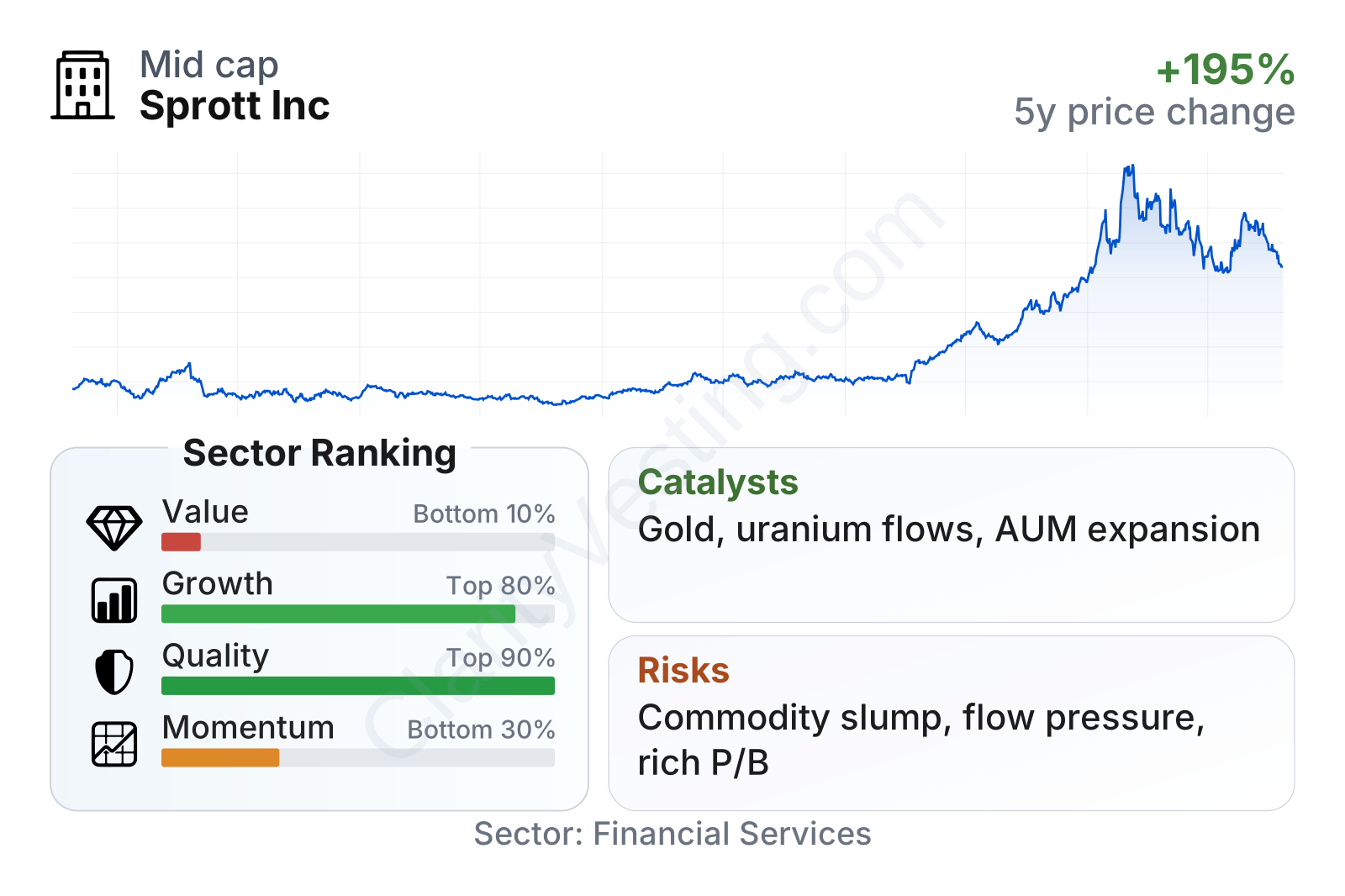
Sprott is a mid-sized asset manager with a stock that has been much more volatile than the broader market, as shown by a beta near 1.4. The share price has delivered a very strong multi-year move, but the recent period has been less smooth, with weakness over the last six months after a steep run-up. In the latest factor snapshot, the company stands out for quality and shows respectable growth, while value looks stretched compared with the financial sector median. That combination usually describes a business the market already recognizes as high quality and strategically well positioned.
Profitability metrics are especially notable. Returns on capital, equity, and assets are all well above sector norms, and the balance sheet appears conservative with net cash rather than meaningful net debt. Free cash flow is positive, but the cash flow yield and dividend yield are below sector medians because the stock price has risen much faster than those distributions. In short, the operating profile looks strong, but the market is not pricing Sprott like a typical inexpensive financial stock.
Growth
Sprott operates in a part of the market that has several structural tailwinds. Precious metals continue to attract demand during periods of inflation concern, geopolitical stress, and central bank gold accumulation. At the same time, uranium, copper, and other critical materials are increasingly tied to long-term electrification, grid expansion, nuclear power interest, and industrial supply-chain security. That does not make the sector predictable year to year, but it does create a credible long-term backdrop for specialized managers with recognized expertise.
The company’s strategy also makes sense for future expansion. Rather than competing head-on with the largest diversified asset managers, Sprott has built a brand around real assets and resource investing. That specialization can help it attract clients looking for focused exposure that generalist firms may not deliver with the same identity or depth. Because fee revenue is linked to assets under management, a favorable commodity cycle can lift the business in multiple ways at once: better market performance, stronger investor interest, and potentially new product demand.
Earnings progression supports the growth case, even with normal cyclicality. After a setback in 2022, earnings per share recovered in 2023 and 2024, then accelerated sharply in 2025. That pattern suggests the business can rebound strongly when market conditions improve.
Book value per share has also trended upward over the past five years, which is a useful sign that value is being built over time rather than only through short-term market enthusiasm. Growth here has been steadier than earnings, which is normal for a company exposed to fluctuating markets.
A significant recent opportunity for Sprott is the continued expansion of investor interest in uranium and critical minerals, areas where the company already has established product recognition. In addition, sustained strength in gold-related demand can support both asset values and fund flows. For a specialized asset manager, these thematic waves matter a great deal because they can push assets under management higher without requiring a proportional increase in expenses.
Risks
This article is for informational purposes only and does not constitute financial advice. Some content is AI-generated. See Disclaimer


