Stock Analysis · Selective Insurance Group Inc (SIGI)
Overview
Selective Insurance Group is a U.S. property and casualty insurer. In simple terms, it collects premiums from customers, invests part of that money, and pays claims when covered losses occur. The company focuses mainly on commercial insurance sold through independent agents, with additional business in personal insurance and excess and surplus lines. It also has an investment portfolio that contributes income alongside underwriting results.
Its revenue mix is driven primarily by premiums earned, while investment income and smaller service-related items add to the total. Based on the company’s recent business mix and operating disclosures, the main sources of revenue can be summarized as follows:
- Standard Commercial Lines: about 75% to 80% — insurance for businesses, including workers compensation, general liability, commercial auto, property, inland marine, and package policies.
- Standard Personal Lines: about 10% to 15% — mainly homeowners and auto coverage for individuals.
- Excess and Surplus Lines: about 10% to 15% — specialized coverage for harder-to-place or higher-risk commercial exposures, typically with higher pricing flexibility.
- Net investment income and other revenue: usually less than 10% of total revenue — income from the bond-heavy investment portfolio and other smaller operating items.
What stands out in Selective’s model is its concentration in commercial insurance, where pricing discipline and agent relationships matter a great deal. That gives the company a somewhat more specialized profile than broader insurers that rely more heavily on personal auto or life insurance.
The business has expanded its revenue base meaningfully over the past several years, but profit conversion has been uneven. That pattern is typical in property and casualty insurance: premium growth can look strong while earnings swing with catastrophe losses, reserve development, and underwriting conditions.
Key Figures
| Metric | Value | Sector ⓘ |
|---|---|---|
| Date | Oct 24, 2026 | |
| Context | ||
| Sector | Financial Services | |
| Industry | Insurance - Property & Casualty | |
| Market Cap ⓘ | $5.43B | |
| Beta ⓘ | 0.25 | |
Value (Cheapness) | ||
| P/E Ratio ⓘ | 11.30 | 12.46 |
| P/B Ratio ⓘ | 1.51 | 1.25 |
| FCF Yield ⓘ | 21.90% | 9.82% |
| Dividend Yield ⓘ | 1.87% | 2.94% |
| EBIT / EV ⓘ | 9.83% | 8.11% |
| PEG ⓘ | 0.28 | |
Growth (Business expansion) | ||
| Revenue Growth ⓘ | 4.50% | 9.10% |
| RPS Growth (5Y CAGR) ⓘ | 11.90% | 12.31% |
| EPS Growth (5Y CAGR) ⓘ | -5.56% | -6.97% |
| BVPS Growth (5Y CAGR) ⓘ | 6.52% | 5.02% |
| Margin Growth (5Y Trend) ⓘ | -3.85% | -4.00% |
| FCF Growth (5Y CAGR) ⓘ | 12.36% | 4.71% |
| DPS Growth (5Y CAGR) ⓘ | 9.90% | 8.92% |
Quality (Business durability) | ||
| ROIC (Latest) ⓘ | 11.48% | 9.18% |
| ROE (Latest) ⓘ | 13.91% | 13.93% |
| ROA (Latest) ⓘ | 3.39% | 1.57% |
| ROIC (5Y Median) ⓘ | 12.76% | 7.80% |
| ROE (5Y Median) ⓘ | 13.83% | 12.15% |
| ROA (5Y Median) ⓘ | 3.34% | 1.28% |
| Net Debt / EBIT (Latest) ⓘ | 1.45 | 1.02 |
| Net Debt / EBIT (5Y Median) ⓘ | 1.55 | 0.72 |
| Net Debt / EBITDA (Latest) ⓘ | 1.37 | 0.88 |
| Operating Margin (Latest) ⓘ | 11.38% | 22.30% |
| Operating Margin (5Y Median) ⓘ | 11.51% | 24.50% |
| Debt to Equity (Latest) ⓘ | 24.60% | 59.34% |
| Profit Margin (Latest) ⓘ | 9.10% | 26.42% |
| Free Cash Flow (Latest) ⓘ | $1.19B | |
Momentum (Price trend) | ||
| 3Y Return ⓘ | -5.76% | +95.73% |
| 12M Return (excl. last month) ⓘ | +13.75% | +17.30% |
| 6M Return ⓘ | +19.31% | +6.07% |
| Price vs. 200-Day MA ⓘ | +5.94% | +5.36% |
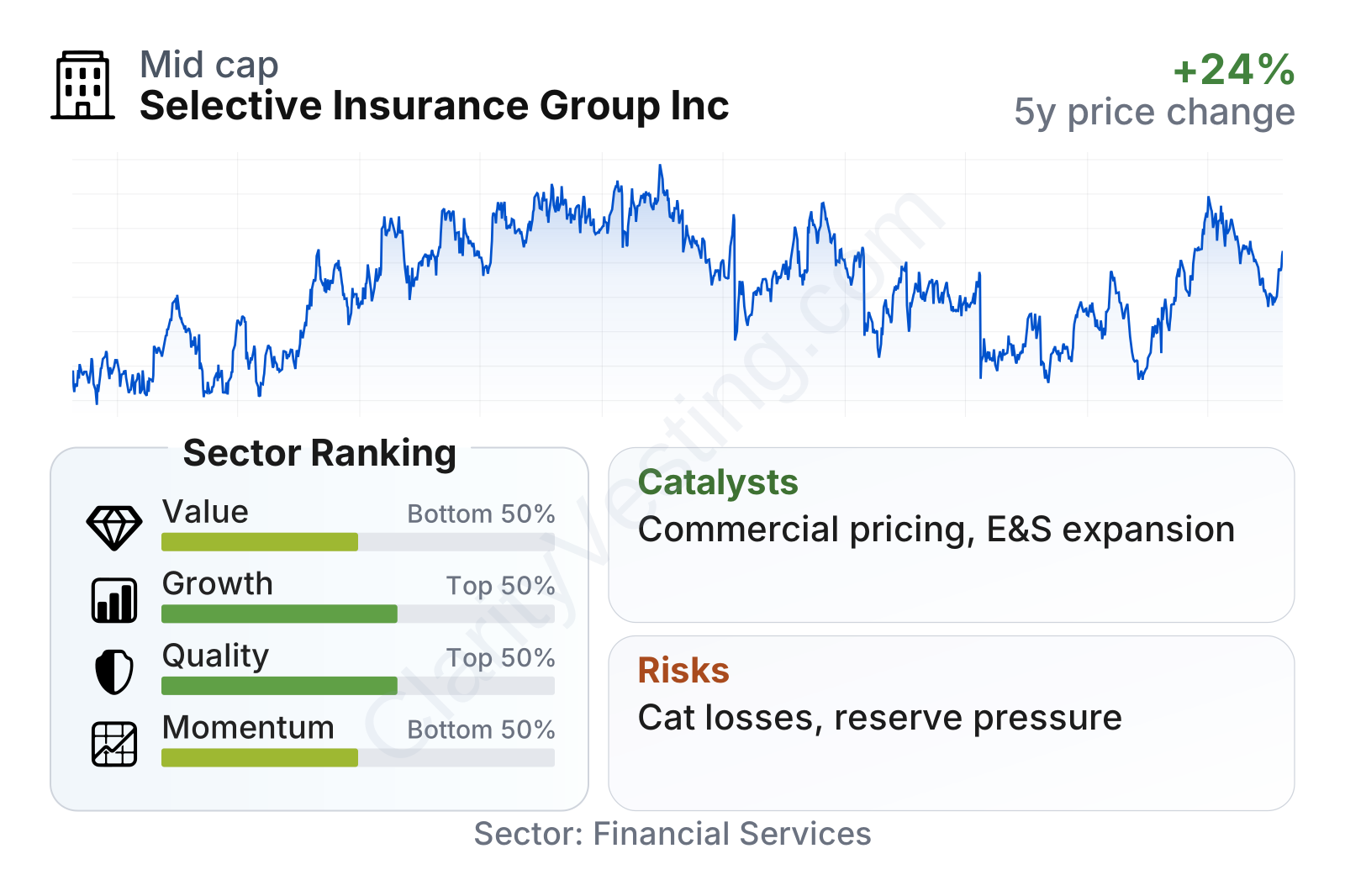
Selective sits in the mid-sized range within financial services, with a low beta that points to less share-price volatility than the broader market. The overall picture is mixed but understandable for an insurer: valuation multiples are not stretched on earnings, quality metrics are generally solid, and growth is respectable rather than fast. Profitability ratios such as return on equity and return on assets are a little above sector medians, while operating and profit margins are lower than many peers, reflecting the pressure that claims costs can place on underwriting results. Free cash flow generation looks unusually strong, but that measure should be read carefully in insurance because cash flows can move around with premiums, claims timing, and portfolio activity.
The stock-price history also shows a business that has not delivered a smooth upward path. Shares have recovered well more recently, but the longer three-year record has lagged much of the sector. That matters because it suggests the market has been weighing both the company’s recovery potential and the cyclical risks that come with the property and casualty industry.
Growth
Selective operates in a sector with durable long-term demand. Businesses, homeowners, vehicle owners, contractors, and institutions continue to need insurance regardless of the economic cycle. That does not make the industry fast-growing, but it does create a recurring revenue base. Within that market, commercial lines and excess and surplus lines remain attractive areas because pricing can adjust when loss trends rise, and specialized risks tend to support better premium rates.
The company’s strategy is sensible for future growth. Its focus on independent agents helps it reach small and mid-sized commercial customers without building a massive direct-sales network. That can support efficient expansion, especially in niches where underwriting expertise matters more than national advertising. The excess and surplus business is particularly important because it can benefit when standard insurance markets tighten and higher-risk accounts need more customized coverage.
Earnings per share have been volatile rather than steadily rising. The pattern shows a drop in 2024 followed by a strong rebound in 2025, which is a reminder that insurer earnings often move with loss experience more than with simple sales growth. For long-term analysis, the key question is less about one weak year and more about whether the company can keep underwriting discipline through the cycle.
Book value per share has moved upward over the past five years despite periodic setbacks, which is important for an insurer because book value reflects the capital base supporting future underwriting. The five-year compound growth rate is a bit above the sector median, suggesting the company has added shareholder value over time even though annual earnings have been uneven.
A meaningful catalyst is the broader pricing environment in commercial property and casualty insurance. When premium rates remain firm, disciplined underwriters can grow premium volume and improve returns at the same time. Another support is investment income: higher reinvestment yields on fixed-income portfolios can help insurers earn more on the float generated by premiums. Selective’s commercial concentration gives it direct exposure to both of those tailwinds if loss costs remain manageable.
Recent company updates in 2026 have continued to emphasize underwriting execution, agency relationships, and the development of specialty capabilities. None of that changes the business overnight, but it does fit a long-term growth path based on disciplined expansion rather than aggressive risk-taking.
Risks
This article is for informational purposes only and does not constitute financial advice. Some content is AI-generated. See Disclaimer


