Stock Analysis · D'Ieteren Group SA (SIEVF)
Overview
D'Ieteren Group SA is a Belgian holding company with several businesses linked to mobility, vehicle distribution, replacement glass, collision repair, and lifestyle cycling. The group is best known for two large assets: its stake in Belron, the global vehicle glass repair and replacement company operating brands such as Carglass and Safelite, and D’Ieteren Automotive, the long-established importer and distributor of Volkswagen Group brands in Belgium. Over time, the company has become less dependent on classic car retailing and more centered on aftermarket services and international mobility platforms.
The main sources of revenue are spread across operating subsidiaries rather than one single product line. Based on the group’s recent annual reporting structure and business mix, revenue is approximately distributed as follows:
- Belron: around 60% to 70% of group revenue. This business focuses on vehicle glass repair, replacement, recalibration of driver-assistance systems, and related claims management services.
- D’Ieteren Automotive: around 20% to 30% of group revenue. This includes importing and distributing Volkswagen, Audi, Skoda, SEAT, Cupra, Porsche, Bentley, Lamborghini, Bugatti, and Maserati in Belgium, plus related services.
- Parts Holding Europe: around 10% to 15% of group revenue. This business distributes spare parts for cars and trucks through independent aftermarket networks.
- TVH stake and other activities, including Moleskine: a small share of reported revenue, but potentially meaningful in earnings and asset value depending on the period and accounting treatment.
The broad picture is important: D'Ieteren is not just a dealership group. It combines a mature local distribution business with a much larger international service operation through Belron. That mix generally gives it more resilience than a pure new-car seller, because windshield replacement, repairs, calibration, and spare parts tend to depend less on discretionary spending than new vehicle purchases.
Over the last several years, revenue expanded strongly from roughly €3.4 billion in 2021 to about €8.0 billion in 2025. The cost base also increased, but gross profit widened materially over the same period, showing that scale and business mix have changed in the company’s favor. Net income has been more volatile than revenue, partly because financing costs and non-operating items can move meaningfully from year to year.
The financial flow shows a company that has become much larger in a short time. Revenue and gross profit are far above 2021 levels, while selling and administrative costs have also risen with expansion. Operating profit improved meaningfully by 2024, although net income remains more uneven because interest expense has become a more important drag.
Key Figures
| Metric | Value | Sector ⓘ |
|---|---|---|
| Date | Oct 03, 2026 | |
| Context | ||
| Sector | Consumer Cyclical | |
| Industry | Auto & Truck Dealerships | |
| Market Cap ⓘ | $10.22B | |
| Beta ⓘ | 0.92 | |
Value (Cheapness) | ||
| P/E Ratio ⓘ | 20.94 | 17.04 |
| P/B Ratio ⓘ | 91.65 | 1.61 |
| FCF Yield ⓘ | 7.99% | 9.02% |
| Dividend Yield ⓘ | 1.13% | 2.75% |
| EBIT / EV ⓘ | N/A | 6.69% |
| PEG ⓘ | N/A | |
Growth (Business expansion) | ||
| Revenue Growth ⓘ | -3.00% | 5.60% |
| RPS Growth (5Y CAGR) ⓘ | 24.68% | 9.04% |
| EPS Growth (5Y CAGR) ⓘ | 1.56% | -17.44% |
| BVPS Growth (5Y CAGR) ⓘ | -90.98% | 5.73% |
| Margin Growth (5Y Trend) ⓘ | 2.32% | -0.26% |
| FCF Growth (5Y CAGR) ⓘ | 41.71% | 4.91% |
| DPS Growth (5Y CAGR) ⓘ | 4.32% | 10.48% |
Quality (Business durability) | ||
| ROIC (Latest) ⓘ | 115.10% | 12.38% |
| ROA (Latest) ⓘ | 12.95% | 5.54% |
| ROIC (5Y Median) ⓘ | 5.71% | 10.63% |
| ROA (5Y Median) ⓘ | 6.59% | 5.44% |
| Net Debt / EBIT (Latest) ⓘ | 2.08 | 2.16 |
| Net Debt / EBIT (5Y Median) ⓘ | 2.37 | 2.31 |
| Net Debt / EBITDA (Latest) ⓘ | 1.47 | 1.52 |
| Net Debt / Assets ⓘ | 33.42% | 21.74% |
| EBITDA / Interest ⓘ | 5.87 | 9.06 |
| Operating Margin (Latest) ⓘ | 7.03% | 9.12% |
| Operating Margin (5Y Median) ⓘ | 4.63% | 9.56% |
| Debt to Equity (Latest) ⓘ | 2463.53% | 76.18% |
| Profit Margin (Latest) ⓘ | 5.53% | 5.30% |
| Free Cash Flow (Latest) ⓘ | $816.54M | |
Momentum (Price trend) | ||
| 3Y Return ⓘ | +108.88% | +11.77% |
| 12M Return (excl. last month) ⓘ | +2.08% | +0.61% |
| 6M Return ⓘ | -0.10% | +1.32% |
| Price vs. 200-Day MA ⓘ | +16.91% | -3.47% |
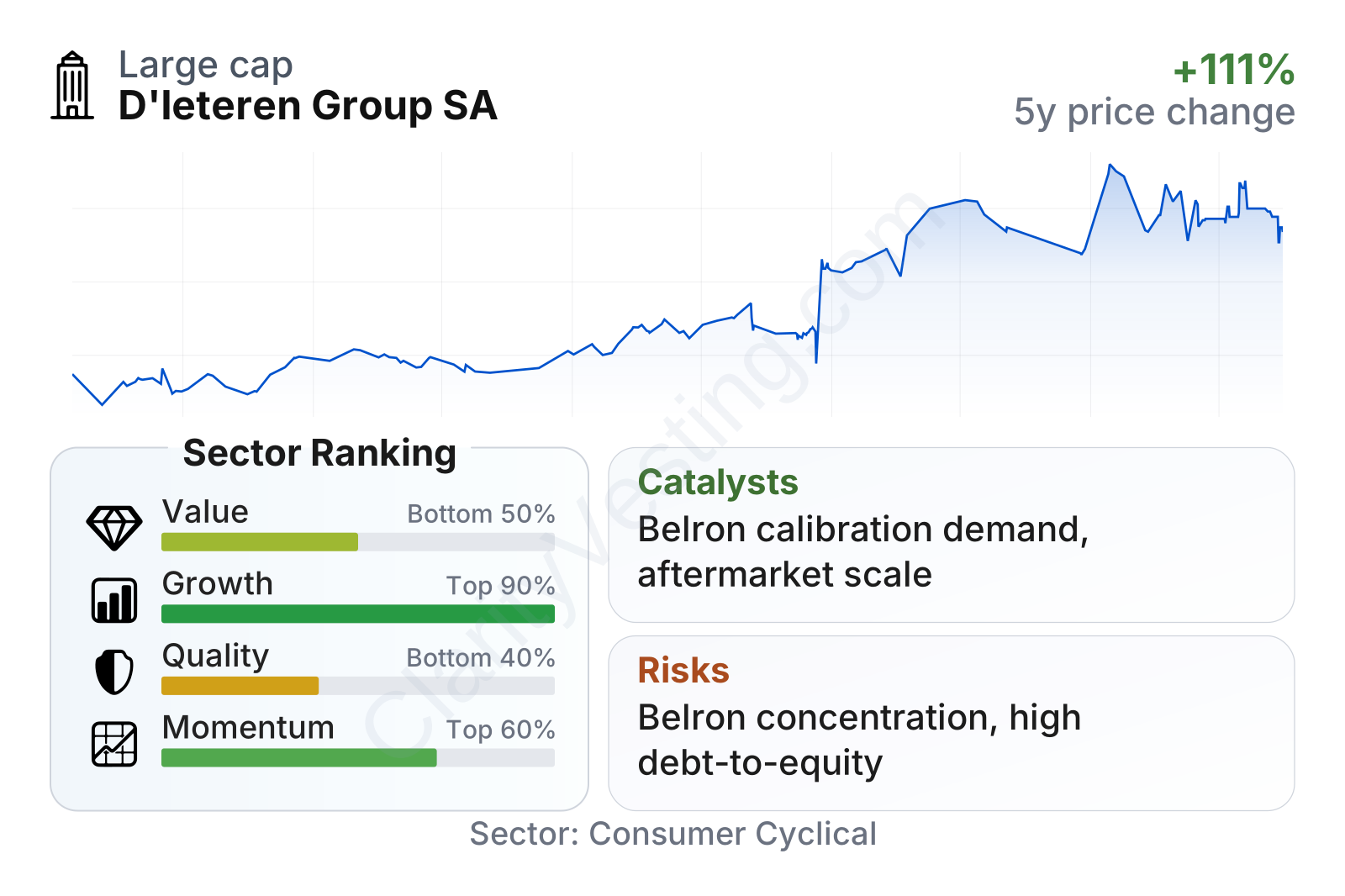
D'Ieteren is now a large public company with a market value around the $10 billion range and a stock that has materially outperformed much of its sector over the last three years. The overall factor picture is mixed but clear enough: growth and momentum rank well versus peers, while value and balance-sheet quality look less favorable. Free cash flow remains solid in absolute terms, margins are acceptable rather than exceptional, and leverage metrics are manageable on an operating basis, even if the balance sheet looks more stretched on equity-based measures.
Growth
D'Ieteren operates in segments that are tied to long-term mobility demand rather than a single short product cycle. That matters because the underlying drivers are durable: cars stay on the road longer, modern vehicles need more specialized glass recalibration after replacement, and the independent spare-parts market tends to benefit from an aging vehicle fleet. These trends support recurring service demand even when new-car markets cool.
The group’s strategy also looks coherent. Belron gives D'Ieteren exposure to a global service network with scale advantages, brand recognition, insurer relationships, and a technical role in repairing increasingly complex vehicles. D’Ieteren Automotive adds local market strength in Belgium, where the company has deep manufacturer relationships and a broad premium-to-mass-market brand portfolio. Parts Holding Europe extends the aftermarket angle further, which makes the group less cyclical than its “auto dealer” label might suggest.
Recent yearly growth has slowed and even dipped slightly in the latest period, but that does not erase the much stronger multiyear pattern. Over five years, revenue per share and free cash flow have grown at rates well above the sector median, and operating margin trends have also improved. In other words, short-term growth has normalized after a period of rapid expansion, yet the medium-term trajectory still points to a business that has scaled up meaningfully.
One of the strongest catalysts is the increasing technological complexity of cars. Windshields are no longer simple pieces of glass: they often contain sensors and cameras connected to safety systems, and replacement increasingly requires calibration. That makes Belron’s technical expertise, footprint, and insurer relationships more valuable. Another catalyst is the continued importance of the automotive aftermarket, which tends to remain active regardless of whether consumers delay buying new cars.
Recent company communication has also emphasized portfolio management and value creation across subsidiaries. For a group structured around major holdings, capital allocation is a central part of the growth case. If management continues to improve subsidiary performance while keeping exposure to service-heavy businesses, the earnings base could become more durable than that of traditional auto retail peers.
Risks
This article is for informational purposes only and does not constitute financial advice. Some content is AI-generated. See Disclaimer