Stock Analysis · South32 Limited (SHTLF)
Overview
South32 Limited is a diversified mining company that produces metals and minerals used in construction, steelmaking, aluminum production, fertilizers, and the energy transition. The group was created in 2015 through the demerger of a set of assets from BHP and today operates mines, smelters, and processing facilities across Australia, Southern Africa, and South America. For U.S. readers, the ticker SHTLF represents the company’s over-the-counter listing, while its primary listings are in Australia, London, and Johannesburg.
The company’s revenue is spread across a portfolio rather than a single flagship commodity. Based on the latest annual reporting, the largest contributors are aluminum, manganese, alumina, and base metals, with metallurgical coal and silver also contributing meaningful amounts. Approximate shares can shift from year to year because prices and production volumes move a lot in mining, but the revenue mix is broadly diversified across the following areas:
- Aluminum: about 20% to 25% of revenue. This mainly comes from Hillside Aluminium in South Africa and Mozal Aluminium in Mozambique.
- Manganese: about 20% to 25%. This includes manganese ore and alloy production from Australia and South Africa, used mainly in steelmaking.
- Alumina: about 15% to 20%. South32’s Worsley Alumina operation in Australia is a major source here; alumina is the refined feedstock used to make aluminum.
- Base metals: about 15% to 20%. This is mainly copper, zinc, and lead from Cannington in Australia and Cerro Matoso in Colombia, with some variation by year and commodity pricing.
- Metallurgical coal: about 10% to 15%. This comes from Illawarra Metallurgical Coal in Australia and is used in steel production rather than power generation.
- Silver and other by-products: about 5% to 10%. Cannington is one of the world’s larger silver-producing operations and also produces lead and zinc.
- Nickel and ferronickel: a smaller and declining share after the closure decision for Nickel West was already outside South32 and the company’s own nickel exposure has become less central. Cerro Matoso remains relevant but is not one of the largest earnings drivers.
One important point for long-term readers is that South32 is not a pure-play on one theme. It combines mature cash-generating assets with some exposure to future-facing metals, especially through copper projects and its interest in Sierra Gorda. That makes the business more balanced than a single-commodity miner, but also means its results can be harder to read because different commodity cycles can offset each other.
Over the last several years, the business has gone through a sharp earnings swing. Revenue and profits surged during the 2022 commodity upswing, then weakened materially in 2023 and 2024 as prices fell and costs stayed elevated, before improving again more recently. Costs of production have come down from the worst period, but the company remains exposed to commodity price volatility much more than a typical industrial company.
The operating picture shows how cyclical this company is: margins were very strong in 2022, turned negative in 2023 and 2024, and then recovered in 2025 and 2026. Revenue has improved only modestly from the trough, but earnings have rebounded more sharply because operating expenses have been reduced and some operations have performed better.
Key Figures
| Metric | Value | Sector ⓘ |
|---|---|---|
| Date | Oct 24, 2026 | |
| Context | ||
| Sector | Basic Materials | |
| Industry | Other Industrial Metals & Mining | |
| Market Cap ⓘ | $12.76B | |
| Beta ⓘ | 0.75 | |
Value (Cheapness) | ||
| P/E Ratio ⓘ | 12.39 | 16.92 |
| P/B Ratio ⓘ | 1.33 | 1.66 |
| FCF Yield ⓘ | 15.34% | 5.83% |
| Dividend Yield ⓘ | 3.26% | 2.07% |
| EBIT / EV ⓘ | 8.63% | 6.38% |
| PEG ⓘ | 7.16 | |
Growth (Business expansion) | ||
| Revenue Growth ⓘ | 1.10% | 11.25% |
| RPS Growth (5Y CAGR) ⓘ | -9.68% | 4.49% |
| EPS Growth (5Y CAGR) ⓘ | -44.62% | -15.24% |
| BVPS Growth (5Y CAGR) ⓘ | -1.70% | 5.49% |
| Margin Growth (5Y Trend) ⓘ | -28.36% | -1.54% |
| FCF Growth (5Y CAGR) ⓘ | -32.95% | 0.37% |
| DPS Growth (5Y CAGR) ⓘ | -17.66% | 5.91% |
Quality (Business durability) | ||
| ROIC (Latest) ⓘ | 9.26% | 9.59% |
| ROA (Latest) ⓘ | 9.17% | 4.92% |
| ROIC (5Y Median) ⓘ | 4.28% | 7.91% |
| ROA (5Y Median) ⓘ | 1.52% | 3.92% |
| Net Debt / EBIT (Latest) ⓘ | -0.21 | 1.36 |
| Net Debt / EBIT (5Y Median) ⓘ | -0.14 | 1.69 |
| Net Debt / EBITDA (Latest) ⓘ | -0.13 | 0.93 |
| Net Debt / Assets ⓘ | -1.93% | 13.69% |
| EBITDA / Interest ⓘ | 13.02 | 12.38 |
| Operating Margin (Latest) ⓘ | 11.53% | 13.24% |
| Operating Margin (5Y Median) ⓘ | 13.12% | 11.82% |
| Debt to Equity (Latest) ⓘ | 19.11% | 40.30% |
| Profit Margin (Latest) ⓘ | 18.30% | 6.38% |
| Free Cash Flow (Latest) ⓘ | $1.96B | |
Momentum (Price trend) | ||
| 3Y Return ⓘ | +51.21% | +73.47% |
| 12M Return (excl. last month) ⓘ | +135.87% | +27.59% |
| 6M Return ⓘ | -4.88% | -4.02% |
| Price vs. 200-Day MA ⓘ | +16.72% | -0.65% |
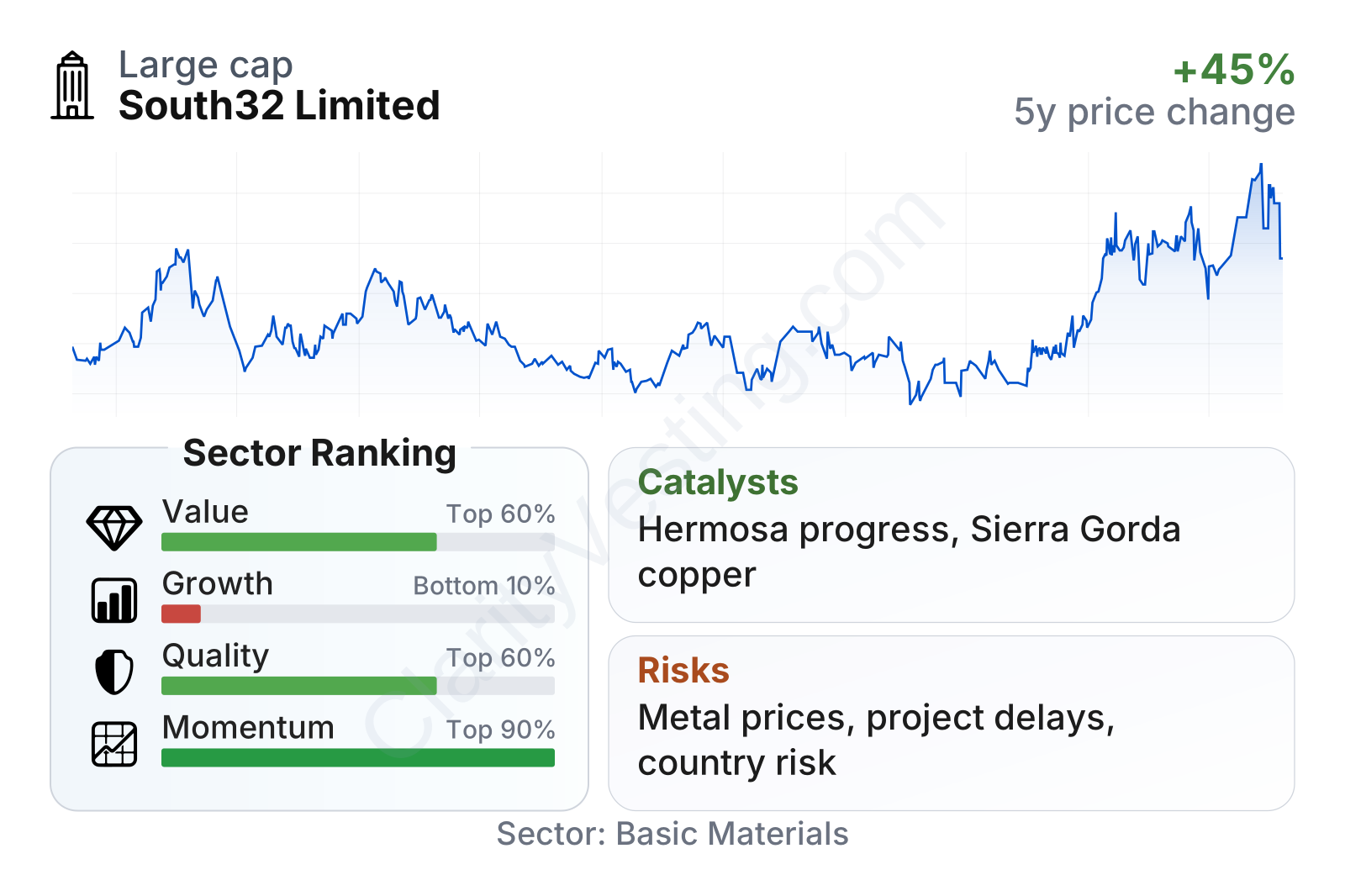
South32 currently looks stronger on balance sheet quality and cash generation than on growth. Valuation metrics sit somewhat below sector medians on earnings and book value, while free cash flow yield and EBIT relative to enterprise value are stronger than many peers. The company also carries unusually low leverage for a miner, with net cash rather than heavy net debt. The weak point is growth: recent revenue growth is modest, and five-year trends for sales per share, earnings, and free cash flow are all well below the sector median. In simple terms, the market appears to be paying for a solid asset base and healthier finances, not for rapid expansion.
The stock has also shown strong recent price momentum relative to the broader materials sector. That can reflect improving sentiment around metals prices, better operating results, and optimism about the company’s copper exposure. At the same time, long-term readers should remember that miners can look statistically cheap near the top of a cycle and expensive near the bottom, so these ratios need to be read together with the commodity backdrop.
Growth
South32 operates in a sector that has two different layers of demand. One layer is cyclical and tied to global industrial activity, construction, and steel production. The other is more structural and linked to electrification, grid investment, and decarbonization, which support long-term demand for aluminum, copper, and some battery-related materials. This means the company is not in a pure high-growth industry, but parts of its portfolio are connected to long-duration themes that can matter over many years.
The company’s strategy makes sense mainly where it is trying to reshape the portfolio toward longer-life, lower-cost, and more future-relevant assets. South32 has been emphasizing copper growth through its stake in Sierra Gorda in Chile and through the development of the Hermosa project in the United States. Hermosa is particularly important because it adds exposure to zinc, lead, silver, and manganese products used in industrial and energy-transition supply chains. In mining, high-quality project pipelines matter because mature operations naturally deplete over time.
Near-term growth in the reported numbers has been modest, and that is the biggest challenge in the growth case. The recent year-over-year revenue increase is only around 1%, far below the sector median of roughly 11%. Over a five-year period, revenue per share has contracted by close to 10% annually, which shows that the company has not yet translated its portfolio repositioning into a durable growth record. So the long-term appeal depends less on recent top-line momentum and more on whether newer projects can improve the mix over time.
A meaningful catalyst is project execution. Hermosa has received increasing attention because it is one of the more advanced U.S.-based critical minerals developments, and that can matter for permitting support, strategic importance, and future customer interest. Sierra Gorda is another notable lever: if copper grades, throughput, or prices improve, South32 gets direct upside through its ownership interest. In a world where large new copper supply is difficult to bring online, even partial exposure to a scalable copper asset can become more valuable.
Another growth support is the company’s financial flexibility. South32’s balance sheet is not stretched, which gives it room to fund projects and navigate weaker commodity periods better than more indebted peers. For miners, the ability to keep investing during downturns can be a real long-term advantage because projects often look most attractive when costs and competition for assets are lower.
Risks
This article is for informational purposes only and does not constitute financial advice. Some content is AI-generated. See Disclaimer


