Stock Analysis · Sunstone Hotel Investors Inc (SHO)
Overview
Sunstone Hotel Investors Inc. is a lodging real estate investment trust, or REIT. In simple terms, it owns hotel properties and earns money from the cash flow those hotels generate. The company focuses on higher-end hotels and resorts in major urban and resort markets in the United States. Many of its properties operate under well-known brands managed by large hotel operators, which allows Sunstone to participate in hotel demand without having to build a consumer brand of its own.
Its business is relatively straightforward: hotel guests pay for rooms and related services, the hotel properties generate operating results, and Sunstone collects the economics from those real estate assets. Because it is a REIT, the company is also commonly evaluated on property quality, occupancy, room rates, cash flow, balance sheet strength, and dividend capacity rather than only on traditional earnings.
The company’s revenue is overwhelmingly tied to hotel operations. Based on recent annual reporting, the main sources are approximately:
- Rooms revenue: about 70% to 75% of total hotel revenue. This is the core business and depends on occupancy and average daily room rates.
- Food and beverage: about 20% to 25%. This includes restaurants, banquets, catering, bars, and event-related spending at the hotels.
- Other hotel revenue: about 3% to 8%. This typically includes resort fees, parking, meeting space-related items, spa, retail, and other guest services.
That mix matters because rooms revenue usually carries the strongest economics, while food, beverage, and event activity can add diversification but may also come with higher operating costs. Sunstone’s portfolio emphasis on upper-upscale and luxury properties means its results are especially influenced by business travel, group bookings, conventions, and higher-end leisure demand.
The multi-year financial flow shows a strong recovery from the post-pandemic period through 2023, followed by softer profitability afterward. Revenue has remained high, but net income and operating profit have been more uneven, which suggests that cost pressure, asset-level variability, and potentially non-recurring items have mattered more recently than top-line growth alone.
Key Figures
| Metric | Value | Sector ⓘ |
|---|---|---|
| Date | Oct 17, 2026 | |
| Context | ||
| Sector | Real Estate | |
| Industry | REIT - Hotel & Motel | |
| Market Cap ⓘ | $2.14B | |
| Beta ⓘ | 1.02 | |
Value (Cheapness) | ||
| P/E Ratio ⓘ | 54.81 | 17.38 |
| P/B Ratio ⓘ | 1.17 | 0.85 |
| FCF Yield ⓘ | 5.41% | 7.38% |
| Dividend Yield ⓘ | 3.09% | 4.85% |
| EBIT / EV ⓘ | 3.26% | 3.78% |
| PEG ⓘ | 3.00 | |
Growth (Business expansion) | ||
| Revenue Growth ⓘ | 6.20% | 5.30% |
| RPS Growth (5Y CAGR) ⓘ | 20.37% | 6.02% |
| EPS Growth (5Y CAGR) ⓘ | 14.60% | -11.37% |
| BVPS Growth (5Y CAGR) ⓘ | 3.63% | 0.45% |
| Margin Growth (5Y Trend) ⓘ | -4.63% | -0.22% |
| FCF Growth (5Y CAGR) ⓘ | 29.06% | 5.40% |
| DPS Growth (5Y CAGR) ⓘ | 62.79% | 5.02% |
Quality (Business durability) | ||
| ROIC (Latest) ⓘ | 3.95% | 5.69% |
| ROE (Latest) ⓘ | 2.33% | 7.56% |
| ROA (Latest) ⓘ | 1.75% | 2.85% |
| ROIC (5Y Median) ⓘ | 3.43% | 4.22% |
| ROE (5Y Median) ⓘ | 1.30% | 6.03% |
| ROA (5Y Median) ⓘ | 1.38% | 2.44% |
| Net Debt / EBIT (Latest) ⓘ | 8.46 | 7.59 |
| Net Debt / EBIT (5Y Median) ⓘ | 7.93 | 8.40 |
| Net Debt / EBITDA (Latest) ⓘ | 3.66 | 5.27 |
| Net Debt / Assets ⓘ | 29.01% | 37.76% |
| EBITDA / Interest ⓘ | 4.76 | 4.10 |
| Operating Margin (Latest) ⓘ | 10.38% | 35.29% |
| Operating Margin (5Y Median) ⓘ | 12.73% | 37.31% |
| Debt to Equity (Latest) ⓘ | 51.83% | 88.87% |
| Profit Margin (Latest) ⓘ | 5.30% | 19.61% |
| Free Cash Flow (Latest) ⓘ | $115.72M | |
Momentum (Price trend) | ||
| 3Y Return ⓘ | +39.06% | +30.75% |
| 12M Return (excl. last month) ⓘ | +18.42% | +4.36% |
| 6M Return ⓘ | +26.00% | -2.52% |
| Price vs. 200-Day MA ⓘ | +16.12% | -2.34% |
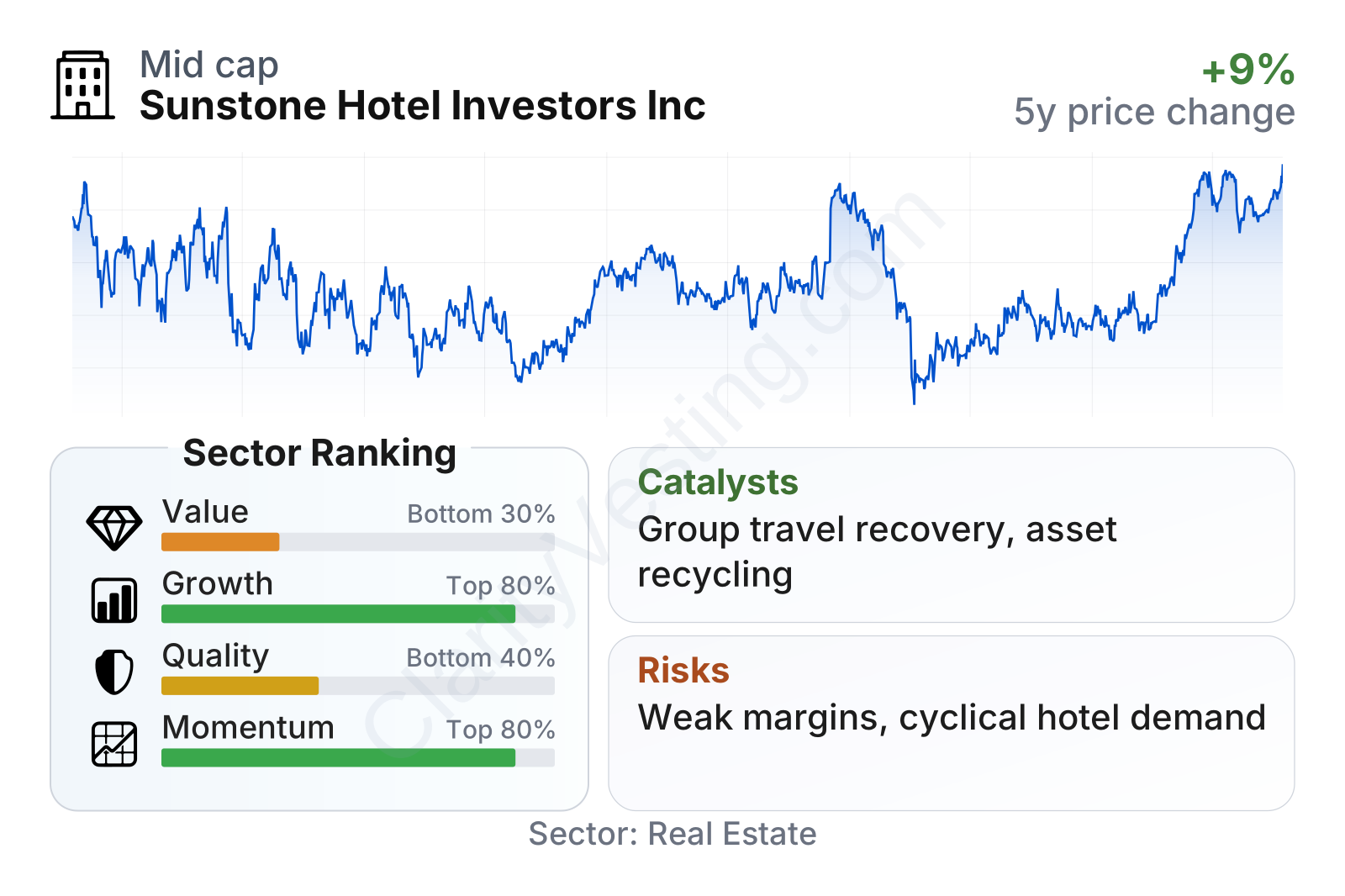
Sunstone sits in the mid-cap range, with a share price profile that has been volatile but has improved meaningfully over the last year. The market signals are stronger than much of the real estate sector recently, with price momentum ranking in the upper part of the group. Growth metrics also compare well with peers, especially over a five-year period, but the picture is less favorable on valuation and operating quality. The stock trades on a higher earnings multiple than the sector median, while profitability ratios and return measures remain below typical peer levels. In other words, the market is giving meaningful credit for recovery and portfolio quality, but current operating efficiency still looks mixed.
Growth
The hotel REIT sector can grow over time, but it is not a smooth growth industry. Demand depends heavily on travel activity, corporate spending, group events, and consumer confidence. Long term, the more attractive part of the sector is generally concentrated in high-quality assets located in markets with limited new supply, strong convention traffic, or resilient leisure demand. That is where Sunstone is positioned, which gives its strategy a logical foundation.
Its portfolio focus on upper-upscale and luxury hotels can support growth through room rate increases, renovations, and mix improvement rather than relying only on adding more properties. For hotel owners, raising average daily rate is often more powerful than simple occupancy gains, especially when a property has strong brand positioning or is located in a supply-constrained destination.
Revenue per share has climbed strongly over the last five years despite some year-to-year unevenness. That is an encouraging sign because it shows the company has rebuilt and expanded its earning base on a per-share level rather than merely through financial engineering. Compared with much of the sector, Sunstone’s five-year revenue and free cash flow growth have been notably strong.
The dividend profile also reflects the lodging recovery. Hotel REIT payouts were hit hard during the pandemic period, so the rebound in distributions since then is important as a signal of normalized cash generation.
Dividend per share increased sharply from depressed levels and has remained at a much higher run rate than in 2021. Even so, the current yield is still below the sector median, which suggests the market is not valuing Sunstone primarily as a high-yield vehicle. Instead, a larger part of the case rests on asset quality, operational recovery, and room for additional earnings normalization.
A meaningful catalyst for future growth is the continued recovery and normalization of group and business travel, especially in convention-oriented or destination markets. Another potential opportunity comes from capital recycling: selling lower-potential assets, reinvesting in renovations, or pursuing acquisitions when hotel property valuations become attractive. If the company can translate premium property positioning into better margins, growth could become more durable rather than simply cyclical.
Recent company communications and filings have also highlighted ongoing portfolio management and balance sheet discipline. For a hotel REIT, that combination matters because growth is rarely just about adding assets; it often comes from repositioning the existing portfolio so that cash flow rises faster than costs.
Risks
This article is for informational purposes only and does not constitute financial advice. Some content is AI-generated. See Disclaimer


