Stock Analysis · Sotera Health Co (SHC)
Overview
Sotera Health is a healthcare services company that helps medical device makers, pharmaceutical companies, food businesses, and laboratories keep products safe, sterile, and compliant with regulations. Its work is mostly behind the scenes: sterilizing single-use medical devices, testing products and environments in laboratories, and providing advisory services around microbiology and regulatory standards. These are specialized services that customers often need every year, which gives the business a recurring and relatively resilient demand base.
The company operates through three main business lines. Based on recent annual reporting, revenue is distributed approximately as follows:
- Sterigenics: about 53% of revenue. This segment provides terminal sterilization services, mainly using gamma irradiation, electron beam, and ethylene oxide processing for medical devices, pharmaceuticals, and some food-related applications.
- Nelson Labs: about 29% of revenue. This business performs microbiological and analytical testing, including sterility assurance, biocompatibility, toxicology, and environmental monitoring.
- Nordion: about 18% of revenue. Nordion supplies cobalt-60 and offers related products and services used in sterilization and other medical and industrial applications.
This mix matters because it combines a service network with technical know-how and a supply role in an important sterilization input. Revenue has grown from roughly $0.93 billion in 2021 to about $1.16 billion in 2025, while operating income recovered after a difficult 2022. Gross profit has also expanded over that period, suggesting the core business remains solid even though interest expense still absorbs a meaningful share of earnings.
The longer-term pattern shows a business with improving revenue and gross profit, but with net income more volatile than operating performance because financing costs and exceptional items have had a large effect. That makes Sotera easier to understand as a strong operating franchise with a more complicated balance-sheet and legal backdrop.
Key Figures
| Metric | Value | Sector ⓘ |
|---|---|---|
| Date | Oct 24, 2026 | |
| Context | ||
| Sector | Healthcare | |
| Industry | Diagnostics & Research | |
| Market Cap ⓘ | $5.07B | |
| Beta ⓘ | 1.85 | |
Value (Cheapness) | ||
| P/E Ratio ⓘ | 31.18 | 25.42 |
| P/B Ratio ⓘ | 7.85 | 3.08 |
| FCF Yield ⓘ | 2.22% | 3.12% |
| Dividend Yield ⓘ | N/A | 1.85% |
| EBIT / EV ⓘ | 5.72% | 0.56% |
| PEG ⓘ | 1.68 | |
Growth (Business expansion) | ||
| Revenue Growth ⓘ | 9.20% | 7.50% |
| RPS Growth (5Y CAGR) ⓘ | 5.06% | 8.60% |
| EPS Growth (5Y CAGR) ⓘ | -20.01% | -17.73% |
| BVPS Growth (5Y CAGR) ⓘ | 0.21% | 3.72% |
| Margin Growth (5Y Trend) ⓘ | -0.77% | -0.57% |
| FCF Growth (5Y CAGR) ⓘ | -4.51% | 0.96% |
| DPS Growth (5Y CAGR) ⓘ | N/A | 6.69% |
Quality (Business durability) | ||
| ROIC (Latest) ⓘ | 9.16% | 3.17% |
| ROA (Latest) ⓘ | 5.04% | 2.98% |
| ROIC (5Y Median) ⓘ | 4.86% | 4.56% |
| ROA (5Y Median) ⓘ | 1.64% | 1.87% |
| Net Debt / EBIT (Latest) ⓘ | 4.69 | 1.34 |
| Net Debt / EBIT (5Y Median) ⓘ | 7.16 | 1.86 |
| Net Debt / EBITDA (Latest) ⓘ | 3.59 | 1.00 |
| Net Debt / Assets ⓘ | 57.80% | 5.06% |
| EBITDA / Interest ⓘ | 3.72 | 9.55 |
| Operating Margin (Latest) ⓘ | 33.50% | 9.25% |
| Operating Margin (5Y Median) ⓘ | 25.31% | 7.33% |
| Debt to Equity (Latest) ⓘ | 340.73% | 26.68% |
| Profit Margin (Latest) ⓘ | 13.44% | 3.34% |
| Free Cash Flow (Latest) ⓘ | $112.70M | |
Momentum (Price trend) | ||
| 3Y Return ⓘ | +39.89% | +51.61% |
| 12M Return (excl. last month) ⓘ | +15.80% | +19.90% |
| 6M Return ⓘ | +15.99% | +10.10% |
| Price vs. 200-Day MA ⓘ | +6.52% | +6.44% |
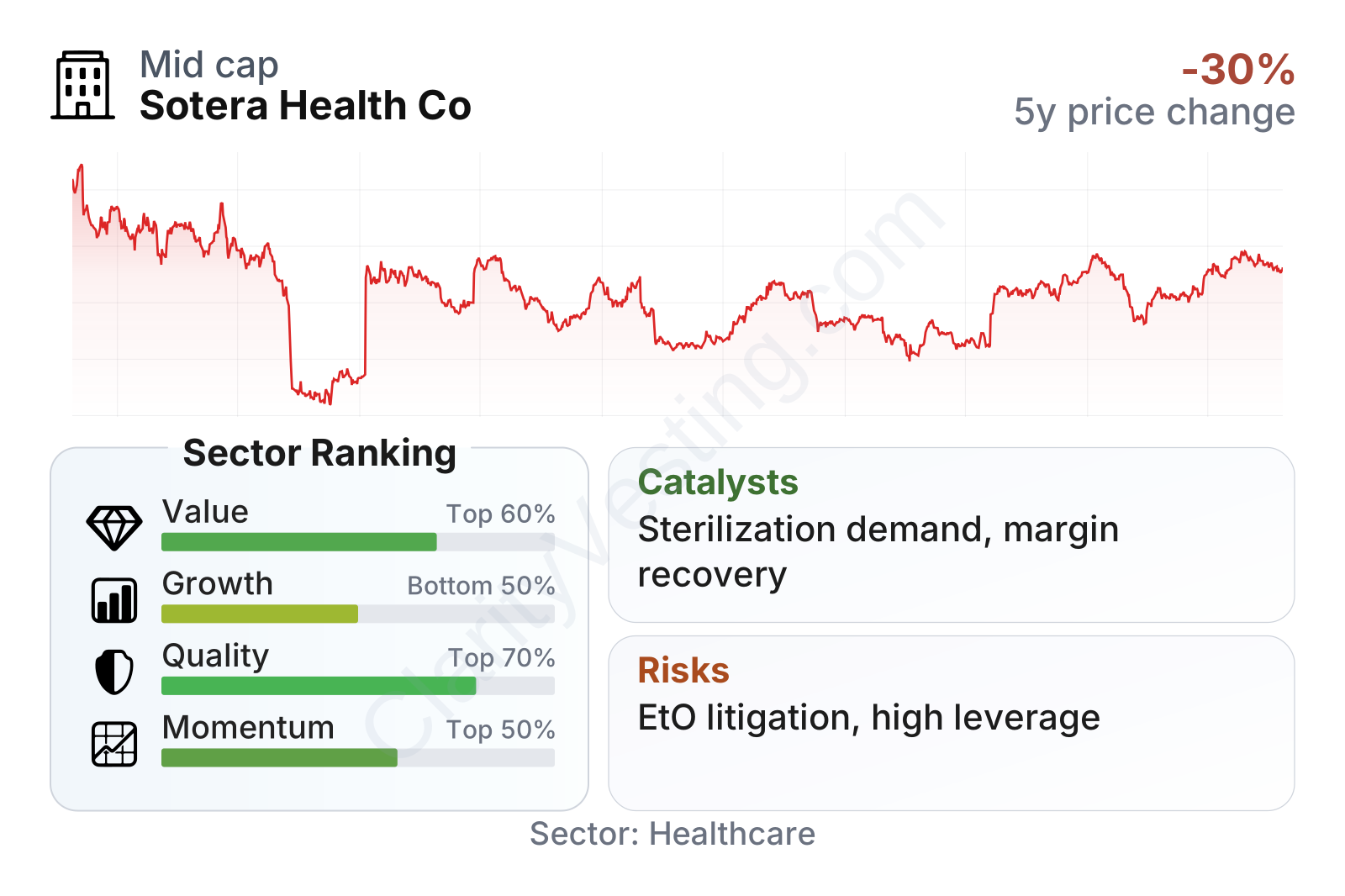
Sotera sits in the mid-cap range and the share price history shows that the market has treated it as a volatile stock rather than a steady compounder. Recent momentum has been better, but the longer record includes sharp swings tied to legal and valuation concerns. The company’s quality profile stands out more positively than its growth profile: margins, return on capital, and return on assets are above many healthcare peers, while growth metrics are more mixed. The value picture is not obviously cheap on traditional ratios, especially on earnings and book value, although enterprise-value-based profitability looks stronger than a simple P/E view would suggest.
Growth
Sotera operates in a part of healthcare that benefits from durable structural demand. More medical procedures, more single-use devices, stricter sterilization standards, pharmaceutical outsourcing, and ongoing laboratory testing needs all support the sector over time. These are not trend-driven markets; they are tied to healthcare volumes, patient safety, and regulation. That usually creates steadier demand than many other healthcare niches.
The company’s strategy also has a clear logic. Sterigenics and Nelson Labs are service businesses embedded in customer workflows, while Nordion supports the supply chain with cobalt-60. Together, they create a broader sterilization and testing platform that can serve customers from product development through commercial production. That can deepen client relationships and create switching friction, since customers often validate processes carefully and do not change providers casually.
Recent growth has been respectable rather than explosive. Year-over-year revenue growth has moved around, but the latest readings are around high-single-digit to roughly 10%, which is ahead of the broader sector median. That is encouraging because it suggests the company is still finding room to expand even after navigating legal and operational pressure in prior periods.
Cash generation has been less smooth. Free cash flow turned sharply negative in 2024 before recovering back to positive territory, and the latest trailing level remains positive but not especially large relative to the company’s size. For a long-term perspective, this means the growth case depends more on stable execution and margin retention than on rapid cash accumulation today.
One meaningful catalyst is healthcare outsourcing and the continued need for validated sterilization capacity. Building and certifying these facilities is difficult, expensive, and time-consuming, so existing operators can benefit when customers want dependable external partners. Another catalyst is margin strength: operating margin is well above the sector median, which gives Sotera room to turn moderate revenue growth into stronger profit growth if interest costs and exceptional headwinds ease.
Recent company communications have also emphasized ongoing network investments, pricing actions, and demand resilience across core sterilization and testing activities. None of these alone transforms the company, but together they support the idea that Sotera remains positioned in an essential part of the healthcare supply chain.
Risks
This article is for informational purposes only and does not constitute financial advice. Some content is AI-generated. See Disclaimer


