Stock Analysis · SGS SA (SGSOF)
Overview
SGS SA is a Swiss testing, inspection, and certification company. In simple terms, it helps businesses and governments check whether products, facilities, supply chains, and operations meet safety, quality, regulatory, and sustainability standards. Its work can range from inspecting industrial equipment and verifying commodity shipments to testing food, pharmaceuticals, and consumer goods in laboratories.
The business is built around trust and compliance. Many customers use SGS because they need an independent third party to confirm that a product is safe, a shipment matches contract terms, or a factory follows local and international rules. That makes SGS less tied to one single industry and more exposed to a broad set of recurring needs across trade, manufacturing, energy, health, and consumer markets.
Based on the company’s recent reporting structure, revenue is spread across several operating areas, with the mix relatively diversified rather than concentrated in one segment.
- Connectivity & Products: approximately 29% of revenue. This includes testing and certification for consumer goods, electronics, electrical products, and related supply chains.
- Industries & Environment: approximately 27%. This covers industrial inspection, environmental services, asset integrity, and support for infrastructure and energy projects.
- Natural Resources: approximately 19%. This activity includes minerals, metals, oil, gas, chemicals, and agricultural commodity testing and verification.
- Health & Nutrition: approximately 16%. This area includes food testing, pharmaceutical and cosmetic support, and related laboratory services.
- Business Assurance: approximately 9%. This includes audits, certification, training, and sustainability-related assurance services.
Geographically, SGS operates globally with a large footprint across Europe, Asia-Pacific, the Americas, the Middle East, and Africa. That broad network is important because customers often want the same service provider across several countries.
The financial profile points to a service company with solid margins and strong cash generation. Revenue has moved gradually higher over the last several years, while operating income and net income have also improved after a softer period. That pattern fits a mature global quality-assurance business: not explosive growth, but a business model that can produce steady profits when demand remains healthy.
Key Figures
| Metric | Value | Sector ⓘ |
|---|---|---|
| Date | Oct 17, 2026 | |
| Context | ||
| Sector | Industrials | |
| Industry | Consulting Services | |
| Market Cap ⓘ | $24.12B | |
| Beta ⓘ | 0.55 | |
Value (Cheapness) | ||
| P/E Ratio ⓘ | 28.49 | 22.10 |
| P/B Ratio ⓘ | 27.15 | 1.97 |
| FCF Yield ⓘ | 8.37% | 6.38% |
| Dividend Yield ⓘ | 2.62% | 1.94% |
| EBIT / EV ⓘ | N/A | 4.79% |
| PEG ⓘ | 5.48 | |
Growth (Business expansion) | ||
| Revenue Growth ⓘ | 7.60% | 9.30% |
| RPS Growth (5Y CAGR) ⓘ | 1.31% | 7.81% |
| EPS Growth (5Y CAGR) ⓘ | -36.35% | -13.06% |
| BVPS Growth (5Y CAGR) ⓘ | -8.47% | 6.14% |
| Margin Growth (5Y Trend) ⓘ | -0.23% | 0.88% |
| FCF Growth (5Y CAGR) ⓘ | 3.83% | 11.01% |
| DPS Growth (5Y CAGR) ⓘ | -22.54% | 9.48% |
Quality (Business durability) | ||
| ROIC (Latest) ⓘ | 30.86% | 10.84% |
| ROA (Latest) ⓘ | 17.00% | 5.41% |
| ROIC (5Y Median) ⓘ | 16.09% | 9.38% |
| ROA (5Y Median) ⓘ | 8.60% | 4.95% |
| Net Debt / EBIT (Latest) ⓘ | 1.91 | 2.08 |
| Net Debt / EBIT (5Y Median) ⓘ | 2.68 | 2.27 |
| Net Debt / EBITDA (Latest) ⓘ | 1.29 | 1.39 |
| Net Debt / Assets ⓘ | 46.24% | 19.28% |
| EBITDA / Interest ⓘ | 19.29 | 9.58 |
| Operating Margin (Latest) ⓘ | 14.48% | 10.50% |
| Operating Margin (5Y Median) ⓘ | 13.82% | 10.29% |
| Debt to Equity (Latest) ⓘ | 517.97% | 65.48% |
| Profit Margin (Latest) ⓘ | 9.20% | 6.67% |
| Free Cash Flow (Latest) ⓘ | $2.02B | |
Momentum (Price trend) | ||
| 3Y Return ⓘ | +72.59% | +61.68% |
| 12M Return (excl. last month) ⓘ | +8.04% | +12.58% |
| 6M Return ⓘ | +13.45% | 0.00% |
| Price vs. 200-Day MA ⓘ | +16.43% | +0.02% |
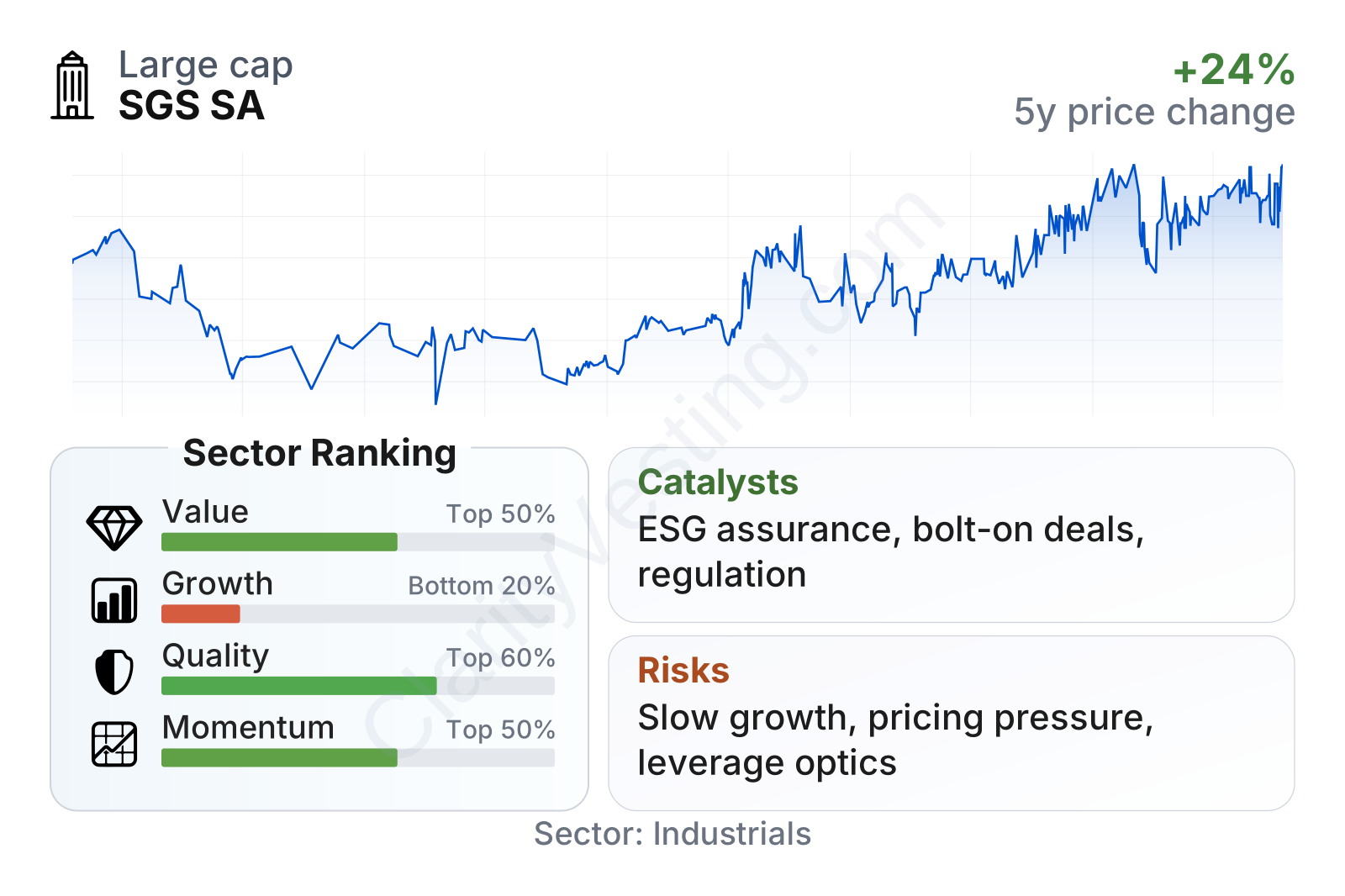
SGS is a large company in its field, with a defensive stock profile as shown by a beta well below 1. Profitability stands out: operating margin is around the mid-teens, above the sector median, while return on invested capital and return on assets are also clearly stronger than typical peers. Free cash flow generation is robust, and the free cash flow yield is above the sector median, which supports the idea that accounting profits are backed by real cash.
Growth metrics are the weaker part of the picture. Recent year-over-year revenue growth is positive, but the longer five-year trends for revenue per share, free cash flow growth, and especially earnings per share look modest compared with the sector. The balance sheet is manageable in interest coverage terms, but leverage ratios need careful interpretation because SGS carries very high debt-to-equity, partly influenced by the structure of its balance sheet rather than by weak operating performance alone.
The stock’s recent market performance has been constructive. The share price is above its long-term average and has outperformed the sector median over the last six to twelve months, even though the three-year return still trails the broader industrial peer group.
Growth
SGS operates in a sector with durable long-term demand drivers. Testing, inspection, and certification tend to benefit from stricter regulation, more complex global supply chains, rising product-safety expectations, and greater demand for traceability. Companies increasingly need outside verification not just for quality and safety, but also for environmental and social claims. That creates a structural growth backdrop even when the broader economy slows.
The company’s strategy also makes sense for this environment. SGS has been focusing on higher-value testing and certification activities, portfolio simplification, productivity, and selective acquisitions. This is a logical path for a mature services group: deepen positions in attractive niches, add specialized capabilities, and use its global laboratory and inspection network more efficiently.
One of the more important catalysts is sustainability and compliance work. As customers face more scrutiny over carbon reporting, responsible sourcing, product origin, food safety, and supply-chain due diligence, independent verification becomes more valuable. SGS is already positioned in these activities through assurance, laboratory testing, and certification services, which gives it room to capture a larger share of spending tied to ESG and regulatory compliance.
Another supportive factor is resilience across end markets. SGS serves many industries rather than relying on one customer category. Weakness in commodities or industrial projects can be partly offset by demand in food, health, consumer products, or regulatory testing. That diversification does not eliminate cyclicality, but it can smooth results over time.
Recent company communications have also pointed to continued operational discipline, margin focus, and ongoing bolt-on acquisitions. For a business like SGS, these smaller acquisitions can matter because they expand local presence, strengthen laboratory capabilities, and add specialized technical services without requiring a major transformation of the group.
Risks
This article is for informational purposes only and does not constitute financial advice. Some content is AI-generated. See Disclaimer


