Stock Analysis · Surgery Partners Inc (SGRY)
Overview
Surgery Partners is a healthcare services company focused mainly on outpatient surgery. It owns or operates ambulatory surgery centers, short-stay surgical hospitals, and related physician practices and ancillary services. The basic idea is simple: many procedures that once took place in large acute-care hospitals can now be performed in lower-cost outpatient settings, which are often more convenient for patients and physicians.
The company’s revenue mix is centered on facility-based care. Based on recent annual reporting, the largest sources of revenue are approximately:
- Ambulatory surgery centers and surgical facilities: about 80% to 85%. This includes fees from outpatient procedures performed in the company’s centers and surgical hospitals across specialties such as orthopedics, gastrointestinal, ophthalmology, pain management, and other elective surgeries.
- Anesthesia services: about 10% to 15%. This comes from anesthesia and related professional services tied to surgical procedures.
- Other patient service revenue and ancillary activities: about 5%. This can include physician practice-related activities and other support services connected to the outpatient care network.
Surgery Partners’ model depends on aligning with physicians, expanding procedure volume, and capturing a larger share of surgeries that continue shifting away from inpatient hospital settings. Over the last several years, revenue has moved steadily higher, and operating income has remained positive even while net income has often stayed negative because of interest expense and other below-the-line items.
The long-term pattern is clear: revenue has increased from a little above $2.2 billion in 2021 to more than $3.3 billion in 2025, while gross profit and operating income also improved. The weak point is that interest costs stayed very heavy, which has limited the conversion of operating progress into bottom-line profit.
Key Figures
| Metric | Value | Sector ⓘ |
|---|---|---|
| Date | Oct 17, 2026 | |
| Context | ||
| Sector | Healthcare | |
| Industry | Medical Care Facilities | |
| Market Cap ⓘ | $1.94B | |
| Beta ⓘ | 1.91 | |
Value (Cheapness) | ||
| P/E Ratio ⓘ | N/A | 24.79 |
| P/B Ratio ⓘ | 1.11 | 3.08 |
| FCF Yield ⓘ | 9.66% | 3.15% |
| Dividend Yield ⓘ | N/A | 1.94% |
| EBIT / EV ⓘ | 13.40% | 0.57% |
| PEG ⓘ | 1.66 | |
Growth (Business expansion) | ||
| Revenue Growth ⓘ | 2.70% | 7.45% |
| RPS Growth (5Y CAGR) ⓘ | -4.08% | 8.61% |
| EPS Growth (5Y CAGR) ⓘ | -26.98% | -17.81% |
| BVPS Growth (5Y CAGR) ⓘ | 47.08% | 3.72% |
| Margin Growth (5Y Trend) ⓘ | -1.81% | -0.62% |
| FCF Growth (5Y CAGR) ⓘ | 60.47% | 1.04% |
| DPS Growth (5Y CAGR) ⓘ | N/A | 6.77% |
Quality (Business durability) | ||
| ROIC (Latest) ⓘ | 11.28% | 3.24% |
| ROA (Latest) ⓘ | -1.11% | 3.01% |
| ROIC (5Y Median) ⓘ | 7.01% | 4.60% |
| ROA (5Y Median) ⓘ | -0.97% | 1.89% |
| Net Debt / EBIT (Latest) ⓘ | 4.93 | 1.34 |
| Net Debt / EBIT (5Y Median) ⓘ | 9.61 | 1.84 |
| Net Debt / EBITDA (Latest) ⓘ | 4.01 | 1.00 |
| Net Debt / Assets ⓘ | 47.22% | 5.45% |
| EBITDA / Interest ⓘ | 1.42 | 9.64 |
| Operating Margin (Latest) ⓘ | 22.89% | 9.27% |
| Operating Margin (5Y Median) ⓘ | 11.96% | 7.38% |
| Debt to Equity (Latest) ⓘ | 240.47% | 28.58% |
| Profit Margin (Latest) ⓘ | -2.63% | 3.59% |
| Free Cash Flow (Latest) ⓘ | $187.60M | |
Momentum (Price trend) | ||
| 3Y Return ⓘ | -38.17% | +42.80% |
| 12M Return (excl. last month) ⓘ | -36.81% | +18.50% |
| 6M Return ⓘ | +11.72% | +7.57% |
| Price vs. 200-Day MA ⓘ | +2.22% | +5.12% |
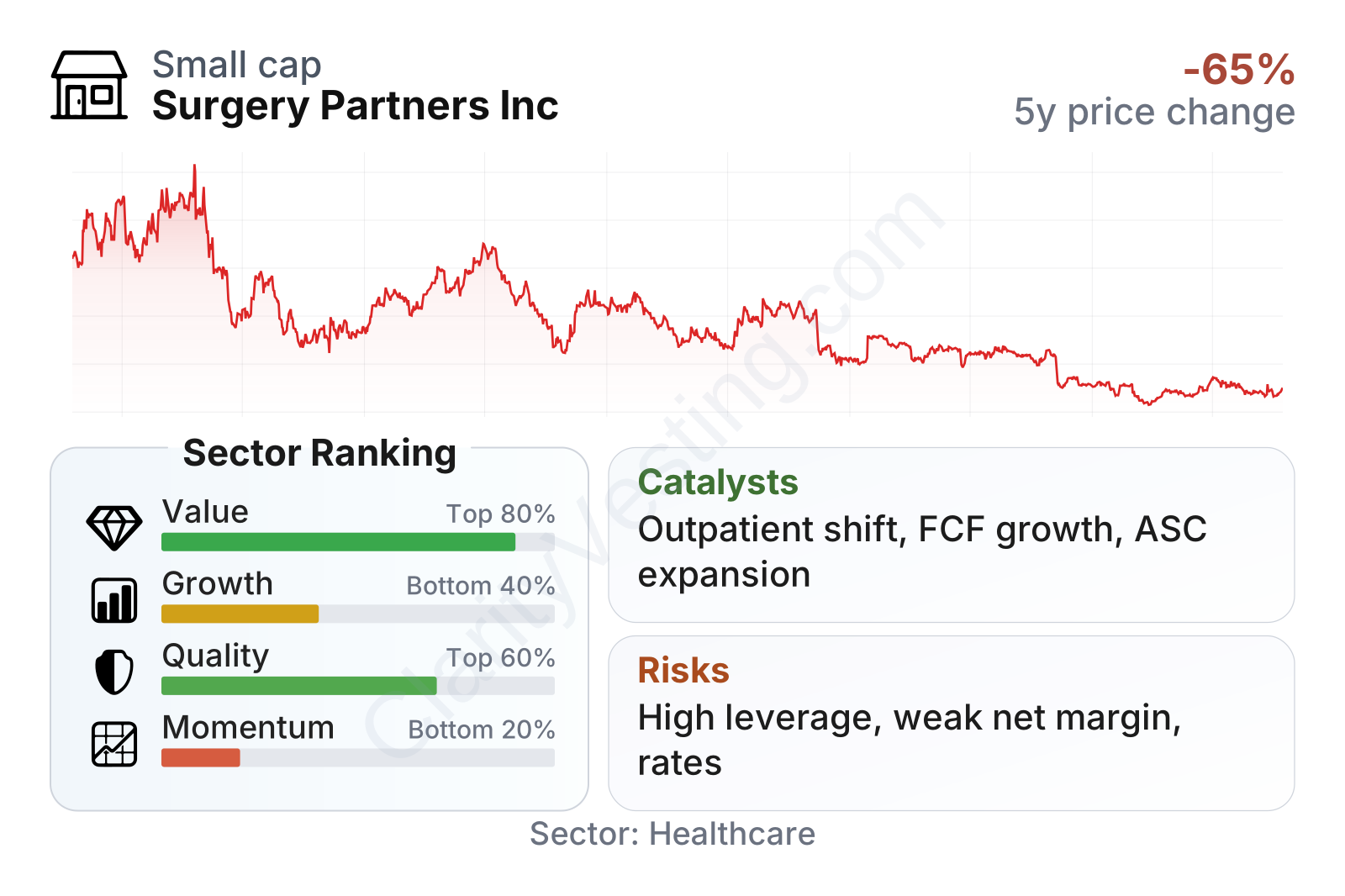
Surgery Partners is a mid-sized healthcare company with a stock that has been much more volatile than the broader market, reflected in a beta close to 2. The factor profile is unusual: value metrics look strong relative to much of the healthcare sector, quality appears mixed but not weak overall, while growth and share-price momentum rank lower. In plain terms, the market is recognizing the company’s cash generation and operating economics, but it remains skeptical about balance-sheet pressure and the pace of earnings growth.
The stock-price history also shows that this has not been a steady compounder in the market’s eyes. Shares were much higher in 2021 and 2022, then fell sharply and have remained far below those earlier levels despite periods of recovery. That gap between business expansion and stock performance is an important part of the current valuation debate.
Growth
Surgery Partners operates in a favorable part of healthcare. The outpatient migration trend is one of the clearest structural shifts in the industry: payers want lower-cost sites of care, physicians often prefer specialized surgical settings, and patients increasingly value shorter stays and more efficient treatment. That gives ambulatory surgery centers a long runway, especially in procedures that continue moving out of traditional hospitals.
The company’s strategy fits that trend well. It has built a scaled network of surgical facilities, often alongside physician partners, and this model can support growth through procedure volume, service-line expansion, acquisitions, and adding capacity in existing markets. Scale also matters in contracting, recruiting, and spreading administrative costs across a wider base.
Revenue growth has clearly remained positive, but the pace has cooled. The company posted double-digit growth in several earlier periods, while the most recent year-over-year gains have moved down into the low single digits. That does not mean the expansion case is broken, but it does suggest that the next phase may depend more on execution, case mix improvement, and selective acquisitions than on broad post-pandemic normalization.
One encouraging feature is cash generation. Free cash flow has improved materially over the last few years and recently moved above $200 million on a trailing basis. That matters because it gives the company more flexibility to invest in facilities, pursue partnerships, and gradually strengthen the balance sheet. In a business carrying meaningful debt, cash flow often tells more than reported earnings.
A notable catalyst is the continuing payer and employer push toward lower-cost outpatient settings. If more procedures keep migrating away from hospitals, Surgery Partners is positioned to participate. The company has also emphasized growth through physician alignment and expansion in higher-acuity procedures that can still be handled outside the traditional inpatient hospital environment. Those are practical, industry-backed levers rather than speculative ones.
Risks
This article is for informational purposes only and does not constitute financial advice. Some content is AI-generated. See Disclaimer


