Stock Analysis · SpyGlass Pharma Inc (SGP)
Overview
SpyGlass Pharma Inc is a clinical-stage ophthalmology company focused on treating eye diseases with drug-delivery technology. Its lead program combines an intraocular lens used in cataract surgery with a long-lasting medicine-delivery platform designed to release therapy over an extended period. In simple terms, the company is trying to turn a one-time surgical procedure into a way to provide sustained treatment inside the eye, which could reduce the need for frequent follow-up injections or drops.
The company is still in the development stage, so its business is centered on research, clinical testing, regulatory preparation, and building the foundation for future commercialization rather than selling products at scale today. That matters for long-term analysis because the value of the business currently depends more on clinical progress and eventual market adoption than on present-day sales.
Based on available public financial information, SpyGlass currently has no meaningful recurring commercial revenue. Its economic profile is therefore highly concentrated:
- Product revenue: 0% — no established commercial sales base has been reported.
- Collaboration, licensing, or other operating revenue: 0% — no material recurring revenue stream appears in the latest available financial profile.
- Capital raised from investors: effectively the main funding source — this is not revenue, but it is what presently finances operations, clinical development, and corporate expenses.
This makes SpyGlass very different from a mature healthcare company. It is not being evaluated on current earnings power; it is being evaluated on whether its platform can successfully move through development and eventually address a meaningful need in ophthalmology.
The expense mix also shows what management is prioritizing. Research and development is the largest cost item and has climbed materially over the last three years, while administrative spending has also increased but remains secondary. That pattern is typical of a company pushing a lead asset forward.
The business remains pre-revenue, while operating losses have widened as development spending has increased. Research and development represents the biggest use of cash by a wide margin, which fits the company’s stage: the core question is not current profitability, but whether that spending can turn into a viable ophthalmology product platform.
Key Figures
| Metric | Value | Sector ⓘ |
|---|---|---|
| Date | Oct 31, 2026 | |
| Context | ||
| Sector | Healthcare | |
| Industry | Biotechnology | |
| Market Cap ⓘ | $1.09B | |
| Beta ⓘ | N/A | |
Value (Cheapness) | ||
| P/E Ratio ⓘ | N/A | 24.88 |
| P/B Ratio ⓘ | 4.68 | 3.16 |
| FCF Yield ⓘ | -4.57% | 2.92% |
| Dividend Yield ⓘ | N/A | 1.78% |
| EBIT / EV ⓘ | -6.92% | 0.56% |
| PEG ⓘ | N/A | |
Growth (Business expansion) | ||
| Revenue Growth ⓘ | N/A | 7.50% |
| RPS Growth (5Y CAGR) ⓘ | N/A | 8.46% |
| EPS Growth (5Y CAGR) ⓘ | N/A | -17.36% |
| BVPS Growth (5Y CAGR) ⓘ | N/A | 3.71% |
| Margin Growth (5Y Trend) ⓘ | N/A | -0.61% |
| FCF Growth (5Y CAGR) ⓘ | N/A | 1.10% |
| DPS Growth (5Y CAGR) ⓘ | N/A | 6.66% |
Quality (Business durability) | ||
| ROIC (Latest) ⓘ | -62.57% | 5.22% |
| ROA (Latest) ⓘ | -30.26% | 3.01% |
| ROIC (5Y Median) ⓘ | N/A | 4.52% |
| ROA (5Y Median) ⓘ | N/A | 1.85% |
| Net Debt / EBIT (Latest) ⓘ | N/A | 1.34 |
| Net Debt / EBIT (5Y Median) ⓘ | N/A | 1.84 |
| Net Debt / EBITDA (Latest) ⓘ | N/A | 0.98 |
| Net Debt / Assets ⓘ | -90.99% | 4.48% |
| EBITDA / Interest ⓘ | N/A | 9.65 |
| Operating Margin (Latest) ⓘ | N/A | 9.44% |
| Operating Margin (5Y Median) ⓘ | N/A | 7.33% |
| Debt to Equity (Latest) ⓘ | 0.70% | 27.22% |
| Profit Margin (Latest) ⓘ | N/A | 3.41% |
| Free Cash Flow (Latest) ⓘ | -$49.74M | |
Momentum (Price trend) | ||
| 3Y Return ⓘ | N/A | +55.86% |
| 12M Return (excl. last month) ⓘ | N/A | +16.75% |
| 6M Return ⓘ | +46.90% | +14.89% |
| Price vs. 200-Day MA ⓘ | N/A | +7.77% |
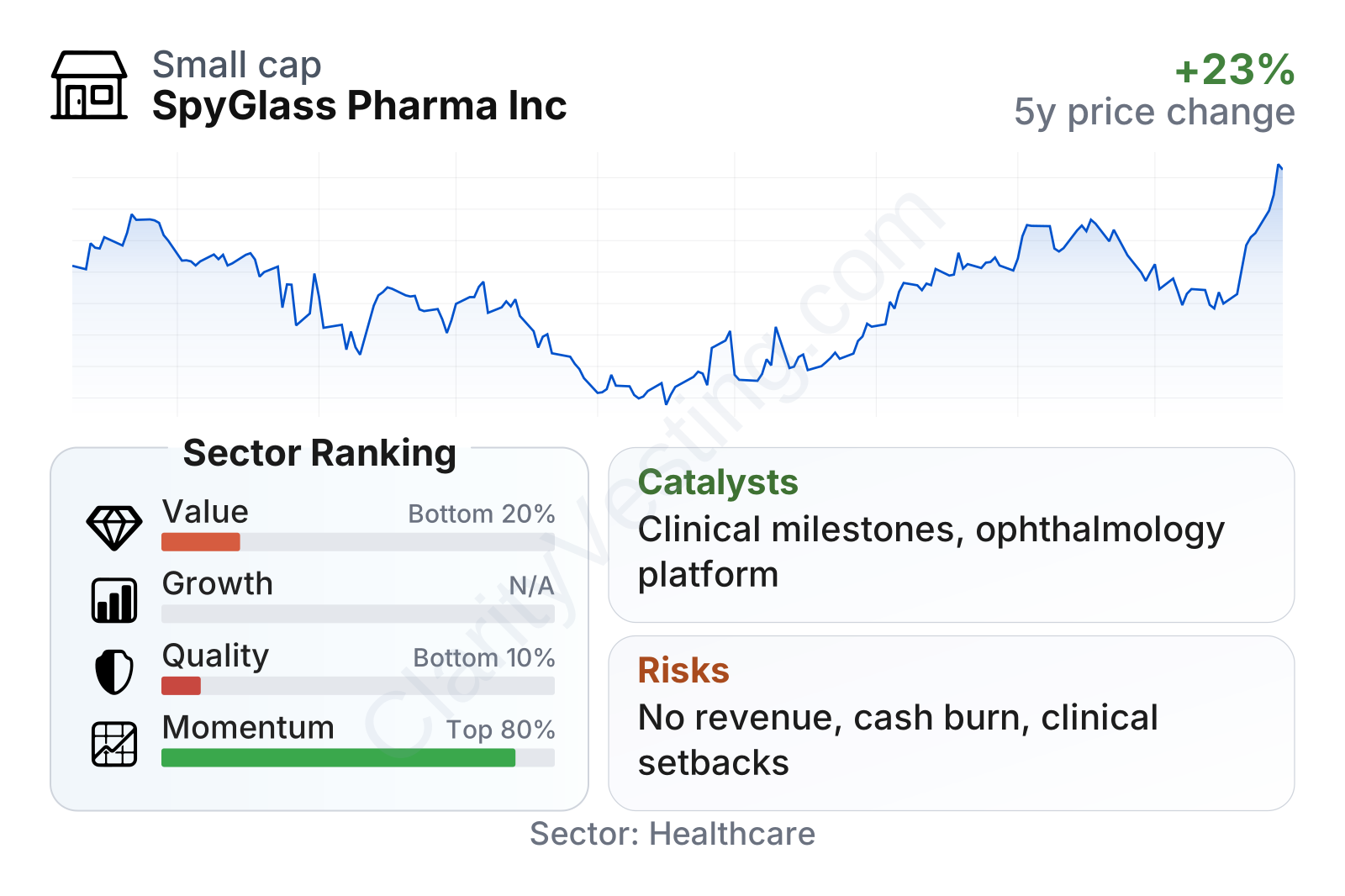
SpyGlass is a small-cap healthcare company with valuation and quality metrics that look weak on traditional screens, which is common for clinical-stage biotech and medtech businesses. The company ranks in the bottom tier of its sector on value and quality measures because it has negative cash flow, negative returns on capital, and no established earnings base. At the same time, its balance sheet leverage is very low, with debt to equity around 1%, far below the healthcare sector median. Price momentum has been stronger than much of the sector over the past six months, suggesting the market has recently become more constructive even though the underlying business is still in the heavy-development phase.
Growth
The company operates in ophthalmology, an area supported by powerful long-term demand drivers. Cataract procedures are common and benefit from aging populations, while chronic eye diseases create interest in treatments that can last longer and reduce treatment burden. This is an attractive backdrop because physicians and patients generally value solutions that improve adherence, lower procedure frequency, and fit into existing care pathways.
SpyGlass’s strategy is coherent if its technology works as intended. By pairing a device already associated with cataract surgery with sustained drug delivery, the company is aiming at a practical clinical problem: many eye treatments work, but repeated administration can be inconvenient and can reduce adherence. A platform that delivers medicine over a prolonged period could potentially improve real-world use and differentiate itself from therapies that require more frequent intervention.
The company’s main catalyst is clinical and regulatory progress in its lead ophthalmology program. For a business at this stage, successful study execution, favorable safety and efficacy updates, and eventual regulatory milestones matter far more than short-term accounting results. Another potential catalyst is strategic validation, such as partnerships, manufacturing progress, or signs that surgeons and payers could support adoption if approved.
There is also a broader strategic appeal here: if SpyGlass proves that its drug-delivery approach can work in one large eye-care use case, the platform may have relevance beyond a single product. That does not guarantee expansion, but it raises the ceiling of the opportunity compared with a company built around only one narrow indication.
Risks
This article is for informational purposes only and does not constitute financial advice. Some content is AI-generated. See Disclaimer


