Stock Analysis · Shanghai Industrial Holdings Ltd (SGHIY)
Overview
Shanghai Industrial Holdings Ltd is a Hong Kong-listed state-linked conglomerate with operations centered on mainland China. Rather than relying on one single product, the group owns and manages a mix of infrastructure, environmental services, and consumer-related assets. Its business model is built around essential services and regulated or semi-regulated activities such as toll roads, water treatment, and municipal waste projects, while also keeping exposure to consumer products through its interest in Huishan Dairy and to property-related assets through legacy operations.
This mix matters for long-term analysis because the company is not a pure industrial manufacturer. A large part of its economic profile comes from assets that can produce recurring cash flow, especially infrastructure and environmental businesses, but that stability is offset by lower growth and by the complexity that comes with running several unrelated divisions at the same time.
Based on the company’s recent annual disclosures, revenue is mainly generated from the following activities:
- Consumer products, mainly dairy and related businesses: approximately 40% to 50% of group revenue in recent years. This includes milk and dairy operations linked to the company’s consumer platform.
- Environmental services: approximately 20% to 30%. This usually includes sewage treatment, water supply, solid waste incineration, and other municipal environmental projects.
- Infrastructure and related facilities: approximately 15% to 25%. This segment is largely tied to toll roads and other infrastructure assets that benefit from traffic and urban activity.
- Property and land development or related activities: generally a smaller share than the segments above, though it can fluctuate depending on project timing and disposals.
The business mix has gradually shifted toward infrastructure-like and public-service assets, which tend to be more defensive than cyclical industrial operations. Even so, the company’s total revenue has moved down over the last several years, showing that portfolio stability has not fully translated into top-line growth.
The financial flow over the last five years shows a clear pattern: revenue has trended lower from the 2021 peak, and operating income has fallen much faster than sales. That suggests margin pressure, weaker mix, or both. Interest expense has also remained meaningful, which reduces the amount of profit left for shareholders despite still-positive earnings and cash generation.
Key Figures
Metric Value Sector ⓘ Date Oct 17, 2026 Context Sector Industrials Industry Conglomerates Market Cap ⓘ $1.66B Beta ⓘ 0.72 P/E Ratio ⓘ 6.36 22.10 P/B Ratio ⓘ 0.03 1.97 FCF Yield ⓘ 282.78% 6.38% Dividend Yield ⓘ 7.68% 1.94% EBIT / EV ⓘ N/A 4.79% PEG ⓘ N/A Revenue Growth ⓘ -7.10% 9.30% RPS Growth (5Y CAGR) ⓘ -14.41% 7.81% EPS Growth (5Y CAGR) ⓘ 79.07% -13.06% BVPS Growth (5Y CAGR) ⓘ -20.89% 6.14% Margin Growth (5Y Trend) ⓘ -19.50% 0.88% FCF Growth (5Y CAGR) ⓘ 34.61% 11.01% DPS Growth (5Y CAGR) ⓘ -1.53% 9.48% ROIC (Latest) ⓘ N/A 10.84% ROA (Latest) ⓘ 2.76% 5.41% ROIC (5Y Median) ⓘ 4.35% 9.38% ROA (5Y Median) ⓘ 1.61% 4.95% Net Debt / EBIT (Latest) ⓘ 3.98 2.08 Net Debt / EBIT (5Y Median) ⓘ 3.56 2.27 Net Debt / EBITDA (Latest) ⓘ 2.59 1.39 Net Debt / Assets ⓘ 20.11% 19.28% EBITDA / Interest ⓘ 4.53 9.58 Operating Margin (Latest) ⓘ 17.91% 10.50% Operating Margin (5Y Median) ⓘ 23.96% 10.29% Debt to Equity (Latest) ⓘ 114.55% 65.48% Profit Margin (Latest) ⓘ 10.10% 6.67% Free Cash Flow (Latest) ⓘ $4.69B 3Y Return ⓘ +49.89% +61.68% 12M Return (excl. last month) ⓘ +9.21% +12.58% 6M Return ⓘ -9.87% 0.00% Price vs. 200-Day MA ⓘ +19.99% +0.02%
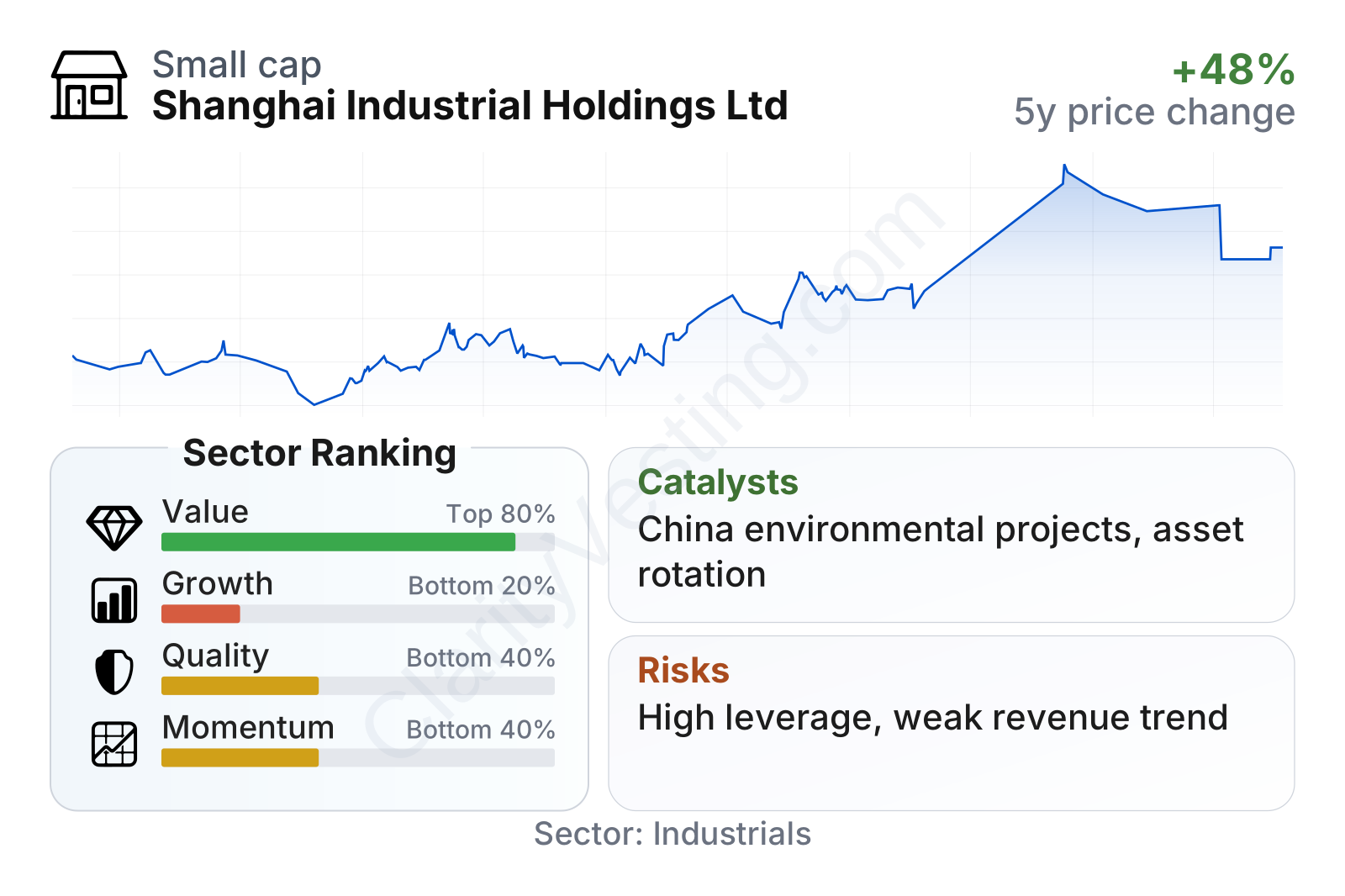
Shanghai Industrial Holdings is a mid-sized company by market value and its share price has risen over the past several years, although with weaker momentum recently. The latest metrics point to a stock that screens as very inexpensive compared with the broader industrial sector: the earnings multiple is far below the sector median, the price-to-book ratio is extremely low, and the dividend yield is notably high. Free cash flow generation also looks solid in absolute terms.
That low valuation comes with trade-offs. Growth metrics rank near the bottom of the sector, reflecting declining revenue over one year and over the past five years on a per-share basis. Quality is mixed rather than strong: operating and profit margins are respectable, but leverage is elevated and returns on assets are below sector norms. In short, the company combines cheap valuation and meaningful cash generation with weak growth and a balance sheet that requires attention.
Growth
Shanghai Industrial Holdings operates in sectors that have long-term relevance. Urban infrastructure, water treatment, sewage treatment, and waste-to-energy services are supported by China’s continuing need for environmental compliance and city services. These are not fad markets; they are essential activities tied to urban living, public health, and regulation. That gives the company exposure to durable demand even when the broader economy slows.
Its strategy also makes sense in broad terms. The group has been leaning on infrastructure and environmental assets that can produce repeatable operating cash flow. That is a practical direction for a company with state-linked roots and access to public-service projects. If management continues simplifying the portfolio and emphasizing regulated or concession-based assets, the business mix could become easier to understand and potentially more resilient.
The revenue trend, however, shows that this transition has not yet produced consistent expansion. Sales growth has swung between strong rebounds and notable declines, and the latest yearly reading remains negative, well below the sector median. This points to a company in a mature phase rather than a high-growth phase. For long-term analysis, the main question is less about rapid expansion and more about whether management can stabilize revenue while protecting margins and cash flow.
A meaningful catalyst could come from policy-driven investment in environmental infrastructure and municipal services in China. Businesses such as water treatment and waste incineration can benefit when local governments continue upgrading public utilities and tightening environmental standards. Another potential opportunity is internal: if the company recycles capital from lower-return or non-core assets into infrastructure and environmental projects, the portfolio could gradually improve in quality even without dramatic revenue growth.
Recent corporate updates have also shown continued focus on core operating segments and funding discipline rather than aggressive expansion. That does not create a near-term growth narrative, but it can support steadier long-range positioning if execution remains consistent.
Risks
This article is for informational purposes only and does not constitute financial advice. Some content is AI-generated. See Disclaimer


