Stock Analysis · Safestore Holdings plc (SFSHF)
Overview
Safestore Holdings plc is a self-storage real estate company focused mainly on renting storage space to individuals and businesses. Its properties are located primarily in the United Kingdom and Paris, with additional exposure through operations and joint ventures in other European markets. The business is simple to understand: Safestore owns or operates storage facilities, rents units to customers, and earns recurring income from occupancy, rent increases, and related services.
The company’s revenue base is centered on storage rental income, while smaller streams come from ancillary services connected to storage use. Based on the group’s business model and reporting structure, the revenue mix is approximately as follows:
- Storage rental income: about 90% to 95% — monthly fees paid by personal and business customers for storage units.
- Ancillary income: about 5% to 10% — insurance-related income, packaging materials, locks, and other add-on services sold at stores.
Geographically, the United Kingdom remains the core earnings engine, with Paris as the second most important market. That concentration matters because self-storage economics tend to be strongest in dense urban areas where housing is expensive, living space is limited, and business customers value flexible storage close to city centers.
Over the last several years, Safestore has shown a fairly resilient operating model. Revenue has generally trended upward from 2021 through 2025, while gross profit remained strong even as financing costs increased. The business also benefits from a high-margin structure typical of mature self-storage assets, where incremental occupancy and rent growth can flow through to profit at attractive rates.
The operating picture points to a business with strong gross profitability and relatively contained administrative costs. The bigger swing factor in reported earnings has been below the operating line, where interest costs and property-related valuation movements can make net income more volatile than the underlying rental business.
Key Figures
| Metric | Value | Sector ⓘ |
|---|---|---|
| Date | Oct 03, 2026 | |
| Context | ||
| Sector | Real Estate | |
| Industry | REIT - Industrial | |
| Market Cap ⓘ | $1.77B | |
| Beta ⓘ | 1.14 | |
Value (Cheapness) | ||
| P/E Ratio ⓘ | 18.64 | 17.35 |
| P/B Ratio ⓘ | 0.95 | 0.86 |
| FCF Yield ⓘ | 11.00% | 7.47% |
| Dividend Yield ⓘ | 4.24% | 4.75% |
| EBIT / EV ⓘ | N/A | 3.81% |
| PEG ⓘ | N/A | |
Growth (Business expansion) | ||
| Revenue Growth ⓘ | 8.70% | 5.30% |
| RPS Growth (5Y CAGR) ⓘ | -1.51% | 5.96% |
| EPS Growth (5Y CAGR) ⓘ | -4.16% | -11.41% |
| BVPS Growth (5Y CAGR) ⓘ | 5.71% | 0.41% |
| Margin Growth (5Y Trend) ⓘ | 4.71% | 0.53% |
| FCF Growth (5Y CAGR) ⓘ | 30.31% | 5.40% |
| DPS Growth (5Y CAGR) ⓘ | 4.07% | 5.02% |
Quality (Business durability) | ||
| ROIC (Latest) ⓘ | 7.57% | 5.77% |
| ROE (Latest) ⓘ | 15.99% | 7.64% |
| ROA (Latest) ⓘ | 10.31% | 2.85% |
| ROIC (5Y Median) ⓘ | 5.41% | 4.20% |
| ROE (5Y Median) ⓘ | 17.89% | 6.03% |
| ROA (5Y Median) ⓘ | 11.79% | 2.45% |
| Net Debt / EBIT (Latest) ⓘ | 4.30 | 7.57 |
| Net Debt / EBIT (5Y Median) ⓘ | 5.53 | 8.41 |
| Net Debt / EBITDA (Latest) ⓘ | 4.25 | 5.12 |
| Net Debt / Assets ⓘ | 30.40% | 37.84% |
| EBITDA / Interest ⓘ | 4.16 | 4.11 |
| Operating Margin (Latest) ⓘ | 54.58% | 35.40% |
| Operating Margin (5Y Median) ⓘ | 57.65% | 36.59% |
| Debt to Equity (Latest) ⓘ | 49.06% | 89.06% |
| Profit Margin (Latest) ⓘ | 26.44% | 19.99% |
| Free Cash Flow (Latest) ⓘ | $194.42M | |
Momentum (Price trend) | ||
| 3Y Return ⓘ | -4.79% | +30.60% |
| 12M Return (excl. last month) ⓘ | -6.97% | +7.55% |
| 6M Return ⓘ | -13.09% | +0.69% |
| Price vs. 200-Day MA ⓘ | -12.67% | -2.30% |
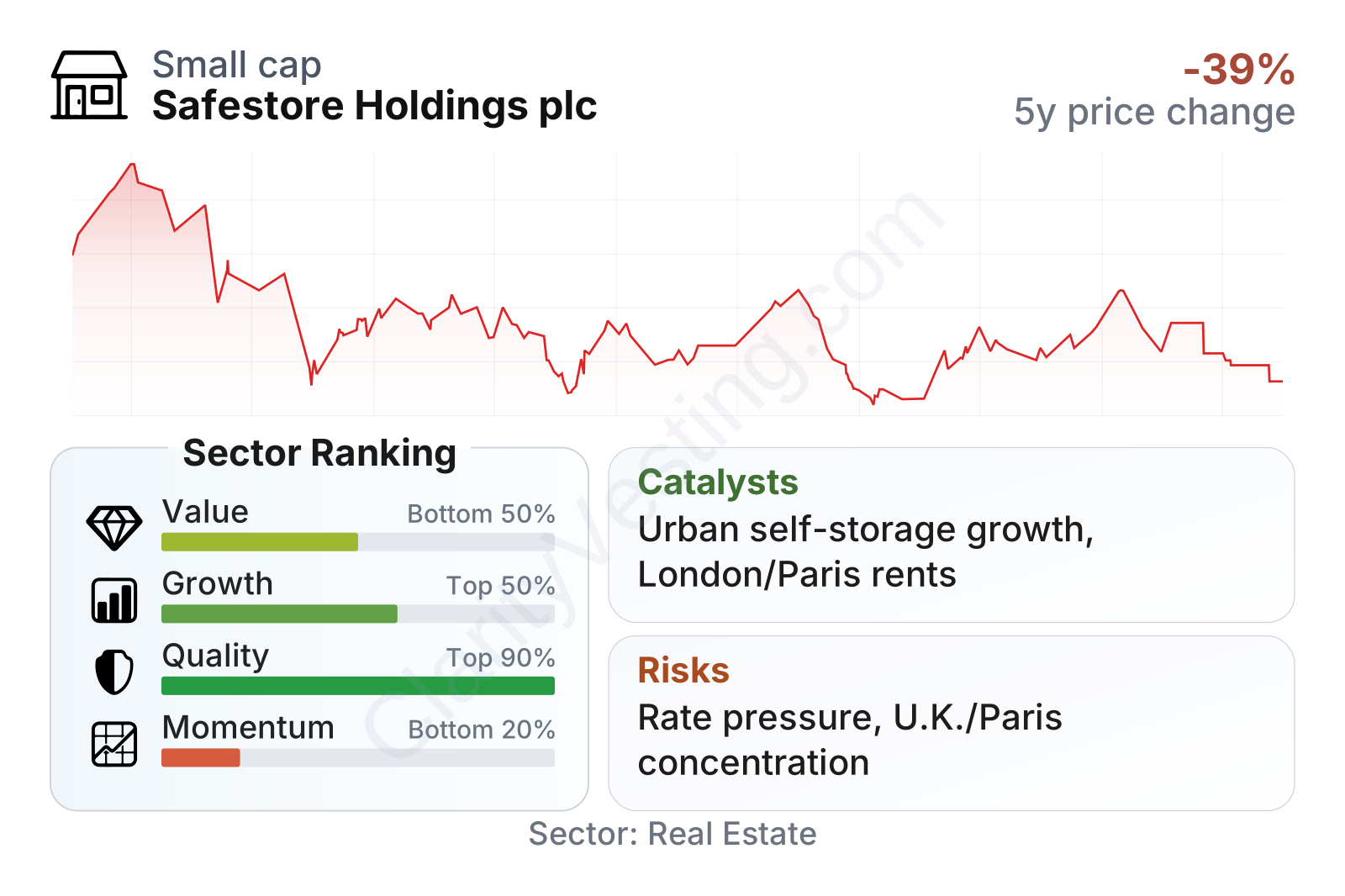
Safestore is a mid-sized listed real estate company with above-average profitability for its sector. Its quality profile stands out: returns on equity, assets, and invested capital are all materially ahead of sector medians, while leverage looks more controlled than many real estate peers. Debt to equity is around 49%, compared with a much higher sector median, and net debt relative to earnings also appears better than average.
The company’s cash generation is another positive feature. Free cash flow yield is above the sector median, and operating margins are unusually strong for real estate at roughly the mid-50% range versus a sector median near the mid-30% range. That suggests the core portfolio is efficient and benefits from favorable pricing power in its markets.
Growth signals are more mixed. Recent year-over-year revenue growth has been solid and above the sector median, but the five-year trend in revenue per share has been slightly negative, and earnings per share over five years have also been pressured. This can happen in property companies when new shares are issued, development spending is elevated, or valuation effects distort accounting earnings.
Market performance has been weak relative to the sector. Over six months, twelve months, and three years, the stock has lagged most peers, which helps explain why valuation no longer looks stretched even though the operating business remains fundamentally profitable.
Growth
Safestore operates in a niche that still has room for structural expansion, especially in Europe. Self-storage is far more mature in the United States than in continental Europe, which suggests a longer runway for new store openings, occupancy gains, and pricing development in underpenetrated markets. Urbanization, smaller living spaces, migration, life-event driven storage demand, and flexible business inventory needs all support the category over time.
The company’s strategy is coherent for this setting. Safestore has focused on dense city markets where barriers to entry are higher because land is scarce, planning is harder, and replacement cost is elevated. That can create durable local advantages once a facility is established. The group has also combined wholly owned assets with partnerships, allowing it to expand its footprint while managing capital needs more carefully than a fully owned rollout would require.
Revenue per share improved from 2021 through 2023, then flattened and fell in the most recent period. That softer per-share trend is worth watching because long-term value creation depends not only on total revenue growth but also on how efficiently that growth is translated on a per-share basis. Even so, the broader operating record still shows a business that has grown sales and maintained strong margins through a changing rate environment.
The dividend trend over the last five years has generally moved upward, although the most recent period shows some pullback. In practical terms, that points to a company that has been capable of returning cash to shareholders, but where distributions are still influenced by the capital intensity of property ownership, development plans, and financing costs.
A meaningful catalyst is the possibility of continued store maturation and rent optimization across key urban markets. Self-storage assets often become more profitable over time as awareness improves, occupancy rises, and pricing is adjusted for demand. Another potential support is the company’s exposure to major cities such as London and Paris, where storage scarcity and limited space can support premium pricing. If interest rates stabilize or move lower, that could also ease pressure on financing costs and improve sentiment toward property stocks more broadly.
Recent corporate updates have continued to emphasize expansion capacity, asset management, and disciplined capital allocation rather than dramatic strategic shifts. That is usually a constructive sign in a real estate operator: stable execution often matters more than bold reinvention.
Risks
This article is for informational purposes only and does not constitute financial advice. Some content is AI-generated. See Disclaimer