Stock Analysis · Sandfire Resources Limited (SFRRF)
Overview
Sandfire Resources Limited is an Australia-based mining company focused mainly on copper, with additional exposure to zinc, lead, silver, and gold. Its operations span several regions, with producing assets in Botswana and Spain and a major development project in Western Australia. In simple terms, Sandfire digs metals out of the ground, processes them, and sells concentrates or metal products to industrial customers and traders. Copper is the central part of the business, which matters because copper is widely used in power grids, electric vehicles, renewable energy systems, electronics, and construction.
The company’s revenue is primarily tied to the volume of metal it produces and the market prices of those metals. Based on recent annual disclosures and operating mix, Sandfire’s revenue sources appear to be concentrated as follows:
- Copper: approximately 70% to 80% of revenue. This is the core earnings driver and includes copper contained in concentrate from its mines.
- Zinc: approximately 10% to 20% of revenue. This has become more relevant through the MATSA operation in Spain.
- Lead: approximately 5% to 10% of revenue. Usually sold alongside zinc-rich ore streams.
- Silver and gold by-products: generally a smaller contribution than the base metals above. These by-products can still meaningfully support margins when prices are favorable.
Operationally, the business is now more diversified than it was a few years ago. That is important because Sandfire was once heavily reliant on a single flagship asset, while today it has a broader producing base and a pipeline led by the Motheo expansion in Botswana and the Black Butte Copper project in the United States. This shift reduces single-asset dependence, although the company is still much smaller than the global mining majors.
The flow of earnings over recent years shows how cyclical the business can be: revenue and profitability weakened during a difficult period around 2023–2024, then recovered sharply into 2025–2026 as production improved and margins expanded. That rebound helps explain why the company’s recent financial profile looks much stronger than its mid-cycle history.
Key Figures
| Metric | Value | Sector ⓘ |
|---|---|---|
| Date | Oct 17, 2026 | |
| Context | ||
| Sector | Basic Materials | |
| Industry | Copper | |
| Market Cap ⓘ | $7.24B | |
| Beta ⓘ | 1.58 | |
Value (Cheapness) | ||
| P/E Ratio ⓘ | 20.36 | 16.90 |
| P/B Ratio ⓘ | 3.25 | 1.65 |
| FCF Yield ⓘ | 11.02% | 5.76% |
| Dividend Yield ⓘ | 1.56% | 2.13% |
| EBIT / EV ⓘ | 10.26% | 6.30% |
| PEG ⓘ | N/A | |
Growth (Business expansion) | ||
| Revenue Growth ⓘ | 58.50% | 11.10% |
| RPS Growth (5Y CAGR) ⓘ | 0.04% | 4.49% |
| EPS Growth (5Y CAGR) ⓘ | 9.08% | -13.47% |
| BVPS Growth (5Y CAGR) ⓘ | -6.19% | 5.51% |
| Margin Growth (5Y Trend) ⓘ | 17.44% | -1.54% |
| FCF Growth (5Y CAGR) ⓘ | 30.53% | 0.37% |
| DPS Growth (5Y CAGR) ⓘ | 40.51% | 6.08% |
Quality (Business durability) | ||
| ROIC (Latest) ⓘ | N/A | 9.26% |
| ROA (Latest) ⓘ | 14.37% | 4.91% |
| ROIC (5Y Median) ⓘ | 6.00% | 7.70% |
| ROA (5Y Median) ⓘ | 3.18% | 3.86% |
| Net Debt / EBIT (Latest) ⓘ | -0.42 | 1.40 |
| Net Debt / EBIT (5Y Median) ⓘ | 1.53 | 1.70 |
| Net Debt / EBITDA (Latest) ⓘ | -0.23 | 0.95 |
| Net Debt / Assets ⓘ | -9.81% | 13.69% |
| EBITDA / Interest ⓘ | 17.25 | 12.34 |
| Operating Margin (Latest) ⓘ | 29.86% | 13.20% |
| Operating Margin (5Y Median) ⓘ | 14.89% | 11.80% |
| Debt to Equity (Latest) ⓘ | 1.64% | 40.56% |
| Profit Margin (Latest) ⓘ | 21.61% | 6.43% |
| Free Cash Flow (Latest) ⓘ | $797.52M | |
Momentum (Price trend) | ||
| 3Y Return ⓘ | +288.82% | +68.89% |
| 12M Return (excl. last month) ⓘ | +90.40% | +30.21% |
| 6M Return ⓘ | +19.46% | -4.16% |
| Price vs. 200-Day MA ⓘ | +15.32% | -1.27% |
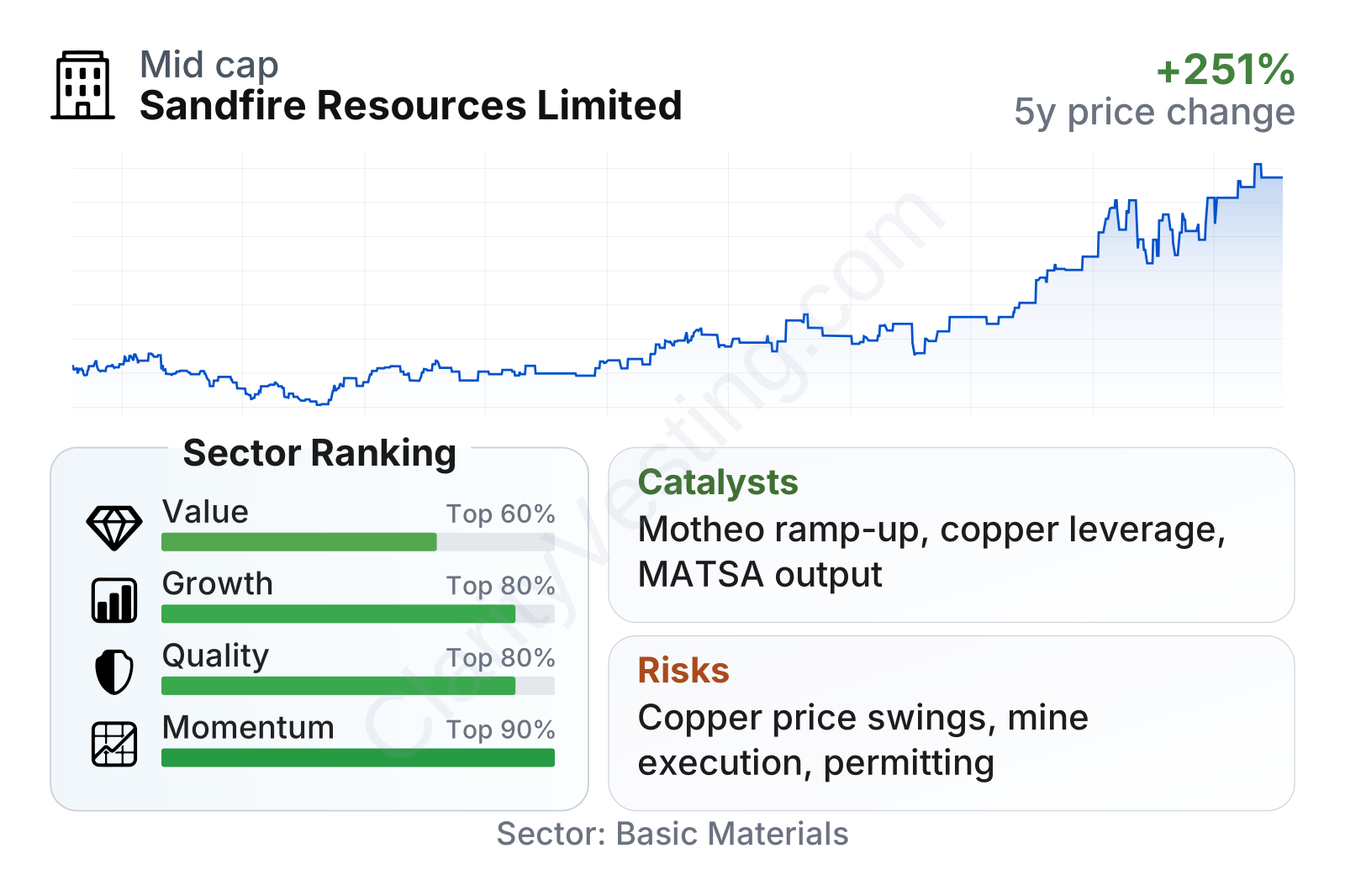
Sandfire currently sits in the larger end of the mid-tier mining range and has shown strong recent share-price momentum, with gains over one, three, and six months well ahead of the sector median. Financial quality also looks solid at this stage of the cycle: profitability is comfortably above many peers, free cash flow generation is strong, and the balance sheet appears conservative, with very low leverage and net cash on some debt measures.
Valuation is more mixed. The earnings multiple and book-value multiple are above sector medians, which suggests the market is already recognizing the recent operational recovery. At the same time, cash flow-based measures remain comparatively favorable, helped by strong free cash flow yield and healthy operating earnings relative to enterprise value. The broad picture is a company with strong recent execution that is no longer priced like a troubled operator, but not stretched on every measure either.
Growth
Sandfire operates in a part of the mining industry with a credible long-term demand tailwind. Copper is one of the most important metals for electrification because it is used in transmission networks, charging infrastructure, electric motors, renewable power installations, and data-related infrastructure. Zinc also benefits from industrial activity, especially through galvanized steel. That does not mean metal prices move in a straight line, but the long-range demand backdrop for copper is stronger than for many traditional bulk materials.
The company’s strategy broadly makes sense for future growth. Sandfire has been reshaping itself from a company once dominated by the aging DeGrussa mine into a more geographically diversified producer. The key pieces are the Motheo operation in Botswana, including the A4 underground development, and the MATSA complex in Spain. This gives the company both organic growth potential and a wider operating base. In mining, that matters because reserve replacement and mine life are constant challenges.
Recent growth metrics underline that the recovery is not just narrative. Revenue growth over the last year has been far above the sector median, operating margins have improved meaningfully over time, and free cash flow growth has been especially strong. The latest annual result also showed a sharp improvement in revenue, operating income, and net income, indicating that the asset base is now producing better returns than it did during the integration and transition period.
One important catalyst is project execution in Botswana. If Sandfire continues to ramp up and optimize Motheo and brings associated deposits into the mine plan efficiently, the company can potentially increase production volumes while spreading fixed costs over a larger output base. Another catalyst is Black Butte Copper in Montana, which remains a longer-dated option on future production growth if permitting and development milestones move forward. In addition, a supportive copper price environment can have a large effect on earnings because miners typically have high operating leverage once assets are running well.
There is also a broader market catalyst embedded in the business model: Sandfire has already demonstrated that a recovery in operational stability can translate into a much larger jump in profits. The latest year’s rebound in margins and earnings suggests the company is benefiting from exactly that dynamic.
Risks
This article is for informational purposes only and does not constitute financial advice. Some content is AI-generated. See Disclaimer


