Stock Analysis · Sprouts Farmers Market LLC (SFM)
Overview
Sprouts Farmers Market is a U.S. grocery retailer focused on fresh, natural, and organic food. Its stores are designed around produce and perishable categories, with a merchandising approach that emphasizes healthier eating, specialty items, and private-label products at prices intended to be more approachable than traditional premium natural food chains. The company operates a single retail banner, so the business is easier to understand than diversified food companies with multiple formats.
Revenue comes overwhelmingly from in-store and digital grocery sales. Based on company reporting, Sprouts does not break sales into many large standalone business lines, but its revenue mix can still be understood in practical terms:
- Retail grocery sales in physical stores: about 90%+ of revenue. This includes fresh produce, meat and seafood, deli, dairy, bakery, frozen, grocery, vitamins and supplements, and household items sold in stores.
- E-commerce and delivery-related sales: a low-single-digit percentage of revenue. These orders are generally fulfilled from stores through pickup and delivery partnerships and are not a separate operating segment.
- Other revenue: a very small percentage. This can include incidental items such as gift cards, fees, and other minor store-related activity.
Within merchandise, produce is historically the centerpiece of the chain and one of the main traffic drivers. That matters because fresh categories can support customer loyalty and help distinguish Sprouts from conventional supermarkets. Over the last several years, the business has also shown a favorable pattern of rising sales, expanding gross profit, and stronger net income, suggesting that growth has not depended only on opening more stores but also on improved store-level economics.
The operating picture has improved meaningfully since 2021. Revenue has climbed from a little above $6.0 billion to about $8.8 billion by 2025, while net income has more than doubled over the same period. Interest expense has also fallen sharply, which has helped earnings quality.
Key Figures
| Metric | Value | Sector ⓘ |
|---|---|---|
| Date | Oct 17, 2026 | |
| Context | ||
| Sector | Consumer Defensive | |
| Industry | Grocery Stores | |
| Market Cap ⓘ | $6.00B | |
| Beta ⓘ | 0.67 | |
Value (Cheapness) | ||
| P/E Ratio ⓘ | 12.30 | 17.88 |
| P/B Ratio ⓘ | 4.00 | 1.29 |
| FCF Yield ⓘ | 5.92% | 12.39% |
| Dividend Yield ⓘ | N/A | 2.85% |
| EBIT / EV ⓘ | 8.38% | 6.43% |
| PEG ⓘ | 1.39 | |
Growth (Business expansion) | ||
| Revenue Growth ⓘ | 4.70% | 4.10% |
| RPS Growth (5Y CAGR) ⓘ | 14.15% | 6.18% |
| EPS Growth (5Y CAGR) ⓘ | 7.00% | -13.59% |
| BVPS Growth (5Y CAGR) ⓘ | 14.50% | 3.20% |
| Margin Growth (5Y Trend) ⓘ | 2.30% | -0.15% |
| FCF Growth (5Y CAGR) ⓘ | 15.54% | 4.10% |
| DPS Growth (5Y CAGR) ⓘ | N/A | 6.79% |
Quality (Business durability) | ||
| ROIC (Latest) ⓘ | 34.97% | 12.34% |
| ROA (Latest) ⓘ | 12.05% | 6.30% |
| ROIC (5Y Median) ⓘ | 22.66% | 10.49% |
| ROA (5Y Median) ⓘ | 8.71% | 5.44% |
| Net Debt / EBIT (Latest) ⓘ | 2.79 | 1.96 |
| Net Debt / EBIT (5Y Median) ⓘ | 3.40 | 2.35 |
| Net Debt / EBITDA (Latest) ⓘ | 1.88 | 1.38 |
| Net Debt / Assets ⓘ | 43.46% | 21.51% |
| EBITDA / Interest ⓘ | 463.16 | 9.46 |
| Operating Margin (Latest) ⓘ | 7.48% | 8.87% |
| Operating Margin (5Y Median) ⓘ | 5.72% | 9.53% |
| Debt to Equity (Latest) ⓘ | 140.34% | 72.35% |
| Profit Margin (Latest) ⓘ | 5.59% | 5.40% |
| Free Cash Flow (Latest) ⓘ | $355.18M | |
Momentum (Price trend) | ||
| 3Y Return ⓘ | +47.19% | +20.92% |
| 12M Return (excl. last month) ⓘ | -46.49% | +2.13% |
| 6M Return ⓘ | -16.37% | +1.26% |
| Price vs. 200-Day MA ⓘ | -17.78% | +1.39% |
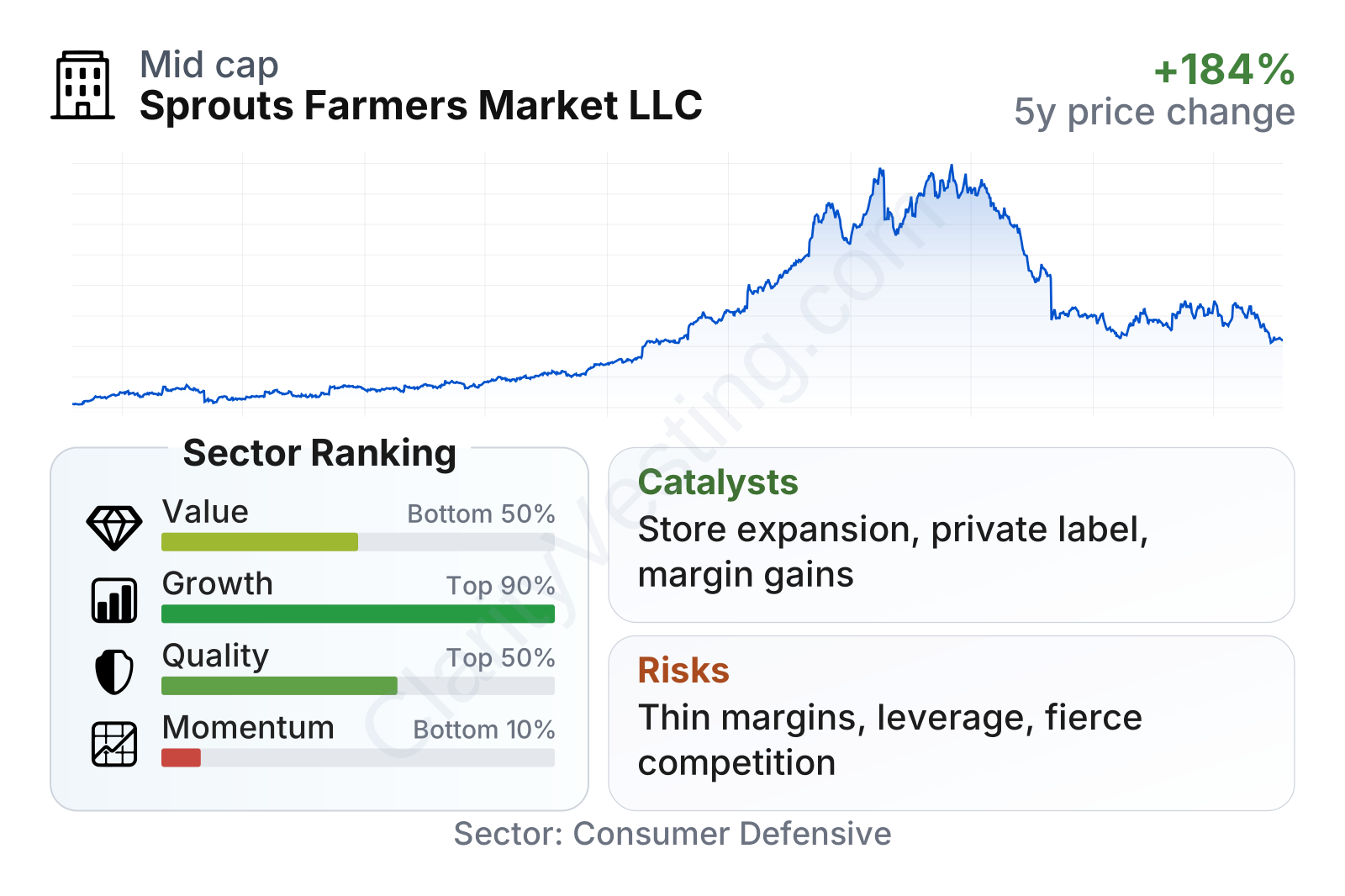
Sprouts is a mid-sized consumer defensive company with a stock that has historically moved less than the broader market, as reflected by a beta below 1.0. The factor profile is unusual in a positive way: growth ranks near the top of its sector, while returns on capital and assets are strong, but value and recent momentum are weaker. In plain English, the business has been performing well operationally, yet the stock has gone through a major re-rating and then a sharp cooling-off period. That combination often leads to more debate around valuation than around business quality.
Growth
The company operates in a part of grocery retail that still has room to expand. Consumer interest in fresh food, organic products, higher-protein diets, wellness-oriented shopping, and convenience has supported long-term demand for the categories where Sprouts is most differentiated. Grocery is not a fast-disrupting industry, but niche positions inside grocery can still grow steadily when they match durable consumer habits.
Sprouts’ strategy appears coherent for future growth. Management has been focusing on smaller-format stores, disciplined new-store openings, sharper private-label development, and a product assortment aimed at health-focused households. This matters because smaller stores can reduce capital intensity and may improve returns in new markets, while private label can support both margins and customer loyalty. The company has also been expanding its geographic reach beyond its historical base, giving it a longer runway than a fully saturated regional grocer.
Sales growth has clearly moderated from the unusually strong pace seen in 2024 and early 2025, but it remains positive in 2026 and still sits ahead of the sector median. That suggests Sprouts is no longer in a burst phase, yet it is still growing faster than many peers in a mature industry.
Cash generation has also been solid. Free cash flow rose sharply into 2025 and, although it has come down from that peak, it remains comfortably positive. That gives the company flexibility to open stores, invest in supply chain capabilities, and repurchase shares without relying heavily on external financing.
A notable recent opportunity is the continued expansion of the store base combined with improving profitability. In recent company updates and filings, Sprouts has emphasized new-store development and customer growth rather than chasing broad discount-led expansion. If execution remains consistent, the combination of unit growth, healthy comparable-store sales, and mix improvement could remain a meaningful business catalyst.
Risks
This article is for informational purposes only and does not constitute financial advice. Some content is AI-generated. See Disclaimer


