Stock Analysis · SFL Corporation Ltd (SFL)
Overview
SFL Corporation Ltd is a ship-owning and asset financing company focused on maritime and offshore transportation. Rather than operating as a pure spot-market shipping company, SFL mainly owns vessels and rigs and charters them out under medium- to long-term contracts. This structure is meant to create more predictable cash generation than businesses that depend heavily on daily freight market swings. Over time, the company has built exposure across several shipping segments, including container vessels, dry bulk carriers, tankers, car carriers, and offshore drilling assets.
The business model is fairly simple at its core: SFL buys or finances large transportation assets, leases them to customers, collects charter hire, and aims to recycle capital when assets become less attractive. That gives it a mix of recurring contracted revenue and periodic gains or losses from vessel sales, refinancing, and asset repositioning.
Based on recent company disclosures, revenue is spread across multiple shipping and offshore categories rather than coming from a single asset class. Exact percentages can shift meaningfully from quarter to quarter because SFL buys and sells vessels, signs new charters, and can record special items. A practical approximation is:
- Container vessels: about 30% to 40% of charter revenue. This includes long-term charters on liner-related ships used in global container trade.
- Dry bulk vessels: about 20% to 30%. These ships carry commodities such as iron ore, coal, grain, and similar raw materials.
- Tankers and chemical carriers: about 15% to 25%. This segment serves crude oil, refined products, and specialty liquid cargo markets.
- Car carriers: about 10% to 20%. These vessels transport finished vehicles and other rolling cargo.
- Offshore drilling rigs and related assets: about 5% to 15%. This reflects contracted income from offshore energy-related assets.
- Other items: usually a smaller share, including profit-sharing elements, finance lease effects, and vessel sale impacts.
SFL’s mix matters because diversification reduces reliance on a single freight market. It also means results can look different from more specialized shipping companies, since SFL is trying to balance income stability, asset values, and financing costs across a broad fleet.
The long-term pattern shows revenue expanding strongly from 2021 through 2024, while interest expense also climbed as debt costs rose. In 2025, profitability weakened sharply despite still meaningful gross profit, which highlights how financing costs, asset-related charges, and non-operating items can have a large effect on final earnings.
Key Figures
| Metric | Value | Sector ⓘ |
|---|---|---|
| Date | Oct 17, 2026 | |
| Context | ||
| Sector | Industrials | |
| Industry | Marine Shipping | |
| Market Cap ⓘ | $1.88B | |
| Beta ⓘ | 0.46 | |
Value (Cheapness) | ||
| P/E Ratio ⓘ | 28.29 | 22.10 |
| P/B Ratio ⓘ | 1.70 | 1.97 |
| FCF Yield ⓘ | 11.56% | 6.38% |
| Dividend Yield ⓘ | 6.48% | 1.94% |
| EBIT / EV ⓘ | 5.65% | 4.79% |
| PEG ⓘ | -1.57 | |
Growth (Business expansion) | ||
| Revenue Growth ⓘ | 2.70% | 9.30% |
| RPS Growth (5Y CAGR) ⓘ | 11.11% | 7.81% |
| EPS Growth (5Y CAGR) ⓘ | -34.68% | -13.06% |
| BVPS Growth (5Y CAGR) ⓘ | 0.61% | 6.14% |
| Margin Growth (5Y Trend) ⓘ | -26.77% | 0.88% |
| FCF Growth (5Y CAGR) ⓘ | N/A | 11.01% |
| DPS Growth (5Y CAGR) ⓘ | 14.02% | 9.48% |
Quality (Business durability) | ||
| ROIC (Latest) ⓘ | 8.49% | 10.84% |
| ROA (Latest) ⓘ | 1.73% | 5.41% |
| ROIC (5Y Median) ⓘ | 8.30% | 9.38% |
| ROA (5Y Median) ⓘ | 3.33% | 4.95% |
| Net Debt / EBIT (Latest) ⓘ | 9.97 | 2.08 |
| Net Debt / EBIT (5Y Median) ⓘ | 8.90 | 2.27 |
| Net Debt / EBITDA (Latest) ⓘ | 4.99 | 1.39 |
| Net Debt / Assets ⓘ | 64.60% | 19.28% |
| EBITDA / Interest ⓘ | 2.87 | 9.58 |
| Operating Margin (Latest) ⓘ | 31.59% | 10.50% |
| Operating Margin (5Y Median) ⓘ | 35.99% | 10.29% |
| Debt to Equity (Latest) ⓘ | 230.29% | 65.48% |
| Profit Margin (Latest) ⓘ | 8.96% | 6.67% |
| Free Cash Flow (Latest) ⓘ | $217.75M | |
Momentum (Price trend) | ||
| 3Y Return ⓘ | +54.65% | +61.68% |
| 12M Return (excl. last month) ⓘ | +76.17% | +12.58% |
| 6M Return ⓘ | +25.73% | 0.00% |
| Price vs. 200-Day MA ⓘ | +20.27% | +0.02% |
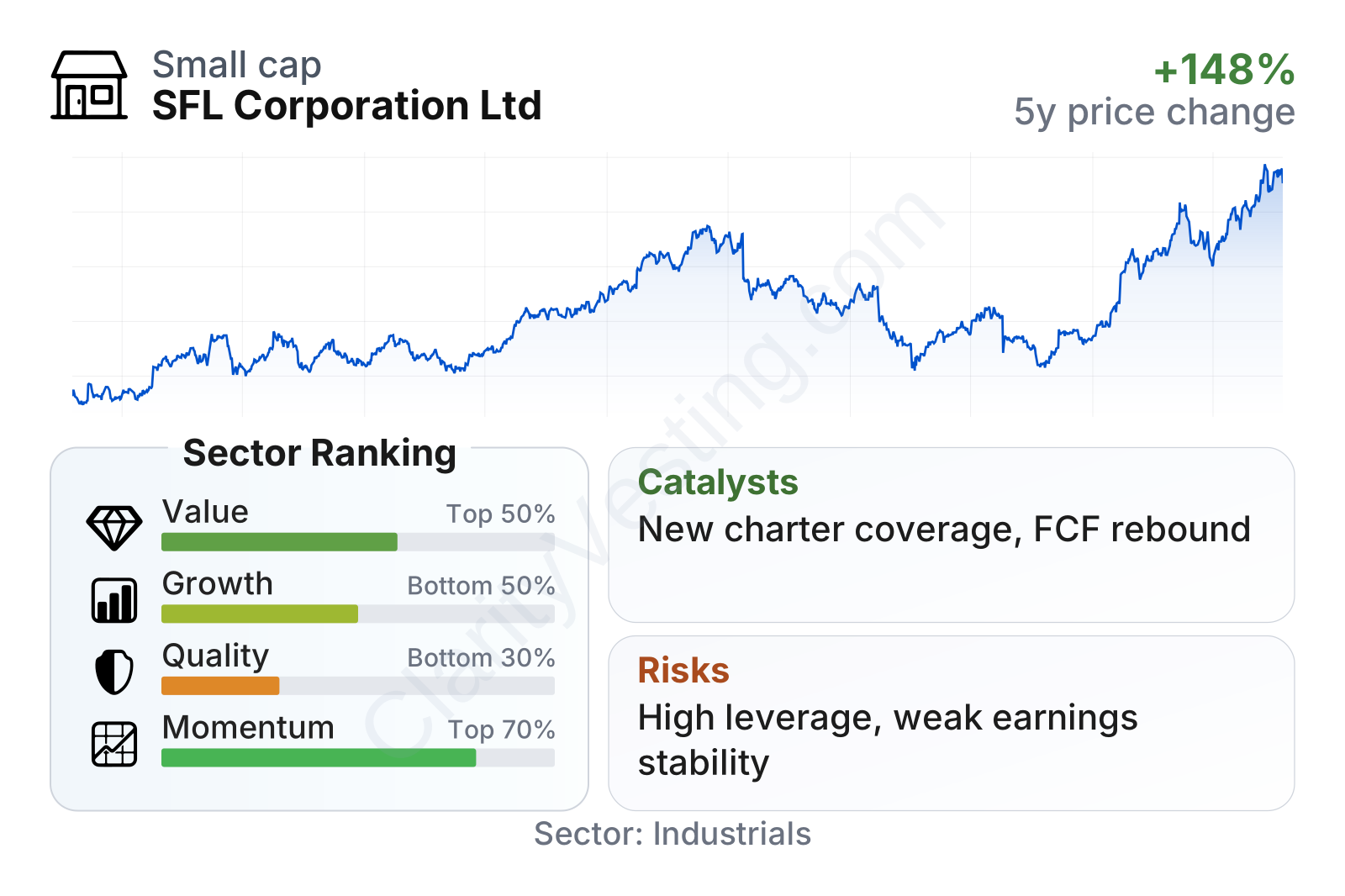
SFL stands out as a mid-sized shipping owner with unusually high income distribution and solid free cash flow yield, while its growth and balance-sheet quality rank weaker than many industrial peers. The overall picture is a company with strong asset earnings and market momentum, but also with leverage and earnings volatility that require closer attention than the headline yield alone suggests.
The share price trend over the last several years has been positive overall, although not smooth. That fits the company’s profile: shipping assets can produce substantial cash flow during favorable periods, but sentiment can change quickly when charter markets soften, vessel values move, or financing conditions tighten.
Growth
SFL operates in a sector that should remain structurally important for decades. Global trade still depends on ocean transport, and vehicle shipping, container logistics, bulk commodities, and energy flows all need fleets. That said, shipping is not a straight-line growth industry. Demand usually grows over time, but earnings can swing sharply because vessel supply, charter rates, and financing conditions move in cycles.
SFL’s strategy makes sense for long-term business resilience because it is built around diversification and contract coverage rather than trying to maximize exposure to short-term freight spikes. The company has repeatedly expanded into segments where charter visibility is stronger, such as car carriers and container vessels, while keeping exposure across several end markets. For a ship owner, that is a rational way to pursue growth without becoming fully dependent on one market.
Recent revenue growth has slowed compared with the stronger period in 2022 through 2024. There were several quarters of contraction in 2025, followed by a return to modest year-over-year growth in 2026. This suggests the company is in a normalization phase rather than a rapid expansion phase. Longer-term revenue per share growth has been better than the sector median over five years, but the near-term pace is clearly softer.
Cash generation has improved meaningfully. Free cash flow was negative in earlier periods, but it turned clearly positive more recently, reaching roughly the low hundreds of millions of dollars on a trailing basis. For a capital-intensive shipping owner, this is important because free cash flow supports debt service, dividends, fleet renewal, and financial flexibility.
A key catalyst for future expansion is fleet renewal tied to long-term charters. When SFL acquires vessels with attached contracts from strong counterparties, it can lock in cash flow before taking delivery risk. Another helpful theme is the tight supply backdrop in some shipping niches, particularly where newbuilding capacity is limited or environmental rules make older tonnage less competitive. If SFL continues placing capital into contracted modern assets, that could support steadier earnings than a pure spot-market strategy.
Recent company updates have also pointed to new charter coverage and selective fleet transactions. Those moves are significant because they can extend earnings visibility and reshape the fleet toward segments with better long-term economics. For SFL, contract duration often matters more than headline freight excitement.
Risks
This article is for informational purposes only and does not constitute financial advice. Some content is AI-generated. See Disclaimer


