Stock Analysis · Smithfield Foods Inc (SFD)
Overview
Smithfield Foods is a U.S. packaged foods and meat company centered on pork. It raises hogs, processes fresh pork, and sells a wide range of packaged meats to retail stores, foodservice customers, and export markets. Its portfolio includes well-known brands such as Smithfield, Eckrich, Nathan’s Famous, Armour, Farmland, and several regional and specialty labels. In simple terms, the company earns money both from commodity-like pork products and from branded, more value-added foods such as bacon, ham, sausage, hot dogs, lunch meat, and prepared products.
The business mix matters because branded packaged meats usually carry steadier margins than fresh pork, while hog production and fresh pork are more exposed to swings in feed costs, livestock cycles, and export pricing. That makes Smithfield a hybrid business: part consumer staples food manufacturer, part agricultural processor.
Based on the company’s recent annual reporting structure and business description, revenue is mainly generated from the following activities:
- Packaged meats: approximately 40% to 45% of revenue. This includes branded and private-label bacon, ham, sausage, hot dogs, deli, and ready-to-cook or prepared meat products.
- Fresh pork: approximately 35% to 40% of revenue. This segment sells fresh cuts and pork products to domestic and international customers, including retailers, distributors, and foodservice operators.
- Hog production: approximately 15% to 20% of revenue. This covers company-owned hog farming operations that supply animals for internal processing and external sales.
- Other and ancillary activities: typically a small single-digit share of revenue, including rendering and by-product related sales.
Over the last several years, the company’s profit profile has been far more volatile than its sales line. Revenue moved between roughly $14 billion and $16 billion from 2021 through 2025, but earnings swung sharply with the livestock cycle. After a difficult 2023, profitability recovered strongly in 2024 and remained solid in 2025, helped by higher gross profit and lower interest expense. That pattern shows how important timing and commodity conditions are for this business.
The broad financial flow highlights a business with very high input costs relative to sales, which is normal in meat processing. What stands out is the rebound in operating income and net income after 2023, suggesting that margin recovery, not just revenue growth, has been the main driver of the recent improvement.
Key Figures
| Metric | Value | Sector ⓘ |
|---|---|---|
| Date | Oct 17, 2026 | |
| Context | ||
| Sector | Consumer Defensive | |
| Industry | Packaged Foods | |
| Market Cap ⓘ | $7.28B | |
| Beta ⓘ | N/A | |
Value (Cheapness) | ||
| P/E Ratio ⓘ | 6.82 | 17.88 |
| P/B Ratio ⓘ | 1.08 | 1.29 |
| FCF Yield ⓘ | 11.02% | 12.39% |
| Dividend Yield ⓘ | 6.05% | 2.85% |
| EBIT / EV ⓘ | 15.40% | 6.43% |
| PEG ⓘ | N/A | |
Growth (Business expansion) | ||
| Revenue Growth ⓘ | -2.30% | 4.10% |
| RPS Growth (5Y CAGR) ⓘ | 0.88% | 6.18% |
| EPS Growth (5Y CAGR) ⓘ | 65.98% | -13.59% |
| BVPS Growth (5Y CAGR) ⓘ | 2.99% | 3.20% |
| Margin Growth (5Y Trend) ⓘ | 4.77% | -0.15% |
| FCF Growth (5Y CAGR) ⓘ | 5.80% | 4.10% |
| DPS Growth (5Y CAGR) ⓘ | 19.87% | 6.79% |
Quality (Business durability) | ||
| ROIC (Latest) ⓘ | 11.77% | 12.34% |
| ROA (Latest) ⓘ | 8.99% | 6.30% |
| ROIC (5Y Median) ⓘ | N/A | 10.49% |
| ROA (5Y Median) ⓘ | 7.33% | 5.44% |
| Net Debt / EBIT (Latest) ⓘ | 0.80 | 1.96 |
| Net Debt / EBIT (5Y Median) ⓘ | 1.26 | 2.35 |
| Net Debt / EBITDA (Latest) ⓘ | 0.64 | 1.38 |
| Net Debt / Assets ⓘ | 8.71% | 21.51% |
| EBITDA / Interest ⓘ | 47.00 | 9.46 |
| Operating Margin (Latest) ⓘ | 8.48% | 8.87% |
| Operating Margin (5Y Median) ⓘ | 7.00% | 9.53% |
| Debt to Equity (Latest) ⓘ | 34.21% | 72.35% |
| Profit Margin (Latest) ⓘ | 6.84% | 5.40% |
| Free Cash Flow (Latest) ⓘ | $802.00M | |
Momentum (Price trend) | ||
| 3Y Return ⓘ | N/A | +20.92% |
| 12M Return (excl. last month) ⓘ | -12.92% | +2.13% |
| 6M Return ⓘ | -34.89% | +1.26% |
| Price vs. 200-Day MA ⓘ | -23.38% | +1.39% |
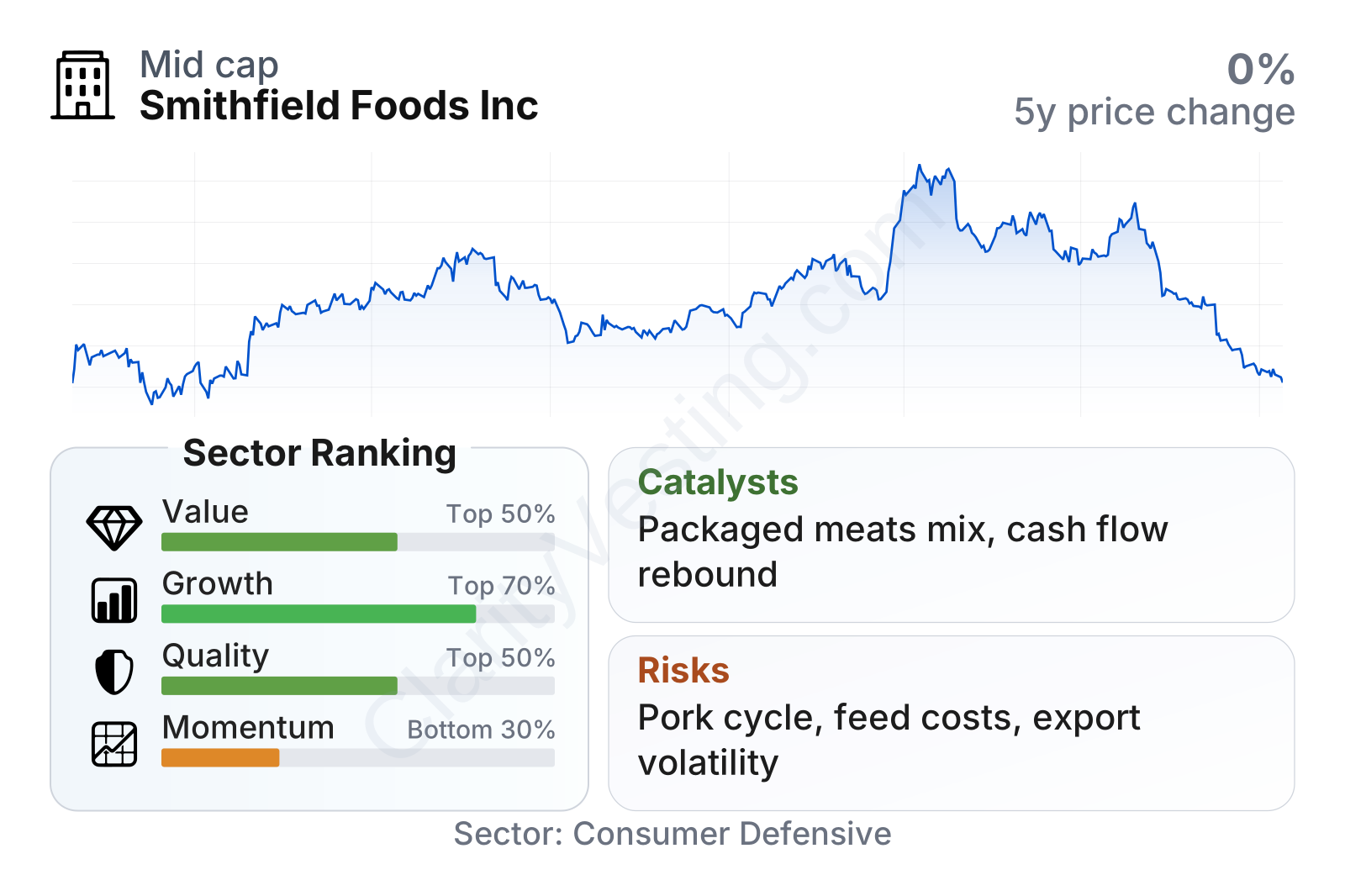
Smithfield currently looks like a mid-sized consumer staples company with a notably low earnings multiple compared with its sector. Its value profile is stronger than average, supported by a P/E around 7 versus a sector median near 18, and by an EBIT-to-enterprise-value ratio well above the sector norm. Income generation is also meaningful, with a trailing dividend yield near 6%.
Quality is more mixed but still respectable. Returns on assets are above the sector median, leverage is clearly lower than many peers, and interest coverage is exceptionally strong. Growth metrics are less convincing on the revenue side, though earnings, cash flow, and dividends have improved substantially over the last five years. Momentum is weak, which means the stock has recently lagged much of the sector despite the stronger profitability backdrop.
Growth
Smithfield operates in a mature industry rather than a high-growth one. Packaged foods and protein consumption tend to be resilient, but they usually do not deliver rapid structural expansion in developed markets. Long-term growth is therefore more likely to come from mix improvement, efficiency gains, export opportunities, and stronger branded product sales than from large increases in total meat consumption.
The strategy makes sense if management can continue shifting the business toward higher-margin packaged meats while using its vertically integrated hog and fresh pork network to support supply control and scale. This is especially relevant in pork, where owning pieces of the supply chain can help with sourcing, logistics, and cost discipline, even if it does not eliminate commodity volatility.
Recent sales momentum has been uneven. Revenue growth turned positive in late 2025, then slowed sharply and slipped negative by mid-2026. That does not necessarily signal a broken business, but it does show that Smithfield is still operating in a cyclical environment where pricing, volumes, and export demand can move around from quarter to quarter.
Cash generation has been a more encouraging signal. Trailing free cash flow improved materially into 2026, reaching roughly $800 million. For a company of Smithfield’s size, that is important because stronger cash flow can support dividends, debt reduction, capital spending, and resilience during weaker parts of the livestock cycle.
One practical catalyst is the company’s ongoing focus on branded, packaged meats, where customer loyalty and shelf presence can create better economics than commodity processing alone. Another is margin normalization after the severe 2023 downturn. If the industry remains more balanced on hog supply, feed costs, and pork pricing, earnings can stay stronger even without impressive top-line growth. International demand, especially for pork exports, can also create upside when global supply conditions tighten.
Recent corporate updates and filings have continued to emphasize operational execution, portfolio strength, and capital returns rather than a transformational expansion plan. That suggests the near-term opportunity is more about sustaining improved profitability and cash conversion than chasing aggressive expansion.
Risks
This article is for informational purposes only and does not constitute financial advice. Some content is AI-generated. See Disclaimer


