Stock Analysis · Sezzle Inc (SEZL)
Overview
Sezzle Inc is a digital payments company best known for its buy now, pay later, or BNPL, platform. It lets consumers split purchases into installments, while merchants use Sezzle to improve conversion rates, increase average order values, and attract younger shoppers. Over time, the company has expanded beyond basic installment payments into a broader consumer payments and engagement platform that includes a subscription offering, virtual card features, and tools aimed at building payment history and loyalty.
Its business model is mainly driven by transaction activity on its platform. Based on recent annual reporting, revenue is concentrated in a few key streams:
- Merchant fees: approximately 75% to 85% of revenue. These are fees paid by merchants when Sezzle processes installment purchases and related payment services.
- Consumer fees: approximately 10% to 20% of revenue. This includes late fees, convenience-related charges, and other user-paid fees tied to the platform.
- Subscription and other revenue: approximately 5% to 10% of revenue. This includes Sezzle Premium and other ancillary products and services.
That mix matters because merchant-funded revenue is usually more scalable and less sensitive to regulatory pressure than a model heavily dependent on penalty fees. It also shows Sezzle is primarily a commerce-enablement business rather than a traditional lender built around spread income.
The business has changed meaningfully in the last few years. Revenue has grown from a little over $100 million in 2021 to roughly $450 million in 2025, while profitability has improved from losses to substantial earnings and cash generation. The broad pattern is a company that moved from aggressive early-stage expansion into a more disciplined operating model with stronger margins.
The long-term direction shown here is more important than any single line item: revenue has expanded strongly, gross profit has improved, and operating leverage has become much more visible. One 2024 operating income figure appears inconsistent with the rest of the financial statements, so the broader multi-year trend is more reliable than that isolated value.
Key Figures
| Metric | Value | Sector ⓘ |
|---|---|---|
| Date | Oct 04, 2026 | |
| Context | ||
| Sector | Financial Services | |
| Industry | Credit Services | |
| Market Cap ⓘ | $3.62B | |
| Beta ⓘ | 6.67 | |
Value (Cheapness) | ||
| P/E Ratio ⓘ | 24.03 | 12.60 |
| P/B Ratio ⓘ | 16.06 | 1.23 |
| FCF Yield ⓘ | 9.03% | 10.15% |
| Dividend Yield ⓘ | N/A | 2.96% |
| EBIT / EV ⓘ | 5.79% | 7.77% |
| PEG ⓘ | 0.06 | |
Growth (Business expansion) | ||
| Revenue Growth ⓘ | 51.70% | 9.50% |
| RPS Growth (5Y CAGR) ⓘ | 36.49% | 12.10% |
| EPS Growth (5Y CAGR) ⓘ | N/A | -9.45% |
| BVPS Growth (5Y CAGR) ⓘ | 41.21% | 5.01% |
| Margin Growth (5Y Trend) ⓘ | 118.92% | -4.07% |
| FCF Growth (5Y CAGR) ⓘ | N/A | 4.96% |
| DPS Growth (5Y CAGR) ⓘ | N/A | 8.79% |
Quality (Business durability) | ||
| ROIC (Latest) ⓘ | 53.02% | 9.60% |
| ROE (Latest) ⓘ | 83.16% | 13.84% |
| ROA (Latest) ⓘ | 39.21% | 1.53% |
| ROIC (5Y Median) ⓘ | 86.73% | 7.86% |
| ROE (5Y Median) ⓘ | 45.89% | 12.20% |
| ROA (5Y Median) ⓘ | 3.69% | 1.29% |
| Net Debt / EBIT (Latest) ⓘ | 0.18 | 0.91 |
| Net Debt / EBIT (5Y Median) ⓘ | 0.29 | 0.74 |
| Net Debt / EBITDA (Latest) ⓘ | 0.18 | 0.97 |
| Operating Margin (Latest) ⓘ | 39.65% | 22.12% |
| Operating Margin (5Y Median) ⓘ | 14.86% | 24.39% |
| Debt to Equity (Latest) ⓘ | 52.30% | 60.37% |
| Profit Margin (Latest) ⓘ | 30.35% | 26.62% |
| Free Cash Flow (Latest) ⓘ | $326.48M | |
Momentum (Price trend) | ||
| 3Y Return ⓘ | +5160.81% | +89.55% |
| 12M Return (excl. last month) ⓘ | +34.28% | +17.35% |
| 6M Return ⓘ | +68.46% | +9.93% |
| Price vs. 200-Day MA ⓘ | +4.20% | +3.73% |
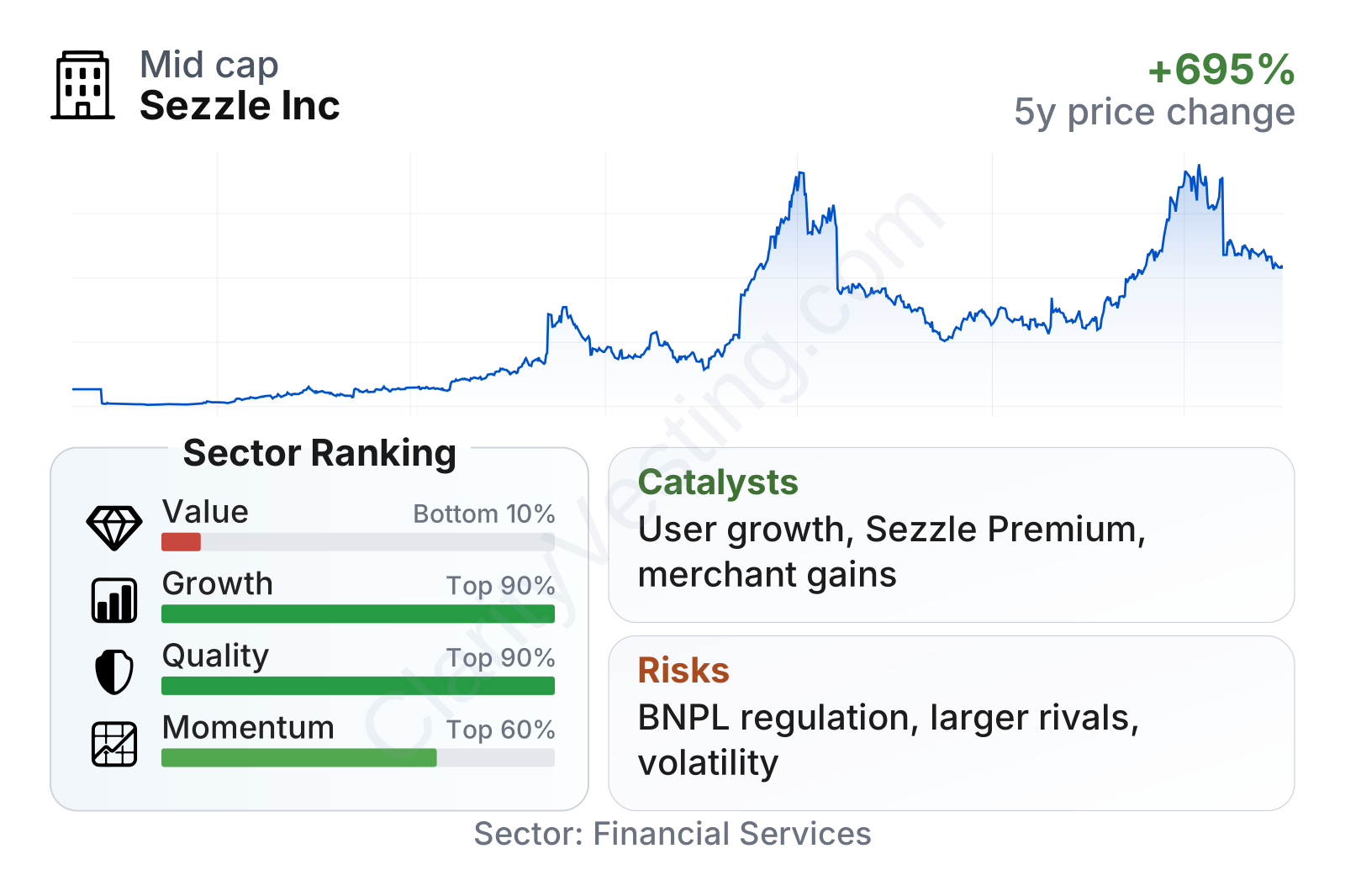
Sezzle now sits in an unusual position for a smaller financial technology company: growth and profitability both rank well above much of the sector, while valuation metrics remain demanding. Revenue growth is running around 50% year over year, operating margin is close to 40%, returns on capital are exceptionally high, and leverage appears modest. At the same time, the shares have been extremely volatile, with a beta above 6 and a stock price path that shows very large swings in both directions. That combination points to a business with strong operating momentum but a market value that can move far faster than the underlying fundamentals.
Growth
Sezzle operates in a part of financial services that is still growing. Digital checkout, alternative payment methods, and embedded finance continue to gain share in online and mobile commerce. BNPL remains especially relevant with younger consumers and budget-conscious households because it offers a more transparent installment structure than many revolving credit products. That gives Sezzle exposure to a real structural trend rather than a one-time demand spike.
The company’s strategy also looks coherent. Instead of trying to become the largest BNPL provider globally, Sezzle has focused on building a strong position in its core markets, improving unit economics, deepening merchant relationships, and increasing engagement from existing users. Products such as Sezzle Premium, on-demand card functionality, and credit-building features can raise usage frequency and make the app more useful between major purchases. This matters because long-term value in payments usually comes from repeat activity, not just signing up users once.
Earnings have improved dramatically versus the loss-making period seen earlier in its history, although the path has not been perfectly smooth. The bigger takeaway is that Sezzle has already crossed an important threshold: it is no longer being evaluated only on future potential, but also on demonstrated profitability. That tends to change how the market looks at a fintech platform, especially when revenue is still expanding quickly.
Book value per share has been volatile, which is common for a company transitioning quickly from losses to profits and adjusting its capital base along the way. Even so, the multi-year direction shows that Sezzle has been able to build equity much faster than the sector median over time. That supports the view that recent profitability is not just accounting noise but part of a broader strengthening in the business.
Recent company updates have reinforced the growth case. Management has highlighted stronger gross merchandise volume, improved repeat usage, and continued expansion in consumer engagement products. The broader opportunity is clear: if Sezzle keeps converting a growing active user base into higher-frequency usage while maintaining merchant demand, revenue can keep rising without needing the same pace of customer acquisition spending seen in earlier years.
Risks
This article is for informational purposes only and does not constitute financial advice. Some content is AI-generated. See Disclaimer